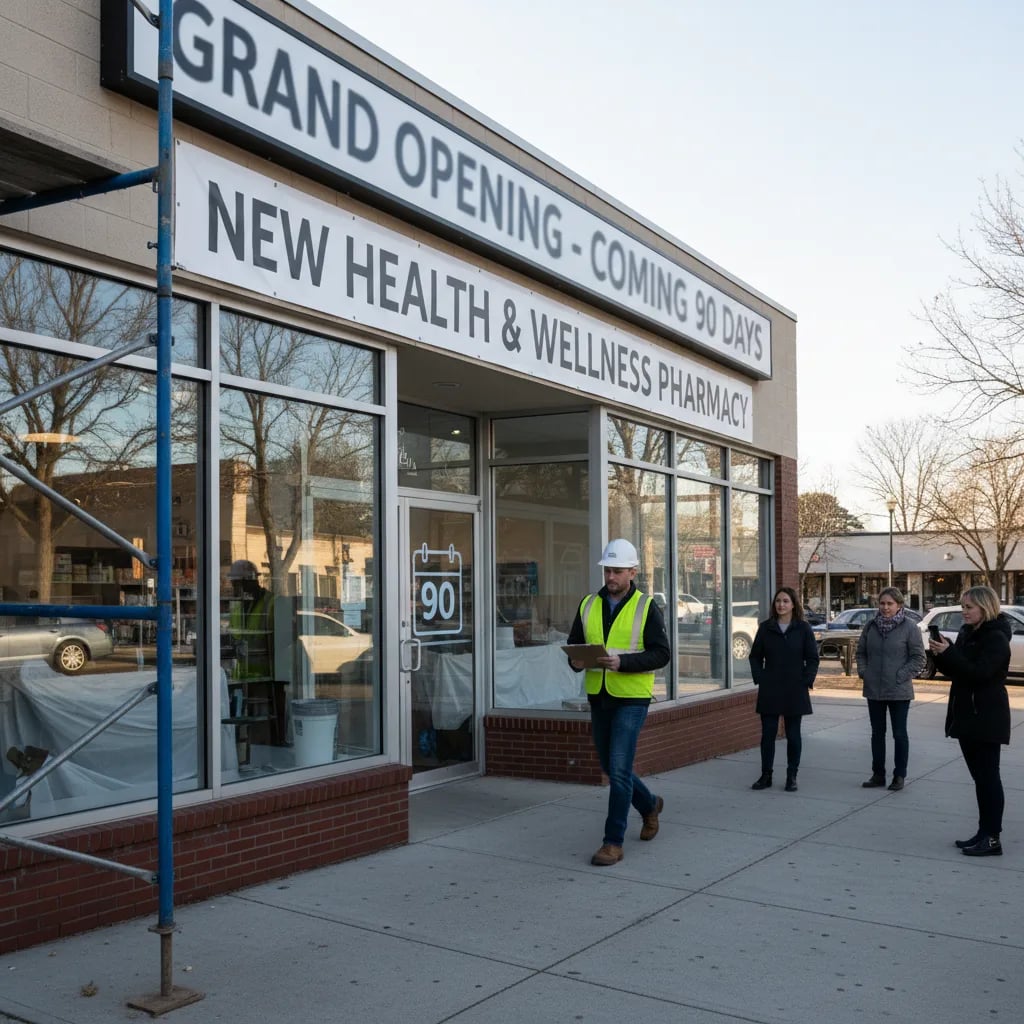
New Pharmacy Grand Opening Marketing Plan (90 Days Out)
RevealSite Team
May 18, 2026 · 14 min read
Key Takeaways
✓Start your new pharmacy grand opening marketing plan at least 90 days before opening day, not two weeks before
✓Five pillars define the plan: digital foundation, community visibility, launch event, paid acquisition, and a transfer-and-retention engine
✓Publish your Google Business Profile in pre-opening status 30 to 90 days early to start ranking for category queries before launch
✓Plan a $12,000 to $18,000 budget across the first 90 days, with 35 to 45 percent allocated to paid acquisition
✓Aim for 15 to 30 Google reviews in launch week. Reviews convert curious locals into transferred prescriptions
✓Track channel attribution from day one. Tagged phone numbers and UTMs reveal which spend produced each transfer
A new pharmacy grand opening marketing plan decides whether your first 90 days look like a thriving community store or a sea of empty stools. Most independent pharmacies open quietly. Big mistake.
Build the presence your community trusts
Let us be your first step. Get in touch with our team today.
Independents have been closing at a rate of more than one per day. NCPA's 2024 Digest reported 18,984 stores in mid-2024, down from 19,432 a year earlier. The owners who survive aren't the ones with the prettiest signage. They're the ones who build patient demand before the doors unlock, and keep building it through month three. That kind of independent pharmacy startup marketing, built before the ribbon cutting rather than after, is what separates the survivors from the closures.
This article walks through the full launch playbook. You'll get the framework, the 90-day timeline, the digital marketing setup that ranks you on Google before you fill a single prescription, the launch-week tactics that move foot traffic, the realistic budget, and the mistakes that quietly sink new pharmacies in year one. Whether you're figuring out how to open a pharmacy for the first time or sharpening the playbook for a second location, the framework below applies.
What Should a New Pharmacy Grand Opening Marketing Plan Include?
A new pharmacy grand opening marketing plan should cover five pillars: a local digital foundation, community visibility, a launch-week event and PR push, paid acquisition, and a transfer-and-retention engine. Each pillar has to be live before your doors open, not after.
Most owners over-invest in two of those (the event itself and the signage) and under-invest in the other three. The result is a great launch day, a slow second week, and a panic call in month two. Mapping every pillar against a simple pharmacy grand opening checklist before launch day catches that imbalance early.
The pillars work as a flywheel. Skip the digital foundation, and your community PR brings traffic that can't find you on Google. Skip the transfer engine, and the foot traffic from launch week converts at half the rate it should.
Independent pharmacies dispensed an average of 59,644 prescriptions per store in 2023, according to NCPA. To hit that benchmark in year one, a new store needs roughly 230 prescriptions per working day by month nine. The launch plan is what sets that trajectory.
Here's how the five pillars map out:
Pillar 1
Digital Foundation
Google Business Profile, website, schema, NAP citations across 30+ directories. Your visibility infrastructure before opening day.
Pillar 2
Community Visibility
Outreach to primary care offices, dentists, physical therapists, and senior centers. Patient referrals from local providers move the needle in month one.
Pillar 3
Launch Event & PR
A two-day soft and public open with on-site screenings, refreshments, and local press. The event itself, not the ribbon, is the marketing asset.
Pillar 4
Paid Acquisition
Facebook and Instagram ads geo-targeted within 3 miles, plus Google Search ads for transactional queries in launch week. Cheapest patient acquisition you'll ever buy.
Pillar 5
Transfer & Retention Engine
A prescription transfer landing page, a same-day review request system, and a refill reminder workflow. Captures and keeps every patient the first four pillars send you.
How Far in Advance Should You Start Marketing a New Pharmacy?
Start marketing your new pharmacy at least 90 days before opening. The first 60 days focus on building the digital foundation and securing community partnerships. The final 30 days drive awareness, event RSVPs, and prescription transfers from competitor pharmacies into your store.
Owners who launch on a 14-day timeline aren't running a marketing plan. They're running a Hail Mary. Google needs time to index your listings, your community partners need time to reciprocate, and patients need to see your name three to five times before they switch pharmacies.
Three Signals That Shape Your Timeline
Three signals shape the timeline:
Google Business Profile listings take 5 to 21 days to verify, and healthcare categories often hit the longer end of that range
Building local citations and getting indexed for category searches takes Google several weeks of crawl and stabilization
Prescription transfers run on a 7 to 14 day cycle, so your transfer page needs traffic at least two weeks before opening
The 90-Day Phase-by-Phase Timeline
Here's a phase-by-phase view of the 90 days.
Day -90 to -60
Foundation phase
Publish Google Business Profile in pre-opening status. Launch website with prescription transfer page. Begin 30+ NAP citations. Recruit community partners.
Day -60 to -30
Authority phase
Earn local press mentions. Begin blog content and FAQ pages. Set up review request system. Verify directory listings are indexed.
Day -30 to -14
Awareness phase
Start Facebook awareness ads geo-targeted within 3 miles. Open pre-launch waitlist for transfers. Confirm partner reciprocity for launch week.
Day -14 to -1
Conversion phase
Activate Google Search ads. Email and SMS reminders to waitlist. Confirm event RSVPs. Stock launch supplies and refreshments.
Day 0 (Soft open)
VIP and partners day
Coffee event for local PCPs, dentists, physical therapists, and senior-living staff. Hand out direct line for transfer questions.
Daily review push at checkout. Continue paid social. Track transfers by source. Begin monthly community engagement cycle.
Sequence Matters More Than Speed
The biggest mistake isn't starting too late. It's starting late on the wrong thing. Many owners spend month one designing logos and ordering signage, then realize in month three that they haven't claimed their Google Business Profile. Sequence matters. Foundation first, content second, paid third.
Need a website and local SEO setup before opening day?
Our Smart Websites & SEO service ships pharmacy sites with schema, transfer flows, and GBP optimization built in.
Your Pre-Launch Digital Foundation (8 to 12 Weeks Out)
Your pre-launch digital foundation includes a Google Business Profile in pre-opening status, a fast website with Pharmacy and LocalBusiness schema, prescription transfer and contact forms, and consistent NAP citations across at least 30 local directories. These four assets decide whether you show up when patients search.
Local search is the cheapest channel a new pharmacy will ever have. 76% of consumers who run a "near me" search visit a related business within one day, according to Backlinko's local SEO research. For pharmacies, that next-day visit window is where prescription transfers happen.
But you only show up if you're in the Google Maps 3-pack. Businesses ranked there receive 126% more traffic and 93% more calls and direction requests than those in positions 4 through 10, per Semrush local SEO data. Position 11 might as well be page two.
Three Assets That Do Most of the Heavy Lifting
Three assets do most of the heavy lifting:
A Google Business Profile created in "pre-opening" status 30 to 90 days before launch, with photos, hours, services, and the correct primary category.
A fast pharmacy website on a custom domain, with mobile-optimized prescription transfer and refill flows. Speed and Core Web Vitals matter for ranking.
NAP citations on at least 30 directories: Yelp, Apple Maps, Bing Places, NPI Registry, Healthgrades, RxList, Foursquare, and the major insurance carrier lookup tools. Inconsistent citations are the most common silent killer of local rankings.
Check Your Foundation With This Scorecard
Use this scorecard to check where you stand.
Pre-Launch Digital Foundation Scorecard
Check each item you have completed at least 30 days before opening.
Your score: count your checks out of 10. Below 7 means you are not ready for launch day.
To go deeper on ranking specifically for category queries, see our pharmacy near me SEO guide.
Grand Opening Week: Tactics That Drive Foot Traffic and Transfers
Grand opening week converts pre-launch interest into actual transfers. Run a soft-open day for VIPs and community partners, a public event day with light food and on-site screenings, plus a paid geo-targeted ad blast and a same-day Google review push. Aim for 25 to 75 transfers in week one.
Why Reviews Are Critical in Week One
The single best move in opening week is securing 15 to 30 Google reviews in the first seven days. Healthcare patients are review-driven. 85% of consumers used Google to find reviews for local businesses in 2025, up from 81% the year prior, per BrightLocal's 2025 Consumer Review Survey. For a new pharmacy with zero history, reviews are the trust signal that converts a curious local into a transferred prescription. That review momentum should start on your pharmacy soft opening day, before the public event even begins.
A High-Leverage Launch Week Schedule
A high-leverage launch week looks like this:
Day minus 7 to minus 1: Final push of paid social ads geo-targeted within a 3-mile radius, plus an email and SMS reminder to the pre-opening waitlist
Day 1 (soft open): Local primary care offices, dentists, physical therapists, and senior-living staff visit for a coffee event. Hand out branded materials and your direct line for transfer questions
Day 2 to 3 (public open): Open to walk-ins. Free blood pressure screenings, immunization clinic, light refreshments. Aim for 50 to 150 walk-in visits across two days
Day 4 to 7: Active review request at the counter, at the event, and on every transfer call. Use a QR card at checkout that lands directly on your Google Review URL
Which Channels Actually Produce Transfers
Two channels will produce most of the opening-week transfers: paid social geofenced around chain-pharmacy locations and word-of-mouth from healthcare provider partners. Print and direct mail can support, but they rarely lead. Most of the pharmacy grand opening ideas above scale just as well for a second or third location as they do for a first.
Our team reviews your demographics, competitor map, and timeline, then designs a 90-day grand opening plan with budget allocations and weekly milestones.
How Much Should You Spend on New Pharmacy Grand Opening Marketing?
A realistic new pharmacy grand opening marketing budget runs $8,000 to $25,000 across the full 90-day window for a single-store launch. Roughly 35 to 45 percent goes to paid acquisition, 25 percent to digital foundation, 20 percent to community and event costs, and the remainder to reviews and creative.
The $8,000 figure assumes you're doing most of the digital foundation work in-house. The $25,000 figure assumes a full-service partner builds the website, manages the paid campaigns, and runs review generation through day 90. Most independent owners land in the $12,000 to $18,000 range.
Why Paid Acquisition Takes the Largest Share
The largest line item is paid acquisition because cost per converted patient at launch runs higher than steady-state. Average Facebook Ads cost-per-lead across service industries was $21.98 in 2024, per WordStream's Facebook Ads benchmarks. A prescription transfer typically requires multiple touchpoints, so a realistic blended cost per transfer in the opening week sits around $35 to $75.
Sample $15,000 Launch Budget Breakdown
Here's how a representative $15,000 launch budget breaks down.
Line Item
Spend Range
% of $15K Budget
Digital foundation (website, GBP, schema, citations)
$3,000 - $5,000
25%
Paid acquisition (Facebook, Instagram, Google Search)
$5,000 - $7,000
40%
Community & event (food, supplies, signage, screenings)
What Mistakes Do New Pharmacy Owners Make at Launch?
The most expensive mistakes are easy to spot in hindsight: skipping the pre-opening Google Business Profile, treating the website as an afterthought, banking on word-of-mouth, running a launch event without a review-capture system, and having no way to track which channel produced each prescription transfer.
Roughly 50% of patients with chronic conditions don't take medications as prescribed, contributing to about $528 billion in annual US morbidity and mortality costs, according to NIH research. For a new independent pharmacy, that gap is the entire opportunity. Most launches squander it on avoidable mistakes. Running through a new pharmacy opening checklist before day one catches most of these before they cost you a transfer.
Five Recurring Patterns to Avoid
Five recurring patterns to avoid:
No GBP in pre-opening status. You can publish a Google Business Profile up to 90 days before opening day. Doing it on Day 1 means losing the first 60 days of category visibility you could have had
A website with no transfer page. Patients are willing to switch. They aren't willing to fill out a six-field generic contact form to do it. Build a dedicated transfer page with the prescription number, current pharmacy name, and insurance fields prefilled where possible This is prescription transfer marketing at its most basic: remove friction, or lose the patient
Banking on word-of-mouth alone. Word-of-mouth works in year three, not year one. In year one, you don't yet have a base of advocates loud enough to fill the schedule
A review system that activates the week after launch. Reviews are most natural during the launch event itself. Once patients leave without leaving a review, they're 90 percent less likely to ever return to do so
No channel attribution. If you don't know which channel produced each transfer, you can't double down on what works. Tag every form, every paid ad, and every print piece with a tracked phone number or UTM at minimum
The pharmacies that thrive in year one don't open. They launch. A new pharmacy grand opening marketing plan is the difference between hoping the foot traffic shows up and engineering it.
The five pillars work in sequence, the 90-day timeline keeps them on schedule, and the budget keeps the spending honest. Skip any of those and the result is the same: a quiet week three, a quieter month two, and a difficult conversation about runway by month six. Treat this pharmacy launch timeline as the backbone the other four pillars hang on, not a side project.
Start the digital foundation today, even if your doors don't unlock for another 60 days. Every day Google has to index your listings, build your authority, and surface your name for category queries is a day your competitors don't get back.
What This Looks Like in Practice
Here's what that sequence looks like in practice. A single-location independent opening in a mixed suburban trade area publishes its Google Business Profile 75 days out, secures four provider-partner visits before opening day, and holds a two-day soft-and-public launch. By day 7, it has collected 22 Google reviews and logged 61 transfers, split roughly evenly between paid social and provider referrals. A store that skips the pre-opening GBP and provider outreach typically lands closer to the 20 to 50 transfers described above, in the same window.
Plan a Grand Opening That Drives Real Transfers
Talk with our pharmacy marketing team about a 90-day launch plan tailored to your trade area, timeline, and budget.
How long does new pharmacy grand opening marketing take to plan?▼
Plan for at least 90 days of pre-launch marketing, then 90 days of intensive post-launch effort. Google Business Profile verification alone takes 5 to 21 days, and prescription transfers run on a 7 to 14 day cycle. Less than 90 days of runway forces shortcuts.
What is the most important channel in a new pharmacy grand opening marketing plan?▼
Google Business Profile and local SEO produce the highest return per dollar for a new pharmacy. Most patients searching for a nearby pharmacy choose from the Maps 3-pack, which receives 126 percent more traffic than positions 4 through 10. Build that foundation first.
How much should I spend on grand opening day itself?▼
Spend $1,500 to $4,000 on the grand opening event day, including food, supplies, signage, and any paid screenings. Most of your budget belongs in the 90-day runway, not in one day. The event drives awareness; the surrounding marketing drives actual prescription transfers.
When should I start advertising a new pharmacy on Facebook and Google?▼
Begin Facebook awareness ads 4 to 6 weeks before opening, geo-targeted within 3 miles. Activate Google Search ads in the final 2 weeks once your landing pages are live. Avoid Google Search ads earlier, because category queries will not convert before you can fill prescriptions.
Do I really need a website before my pharmacy opens?▼
Yes. Your website is where prescription transfers, online refills, and trust building happen. Without a published site at least 4 weeks before opening, you lose Google indexing time, paid ad landing pages, and the ability to capture pre-launch transfer requests. Launch the website before the store.
What is a realistic number of prescription transfers in the first month?▼
A well-marketed independent pharmacy typically captures 75 to 200 prescription transfers in the first 30 days from a 3-mile trade area. Pharmacies that skip pre-launch marketing or shorten the timeline often see 20 to 50 transfers in the same window, costing months of revenue.
Should I hire a marketing agency or handle new pharmacy grand opening marketing myself?▼
An agency saves time on GBP setup, website builds, and paid campaign management, typically compressing 60 to 90 days of work into weeks. DIY works if you have marketing experience and can commit 5 to 10 hours a week for the full 90-day window.
What KPIs should I track during a pharmacy grand opening marketing plan?▼
Track prescription transfers by channel, cost per transfer, Google review count and rating, GBP calls and direction requests, and paid ad click-through rate. Tagging every form and ad with a UTM or tracked phone number from day one makes this attribution possible.
How many staff should I schedule for pharmacy grand opening weekend?▼
Schedule roughly 1.5 to 2 times normal staffing for a two-day soft and public open. You need coverage for on-site screenings or immunizations alongside regular transfer and refill processing, without creating long waits that undercut the reviews you are trying to earn.