Pharmacy Paid Advertising: Google Ads, Facebook, Geofencing
RevealSite Team
May 10, 2026 · 13 min read
Key Takeaways
✓Google Ads averages $66.69 per lead across industries, but pharmacies targeting local service keywords like 'flu shot near me' often achieve $15-$40 per lead with tight geographic targeting.
✓Facebook Lead Ads deliver leads at roughly one-third the cost of Google Ads, making them the most affordable paid channel for pharmacy patient acquisition.
✓Geofencing lets you serve mobile ads to patients visiting competitor pharmacies, nearby clinics, and hospitals, but attribution is harder than search or social ads.
✓Single-location pharmacies should budget $500-$2,000 per month across paid channels, with Google Search getting the largest share for high-intent patient capture.
✓Track four metrics to measure pharmacy paid advertising ROI: cost per lead, cost per new patient, return on ad spend, and phone call conversions.
✓
Build the presence your community trusts
Let us be your first step. Get in touch with our team today.
Your ad landing page matters as much as the ad itself. Slow pages, missing phone numbers, and no trust signals waste your entire ad budget.
Pharmacy paid advertising is the fastest way to put a new patient in front of your counter this week, not months from now. An independent pharmacy can spend months building organic search rankings, publishing blog posts, and optimizing a Google Business Profile, all of that work matters, but it doesn't move as fast as paid ads do. A well-targeted Google Search ad shows your pharmacy website and services at the top of the results page the same hour you launch it. A Facebook Lead Ad puts your flu shot promotion in front of every adult within 5 miles of your front door. And geofencing can reach patients walking out of a competitor's location before they even get to their car.
This guide breaks down the three paid channels that produce results for independent pharmacies, how much to spend on each, and how to track whether your investment is actually generating patients, not just clicks. Building all three into one pharmacy advertising strategy, rather than running them as disconnected campaigns, is what separates pharmacies that grow steadily from ones that spend without a clear plan.
Why Should Your Pharmacy Invest in Paid Advertising?
Pharmacy paid advertising is the fastest way to acquire new patients because it puts your pharmacy in front of people at the exact moment they're searching for a service you offer. Organic SEO and social media build long-term visibility, but paid ads produce results within days, not months.
The Local Search Intent Behind Paid Ads
That speed makes paid ads a natural complement to the slower-building side of independent pharmacy marketing, like SEO and review generation. The intent behind local search is staggering. According to Backlinko's local SEO research, 76% of consumers who run a "near me" search visit a related business within one day. That means when someone in your zip code types "pharmacy near me" or "flu shot near me," they aren't browsing. They're deciding. Paid ads let you be the answer at that decision point instead of hoping your organic listing appears on the first page.
Why Thin Margins Make Speed Non-Negotiable
There's an economic urgency too. The NCPA 2024 Digest reported gross profit margins for independent pharmacies fell to 19.7%, the lowest in a decade. When margins are that thin, you can't afford to grow slowly. Pharmacy paid advertising lets you control your patient acquisition cost, scale up what works, and pause what doesn't, something organic marketing can't offer.
The pharmacies that combine paid advertising with strong organic foundations, a solid Google Business Profile, good SEO, and an overall marketing strategy, see the strongest returns because the paid traffic lands on pages that are already built to convert.
Google Ads places your pharmacy at the top of search results when patients search for services you offer. You bid on keywords like "pharmacy near me" or "flu shot [city]," and your ad appears above the organic listings. You only pay when someone clicks, a pay-per-click model often shortened to pharmacy PPC.
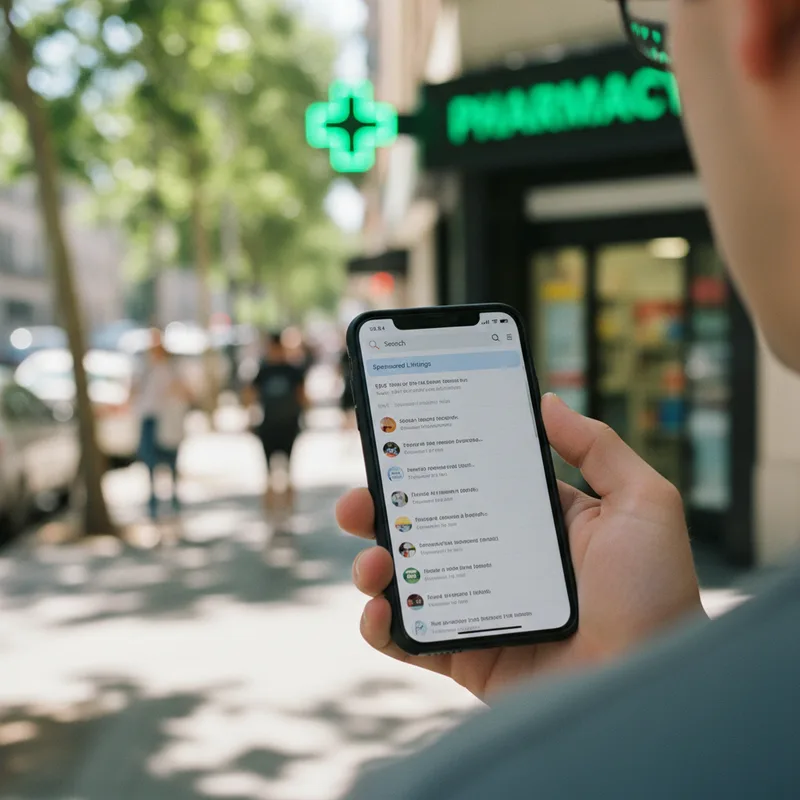
When a patient searches "pharmacy near me," paid ads put your name at the top of the list.
According to WordStream's 2024 Google Ads benchmarks, the average cost per lead across all industries was $66.69. Pharmacies targeting local service keywords with tight geographic boundaries typically achieve much lower CPLs, often $15-$40, because competition is local rather than national.
There are three campaign types worth understanding:
Campaign Type
How You Pay
Best For
Targeting
Effort to Manage
Search Ads
Per click (CPC)
High-intent patients searching specific services
Keywords + radius
Medium
Local Services Ads
Per lead (call/message)
Direct phone calls from nearby patients
Category + location
Low
Performance Max
Per click/conversion
Multi-channel: Search, Maps, Display, YouTube
AI-optimized signals
Low-Medium
Search Ads: your starting point
Start here. Search Ads appear when someone types a query that matches your keywords: "pharmacy near me," "prescription refill [city]," "flu shot [neighborhood]," and "compounding pharmacy [city]." Set your location targeting to a 5-10 mile radius and exclude areas you don't serve. A daily budget of $10-$30 covers most single-location pharmacies.
Your ad is only as good as the page it sends traffic to. A slow-loading page, a phone number buried in the footer, or no mention of the specific service from the ad wastes every click. Point every ad group to a relevant service page on your pharmacy website with a visible click-to-call button and clear hours.
Local Services Ads: pay per lead
Local Services Ads (LSAs) appear above standard Search Ads at the very top of Google. You pay per qualified lead rather than per click, which for healthcare categories can be the most efficient spend since you only pay for actual patient contact.
Performance Max: the AI-driven option
Performance Max campaigns use Google's AI to distribute your ads across Search, Maps, Display, YouTube, and Gmail at once. You provide creative assets and audience signals, and the algorithm decides where to show them. Use it as a supplement once you've validated your core keywords, not as your first campaign.
Want an expert managing your pharmacy's Google Ads?
RevealSite runs paid search campaigns for independent pharmacies with full reporting and optimization.
How Do Facebook and Instagram Ads Work for Pharmacies?
Facebook and Instagram ads target patients by location, age, interests, and behavior within a specific radius of your pharmacy. Unlike Google Ads, which capture people already searching, social ads reach people who match your ideal patient profile but aren't actively looking.
That makes social ads better for building awareness and generating leads at a lower cost per contact, especially when each ad promotes a single specific offer instead of the practice in general. Facebook Lead Ads average roughly $20-$25 per lead across service industries, about one-third the cost of Google Ads. For a pharmacy promoting no-wait immunizations, free local delivery, or a new patient welcome offer, that works out to acquiring patients for $20-$50 each when follow-up is handled promptly.
Campaign types that produce results
Lead generation campaigns are the workhorses. A patient sees your ad in their Facebook feed, taps it, and fills out a pre-populated form without ever leaving the app. Target adults 30-65 within 5-10 miles, promote a specific offer, and follow up within 24 hours, leads left untouched for a week are wasted spend.
Boosted posts are the simplest entry point. Take an organic post that's already getting engagement and put $5-$10 per day behind it targeting your local zip codes. This won't generate leads directly, but it builds familiarity for when that person later searches "pharmacy near me."
Awareness campaigns run at $0.005-$0.01 per impression and help when opening a new location or launching a new service like compounding or point-of-care testing. They don't produce immediate conversions but fill the top of the funnel.
These three tactics all live inside one channel, which is why creative quality and offer clarity matter more than which campaign type you pick first. According to Statista, mobile devices generated 62.54% of global website traffic in Q4 2024, so vertical or square formats, large readable text, and a pharmacist's real face (not a stock photo) matter. Ads with a real team photo consistently outperform polished graphics.
Pharmacy paid advertising, managed end-to-end
RevealSite builds and manages Google Ads and Facebook campaigns for independent pharmacies. From keyword research to creative to monthly reporting.
What Is Geofencing and Should Your Pharmacy Use It?
Geofencing draws a virtual boundary around a physical location and serves mobile ads to anyone whose phone enters that zone. For pharmacies, this means targeting patients visiting a competitor chain, a nearby urgent care clinic, or a hospital discharge area, and showing them your ad within hours.
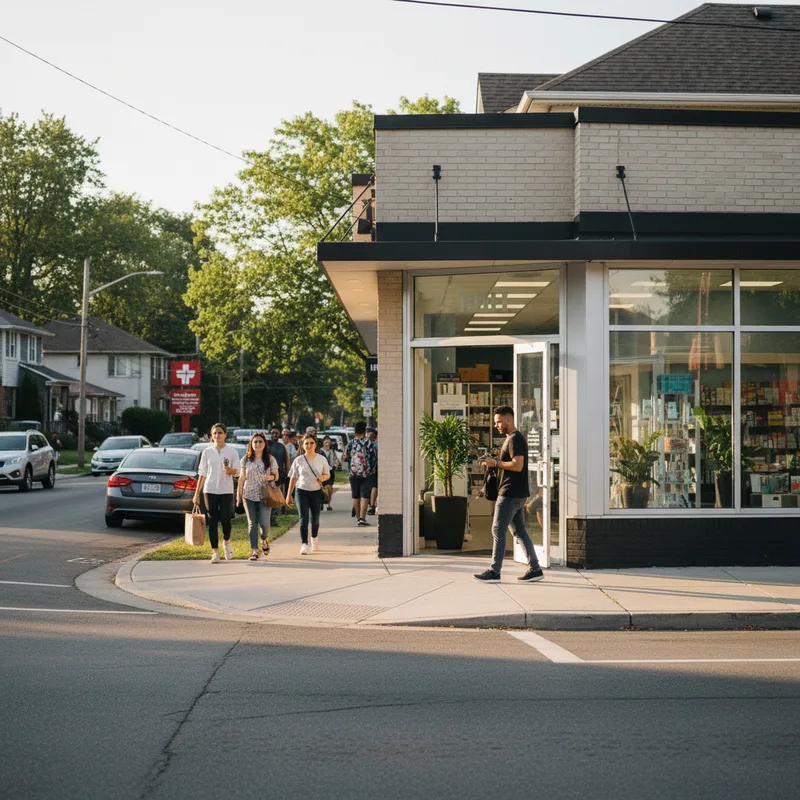
Geofencing targets patients near competitor locations and redirects them to your pharmacy.
How Geofencing Targeting Works
Here's how it works in practice. You define a geofence, say a 500-foot radius around the CVS two miles from your pharmacy. When a patient's phone (with location services enabled) enters that zone, their device ID is captured. Over the next 24-72 hours, that person sees your display or video ads on websites, apps, and social platforms they use. The ad might say something like "Tired of long pharmacy wait times? [Your Pharmacy] averages 8 minutes. Walk-ins welcome."
Geofencing the competition vs. geofencing clinics
Targeting competitor pharmacies is the most common use case, but targeting nearby medical offices, urgent care clinics, and hospital campuses often produces better results. Why? A patient leaving a doctor's appointment with a new prescription has immediate need. They haven't chosen a pharmacy yet. Your ad appears on their phone within the hour. That's timing organic marketing can't replicate.
The honest assessment: geofencing is better for awareness than direct attribution. You'll know how many impressions and clicks your campaign generated, but connecting a geofenced ad impression to a patient walking through your door three days later is harder to track than a Google Search click that leads to a phone call. Use geofencing as a supplement to search and social ads, not as your primary channel. Budget $100-$400 per month for testing, and measure lift in branded searches or walk-ins during campaign periods.
Geofencing also pairs well with your broader strategy for competing against chain pharmacies. Chains have brand awareness by default. Geofencing lets you intercept their customers at the physical location where the relationship is weakest, while they're waiting in a long line or dealing with impersonal service.
Pharmacy Paid Advertising Budgets: How Much Should You Spend?
Most single-location independent pharmacies should budget $500-$2,000 per month on paid advertising, with roughly half going to Google Ads, a third to Facebook, and the remainder to geofencing or testing new channels. The exact split depends on your growth goals and which services you're promoting.
Here's how budgets typically break down by pharmacy size:
Pharmacy Size
Monthly Budget
Google Ads
Facebook/Instagram
Geofencing/Testing
Single location
$500-$2,000
$250-$1,000 (50%)
$150-$600 (30%)
$100-$400 (20%)
2-3 locations
$2,000-$5,000
$1,000-$2,500 (50%)
$600-$1,500 (30%)
$400-$1,000 (20%)
4+ locations
$5,000-$15,000
$2,500-$7,500 (50%)
$1,500-$4,500 (30%)
$1,000-$3,000 (20%)
Why Google Gets the Largest Share
Why does Google get the biggest share? Intent. According to Semrush's local SEO data, businesses ranking in Google's local 3-pack receive 126% more traffic and 93% more calls, clicks, and direction requests than positions 4-10. Paid search ads appear above that 3-pack. When you combine paid visibility at the top of the page with a strong organic listing below it, you're dominating the entire search results page for your target keywords.
Think in Cost Per Patient, Not Cost Per Click
Think about pharmacy paid advertising spend in terms of cost per new patient, not cost per click. If your average Google Ads lead costs $30 and one in three leads becomes a patient, your cost per new patient is $90. A patient who fills prescriptions monthly at your pharmacy for three years generates thousands of dollars in lifetime revenue. That's a return most marketing channels can't touch.
If managing bids, creative, and reporting across three channels every week isn't realistic on top of running the pharmacy, that's usually the point where a pharmacy advertising agency earns its cost. The numbers above assume someone is actively optimizing the campaigns, not just launching them once and checking back quarterly.
Not sure where to start with your pharmacy ad budget?
RevealSite builds custom paid advertising plans for pharmacies based on location, competition, and growth goals.
Measure pharmacy paid advertising ROI with four metrics: cost per lead, cost per new patient, return on ad spend, and phone call conversions. These connect ad dollars directly to patient acquisition instead of vanity numbers like impressions or click-through rate.
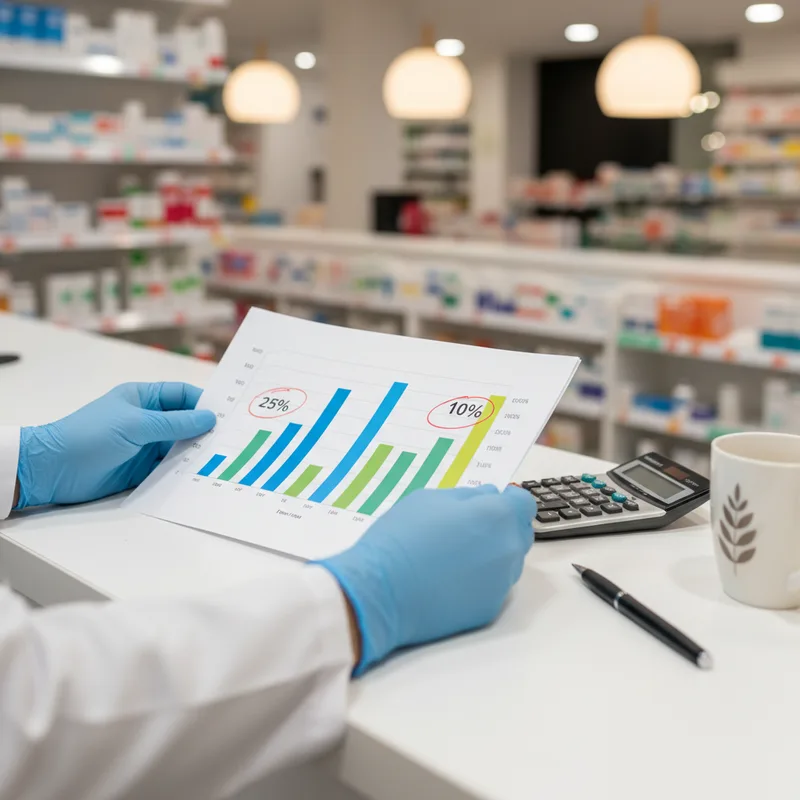
Cost per new patient, not cost per click, is the metric that determines advertising profitability.
Cost per lead and cost per new patient
Cost per lead (CPL) is your ad spend divided by the number of leads generated: form submissions, phone calls, and messages. This is useful for comparing channels. If Google delivers leads at $35 each and Facebook at $22, you know where your next dollar should go. But CPL doesn't tell the full story because not every lead becomes a patient. Cost per new patient (CPNP) divides your total ad spend by patients who actually filled a prescription or used a service. That's the number that determines whether your pharmacy paid advertising is profitable.
Return on ad spend
ROAS measures revenue generated per dollar spent on ads. A pharmacy spending $1,000 per month on Google Ads that generates 12 new patients, each filling an average of $150 in prescriptions per month, produces $1,800 in first-month revenue. That's a 1.8x ROAS in month one alone, and it grows with every refill cycle. Most pharmacies should target a 3x ROAS within the first 90 days when accounting for patient lifetime value.
Why Does Your Landing Page Determine Ad Performance?
Your landing page determines whether the ROI metrics above go up or down, because even a perfectly tracked call or lead means nothing if the page a patient clicks through to fails to turn them into a walk-in patient.
Phone call tracking
Pharmacy patients overwhelmingly convert by phone, not through web forms. If you're not tracking calls, you're flying blind on ROI. Use a dedicated tracking number on each ad landing page, one for Google Ads and one for Facebook, so you can attribute every call to its source. Call tracking services cost $30-$100 per month and pay for themselves by telling you exactly which campaigns generate real patient conversations.
Why Your Landing Page Determines Everything Else
One factor that affects every metric above: your landing page. According to the BrightLocal 2025 survey, 85% of consumers used Google to evaluate local businesses. When a patient clicks your ad and lands on a page with visible Google reviews, a pharmacist's photo, clear hours, and a tap-to-call button, conversion rates climb. When they land on a generic homepage with no relevance to the ad they clicked, your money evaporates. Match every ad to a specific, fast-loading landing page built for that service, and your pharmacy's online reputation does the heavy lifting from there.
Pharmacy paid advertising is the fastest growth lever an independent pharmacy owner can pull, but only when the infrastructure behind the ads is ready: a fast website with service-specific landing pages, a claimed and optimized Google Business Profile, call tracking in place, and a follow-up process that contacts leads within 24 hours. Roll the three channels out in this order:
Start with Google Search ads on your top three service keywords.
Add Facebook lead generation once your funnel converts.
Test geofencing once the first two channels are producing consistent returns.
The pharmacies that treat advertising as a system, not a one-time experiment, are the ones that grow year over year.
Ready to Launch Pharmacy Paid Advertising That Produces Patients?
RevealSite builds and manages paid advertising campaigns for independent pharmacies across Google, Facebook, and geofencing. Full-service, from strategy to monthly reporting.
Most single-location pharmacies should budget $300-$1,000 per month on Google Ads. Start with 3-5 high-intent keywords like 'pharmacy near me' and specific service terms. Set a daily budget of $10-$30, use location targeting within 5-10 miles, and optimize based on cost per lead after the first 30 days.
Are Facebook Ads worth it for pharmacies?▼
Yes. Facebook Ads let you target adults 30-65 within a specific radius of your pharmacy at a cost per lead around $15-$25. Lead generation campaigns promoting services like free delivery, immunizations, or new patient discounts consistently produce results for independent pharmacies when followed up within 24 hours.
What is geofencing for pharmacy advertising?▼
Geofencing creates a virtual boundary around a physical location like a competitor pharmacy, medical clinic, or hospital. When someone's phone enters that zone, they become eligible to see your mobile ads for hours or days afterward. It's best used for brand awareness rather than direct patient acquisition.
What keywords should a pharmacy bid on in Google Ads?▼
Start with high-intent local keywords: 'pharmacy near me,' 'prescription refill [city],' and specific services like 'flu shot near me,' 'compounding pharmacy [city],' or 'medication delivery [neighborhood].' Avoid broad terms like 'pharmacy' without a location modifier, which attract irrelevant clicks from outside your service area.
How do I track whether pharmacy paid advertising is working?▼
Use call tracking numbers on ad landing pages so you can count phone calls generated by each campaign. Set up Google Ads conversion tracking for form submissions. Ask every new patient how they found you. Calculate cost per new patient by dividing monthly ad spend by new patients attributed to ads.
Should pharmacies use Google Ads or Facebook Ads?▼
Use both for different purposes. Google Ads captures patients actively searching for pharmacy services right now, which makes it better for high-intent conversions. Facebook Ads reach people who aren't searching yet but match your ideal patient profile, making it better for awareness and lead generation at a lower cost per lead.
Can a small pharmacy compete with chains on paid advertising?▼
Yes, because local paid advertising levels the playing field. A single-location pharmacy targeting a 5-mile radius competes only against other businesses in that same zone, not against a national chain's total budget. Tight geographic targeting, specific service keywords, and a strong landing page can outperform chain ads locally.