Independent Pharmacy Marketing: The Complete 2026 Guide
RevealSite Team
May 6, 2026 · 13 min read
Key Takeaways
✓Multi-location businesses ranking in Google's local 3-pack receive 126% more traffic and 93% more calls, clicks, and direction requests than those ranked 4-10, according to SOCi research cited by Semrush.
✓Google Business Profile optimization is a top priority for pharmacies, since 86% of profile views come from non-branded discovery searches, according to Birdeye.
✓On average across industries, Facebook Lead Ads cost roughly one-third as much per lead as Google Ads ($21.98 vs. $66.69, WordStream 2024), so they can suit pharmacies with limited budgets.
✓88% of consumers would use a business that responds to all of its reviews, versus 47% for one that doesn't respond, according to BrightLocal's 2024 survey.
✓91% of respondents to Conductor's 2025 State of SEO survey said SEO positively impacted their website performance and marketing goals in 2024.
Build the presence your community trusts
Let us be your first step. Get in touch with our team today.
Independent pharmacy marketing isn't something you can table until next quarter.
Your ability to attract new patients online is what separates growth from a slow fade. The data backs this up: according to Backlinko's analysis of Google data, 76% of consumers who run a "near me" search visit a related business within 24 hours.
This guide covers the full independent pharmacy marketing playbook for 2026: local SEO, paid ads, content and social media, online reviews, and how to measure what's actually working.
Why Does Independent Pharmacy Marketing Matter More Than Ever?
Independent pharmacy marketing is the difference between competing on your terms and slowly losing patients to chains with bigger budgets. Targeted local marketing puts you in front of patients actively searching for pharmacy services in your area.
You don't need to outspend CVS or Walgreens. You need to outrank them locally. SOCi research, cited in Semrush's local SEO statistics, found that multi-location businesses in Google's local 3-pack receive 126% more traffic and 93% more calls, clicks, and direction requests than those ranked 4-10. And Birdeye's 2025 State of Google Business Profiles report revealed that 86% of profile views come from discovery searches like "pharmacy near me," not branded queries. Your future patients aren't typing your pharmacy's name into Google. They're searching for what you do.
If you operate more than one store, our multi-location pharmacy marketing playbook covers how to manage brand, SEO, and reviews across locations.
The independent pharmacy landscape has shifted in three ways that make marketing unavoidable:
PBM reimbursement pressure has squeezed prescription margins so tightly that front-end sales, clinical services, and new patient volume now drive profitability more than fill counts alone. The NCPA 2024 Digest noted that 81% of independent pharmacies now offer medication therapy management as a revenue diversification strategy.
Patient expectations have changed. J.D. Power's 2024 US Pharmacy Study reported that even the top-performing brick-and-mortar pharmacies saw satisfaction scores fall more than 10 points in a single year. Patients are actively looking for alternatives, and they're starting that search online.
Digital discovery is the default. Research published in the Journal of the American Pharmacists Association found that 88.9% of Americans live within 5 miles of a pharmacy. Proximity alone won't win them over. Visibility will.
How Should You Build Your Pharmacy's Local SEO Foundation?
Local SEO is the process of optimizing your online presence so your pharmacy appears when nearby patients search for services you offer. It's one of the highest-intent marketing channels for independent pharmacies because it targets people with an immediate need, and Backlinko reports that 42% of all local searchers click a result inside the Google Maps Pack.
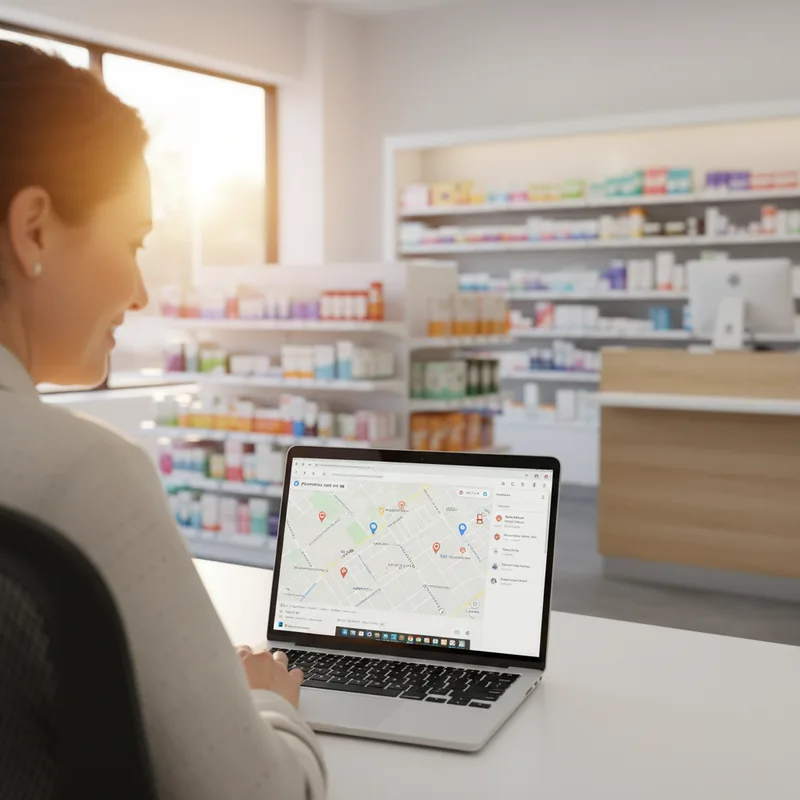
Local SEO puts your pharmacy on the map when nearby patients search for services.
Google Business Profile: Your Most Valuable Free Asset
Your Google Business Profile (GBP) is the single most important listing your pharmacy owns. Complete every field: business name, address, phone number, hours (including holiday hours), service categories, and a detailed business description that mentions your key services.
Upload fresh photos at least monthly. Real photos of your storefront, team, and services show patients what to expect before they visit. Post weekly GBP updates about flu shot availability, new services, or seasonal health tips. These posts signal activity to Google's algorithm and give patients a reason to engage with your profile directly.
One detail many owners miss: add every service you offer as a GBP "service" item with a short description. If you do compounding, immunizations, medication therapy management, pet medications, or point-of-care testing, each of those should appear on your profile. RevealSite's Smart Websites & SEO service handles full GBP optimization for pharmacy clients.
On-Page SEO for Your Pharmacy Website
Your website needs dedicated pages for every service you offer. Don't lump compounding, immunizations, and MTM onto a single "Services" page. Each service deserves its own URL targeting a specific keyword like "compounding pharmacy in [your city]."
Technical basics matter too. Google completed its mobile-first indexing rollout in July 2024, meaning every site is now ranked based on its mobile version. Run your site through Google's PageSpeed Insights and fix any Core Web Vitals issues flagged as "poor."
Local Schema Markup
Add LocalBusiness and Pharmacy schema markup to your website's code. It's a one-time setup that helps Google understand what your pharmacy offers and where it's located, and it gives you an edge over competitors who skip it.
Need Help With Local SEO?
RevealSite builds pharmacy websites paired with Google Business Profile optimization so you rank for "pharmacy near me" in your service area.
What Paid Advertising Channels Actually Work for Pharmacies?
Paid advertising gives you immediate visibility while your organic SEO builds over time. The two most effective channels for independent pharmacies are Google Ads (search) and Facebook/Instagram Ads, and they serve fundamentally different roles in your marketing mix.
Google Ads captures high-intent patients. Someone searching "pharmacy open near me" or "flu shot walk-in [city]" is ready to act right now. WordStream's 2024 benchmarks put the average cost-per-lead across all industries at $66.69.
Facebook and Instagram Ads work differently. They reach patients before a search ever happens. Someone scrolling their feed sees your immunization reminder, your compounding explainer, or a patient testimonial, and your pharmacy stays top-of-mind when they need a new provider. WordStream's 2024 Facebook benchmarks show the average cost-per-lead on Facebook Lead Ads at $21.98 across all industries. That's roughly one-third of WordStream's $66.69 Google Ads average, though your own costs will vary by market.
Channel
Best For
Avg. CPL (2024)
Speed to Results
Google Search Ads
High-intent searches ("pharmacy near me," service keywords)
~$66.69
Immediate
Facebook/Instagram Ads
Awareness, promotions, new service launches
~$21.98
1-2 weeks
Google Local Services Ads
Top-of-map placement for verified businesses
Pay per lead (varies)
Immediate
Here's the practical takeaway: if your budget is under $1,500 per month, start with Facebook Lead Ads targeting a 10-mile radius around your pharmacy. The lower CPL stretches your dollars further while you build brand recognition in the community. Once you're ready to scale, add Google Search Ads for high-intent service keywords and "near me" queries.
One mistake to avoid: running ads without a landing page that matches the ad's promise. If your ad promotes compounding services, the click should land on your compounding page, not your homepage.
Ready to Run Pharmacy Ads That Convert?
RevealSite manages Google Ads, Facebook Ads, and hyper-local patient acquisition campaigns for independent pharmacies across the country.
How Can Content Marketing and Social Media Build Patient Trust?
Content marketing positions your pharmacist as the trusted local health authority, not just another place to pick up prescriptions. When done consistently, it builds the kind of patient loyalty that chain pharmacies struggle to replicate.
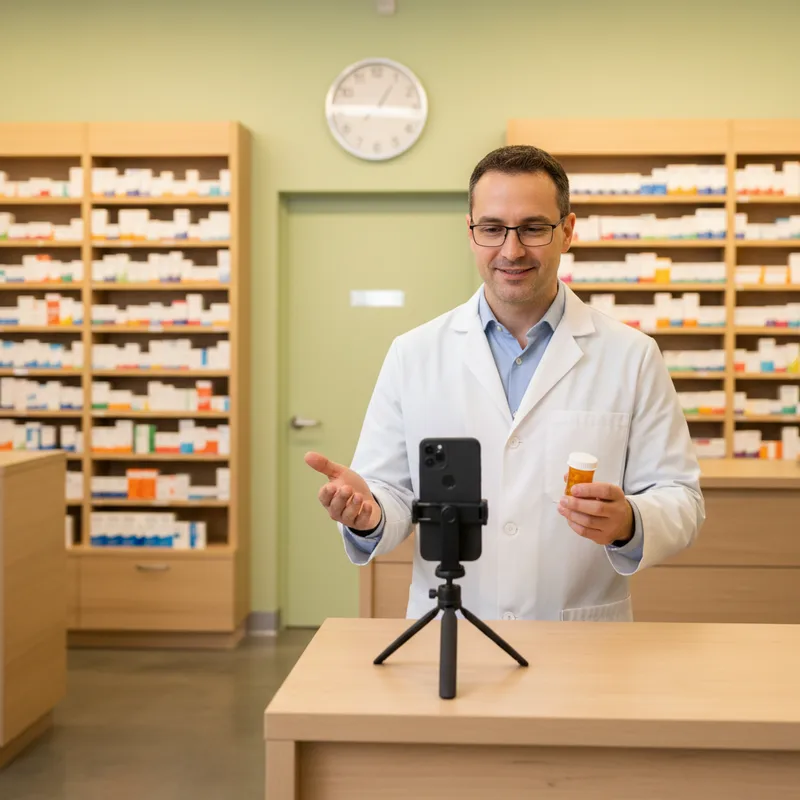
Short pharmacist-led videos build trust faster than any polished ad campaign.
Blogging and Patient Education
A pharmacy blog does two things at once. It gives Google fresh, keyword-rich pages to index, improving your organic rankings over time. And it gives patients a reason to visit your site beyond checking hours or refilling a prescription.
You don't need enterprise volume. Two to four well-researched articles monthly is a strong cadence for a single-location pharmacy. Focus on topics your patients actually ask about at the counter: medication interactions, blood pressure management, immunization schedules, supplement safety, and managing chronic conditions. Each post should target a specific long-tail keyword and link back to the relevant service page on your site.
The format matters too. Short, scannable posts with clear headings outperform long academic-style articles. Answer the patient's question in the first two sentences, then provide supporting detail.
Facebook is still a practical home for community pharmacy content, since local events and community groups live there. Post three to five times per week: a mix of health tips, pharmacy team spotlights, service reminders (flu shots, travel vaccines), and community event mentions. Video performs particularly well. Even a 30-second clip of your pharmacist answering a common question can outperform a polished graphic post. Pair that organic cadence with a small paid budget behind your best posts, and pharmacy social media marketing starts pulling its own weight instead of just building awareness.
Instagram works well for visual storytelling. Behind-the-counter moments, pharmacist Q&A Reels, and infographic carousels about medication safety.
Email Marketing
Email remains one of the most underused channels in independent pharmacy marketing. HubSpot's 2025 benchmarks show B2B services averaging a 39.48% open rate and 2.21% click-through rate. A monthly newsletter covering seasonal health topics, new services, and pharmacy updates keeps you top-of-mind between visits.
RevealSite's Creative & Content service handles blog writing, social media management, and email newsletters for pharmacies that don't have time to produce content in-house.
What Role Do Online Reviews Play in Pharmacy Growth?
Online reviews are the single most influential trust signal for patients choosing a pharmacy. They affect your Google ranking, your click-through rate in search results, and whether a new patient walks through your door or drives to the next option on the map.
The numbers here are striking. According to BrightLocal's 2024 Local Consumer Review Survey, 88% of consumers will use a business that responds to all of its reviews, compared to just 47% for businesses that don't respond at all. Semrush's compilation of local SEO data cited research showing that a one-star improvement in your average Google rating can boost calls, clicks, and direction requests by 44%.
Here's what a strong review strategy looks like in practice:
Ask at the point of service. Train your front-counter staff to say, "If you had a good experience today, we'd really appreciate a Google review." Simple and direct. Most patients are happy to help when asked in the moment. Some pharmacies print a small card with a QR code linking directly to their Google review page.
Respond to every review within 48 hours. Thank positive reviewers by name. For negative reviews, acknowledge the concern, avoid disclosing any protected health information (HIPAA applies even in public replies), and offer to continue the conversation offline via phone or email.
Monitor weekly. Set a Google Alert or use a review management tool to catch new reviews before they age. BrightLocal's 2025 survey found that just 4% of consumers say they never read online reviews of local businesses.
Reviews compound over time. A pharmacy with 150 reviews and a 4.7-star average often looks more credible than a competitor with 12 reviews and a perfect 5.0. Volume signals trust, and fresh reviews signal that the pharmacy is active.
Don't ignore reviews on platforms beyond Google. Facebook recommendations, Yelp, and Healthgrades all contribute to your online reputation, but focus on Google first.
See How Other Pharmacies Are Growing
From CBD programs to patient acquisition, see real results from pharmacies using a full-service marketing approach.
What pharmacy marketing ideas should you start with in your first 90 days?
Start with a 90-day pharmacy marketing plan that fixes the basics first, then adds one new channel at a time. Month one builds the foundation, month two builds trust, and month three tests paid ads and measures what works. Here is how to sequence the pharmacy marketing ideas in this guide.
Month one: local foundation. Finish your Google Business Profile, fix inconsistent name, address, and phone listings, and add a page for each service you offer.
Month two: trust. Start asking patients for Google reviews, reply to every review, and publish two or three helpful articles or posts.
Month three: test and measure. Run one small paid campaign on Google or Facebook, and track calls, direction requests, and new patients by source.
Keep each month's goal small enough to finish. If you are wondering how to market a pharmacy on a limited budget, this order keeps spending low until you know what works, and each step builds on the last.
How Do You Measure ROI for Independent Pharmacy Marketing?
Measuring marketing ROI means tracking how much new revenue each channel generates relative to what you spend on it.
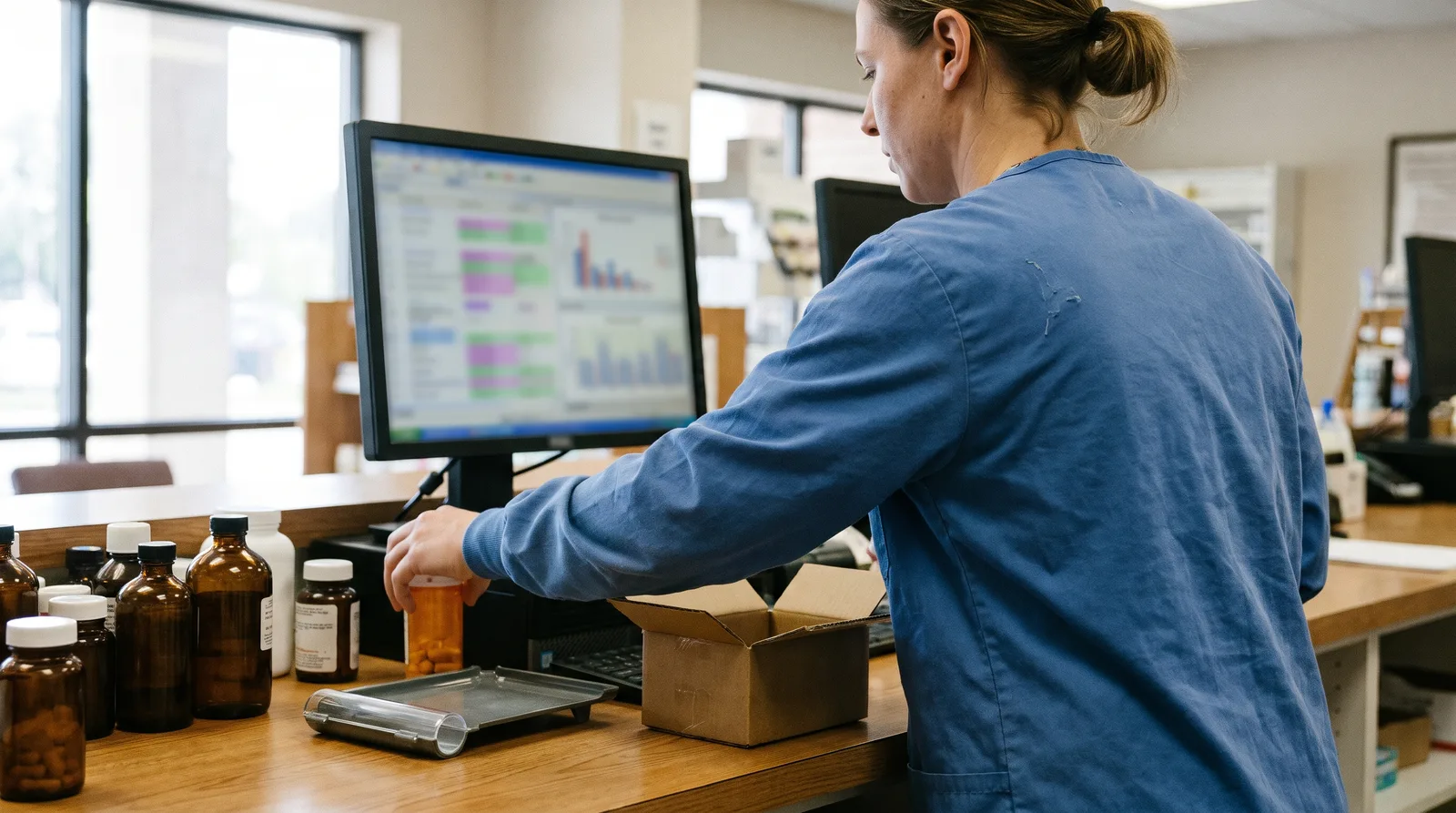
Tracking cost-per-lead by channel tells you exactly where your marketing budget works hardest.
The good news: pharmacy marketing is more measurable than most owners realize. In Conductor's 2025 State of SEO survey, 91% of respondents said SEO positively impacted website performance and marketing goals in 2024. Paid channels are easier to track in real time, but organic efforts often deliver a strong long-term return because the traffic doesn't stop when you pause your budget.
Key Metrics to Track Monthly
Focus on these numbers every month, at a minimum:
Google Business Profile actions: calls, direction requests, and website clicks from your GBP listing. A month-over-month increase usually means your visibility is improving.
Website traffic by source: separate organic search, paid ads, social media, and direct visits in Google Analytics.
Cost per lead by channel: divide your monthly spend on each channel by the number of leads (calls, form submissions, appointment requests) it generated. If your Facebook ads cost $600 and produced 30 leads, your CPL is $20.
New patient volume: track how many first-time patients visit each month and ask how they found you.
Review count and average rating: trend these monthly.
The Pharmacy Marketing Self-Assessment
Use this checklist to gauge where your independent pharmacy marketing stands today. Score yourself honestly, then prioritize the gaps.
Local SEO & Online Presence
Check each item you have completed.
Your score: count your checks out of 4
Content & Social Media
Your score: count your checks out of 3
Reviews & Reputation
Your score: count your checks out of 3
Paid Advertising & Measurement
Your score: count your checks out of 3
If you scored below 8 out of 13, you have clear gaps to close. If the gaps span most categories, that's often a sign to bring in a marketing agency for pharmacy clients specifically, rather than trying to build every channel in-house from scratch.
The most important thing about independent pharmacy marketing is that it compounds. Each blog post, each review, each month of consistent GBP activity builds on the last.
Pick one area from the self-assessment where you scored zero. Start there. Build the habit, measure the results, then add the next channel.
Ready to Build Your Pharmacy Marketing Engine?
See how RevealSite can handle your SEO, ads, content, and reputation management so you can focus on patients.
How much should an independent pharmacy spend on marketing?▼
Most independent pharmacies allocate 3-7% of gross revenue to marketing. Start with high-ROI channels like Google Business Profile optimization and review management, which cost little beyond staff time. Add paid advertising only after your organic foundation produces consistent local search visibility.
What is the best marketing strategy for a small pharmacy?▼
Local SEO and Google Business Profile optimization are a strong place to start for most small pharmacies. These channels target patients actively searching for services nearby, and SOCi research cited by Semrush found that multi-location businesses in Google's local 3-pack receive 126% more traffic than those ranked 4-10.
How long does it take for independent pharmacy marketing to show results?▼
Google Business Profile updates and review generation can produce measurable increases in calls and direction requests within 30-60 days. SEO content typically takes 3-6 months to rank. Paid ads generate leads immediately but require ongoing budget to sustain.
Should pharmacies use Google Ads or Facebook Ads?▼
Both channels serve different purposes. Google Ads captures patients actively searching for pharmacy services with high purchase intent. Facebook Ads builds awareness and reaches patients before they search. Facebook's average cost-per-lead runs roughly one-third of Google's.
How do online reviews affect independent pharmacy marketing?▼
Online reviews directly impact local search rankings and patient trust. BrightLocal found that 88% of consumers will use a business that responds to all its reviews, compared to just 47% for businesses that ignore reviews entirely.
Do independent pharmacies need a website in 2026?▼
Yes. Your website is the destination for map pack clicks, ad traffic, and patients researching your services. Birdeye's 2025 data shows 47% of Google Business Profile clicks go directly to the pharmacy website, making it your most important conversion tool.
What social media platform works best for pharmacies?▼
Facebook remains a practical home for community pharmacy content because local events and community groups live there. Instagram works well for visual content like health tips, behind-the-counter moments, and pharmacy team introductions.
What is pharmacy marketing?▼
Pharmacy marketing is everything you do to help patients find, choose, and keep using your pharmacy. It includes your Google Business Profile, website, reviews, social media, paid ads, and patient messages such as refill reminders. Advertising is one part of it, and the rest is the work that builds trust over time.