Pharmacy Patient Communication Software: The 2026 Guide
RevealSite Team
May 10, 2026 · 13 min read
Key Takeaways
✓Two-way SMS texting has a 98% open rate and is the fastest communication channel to implement, making it the ideal starting point for most independent pharmacies.
✓A pharmacy-branded mobile app puts refill requests, prescription tracking, push notifications, and direct messaging in every patient's pocket, matching the chain pharmacy experience.
✓Email marketing delivers a 39% open rate for healthcare services and is the most cost-effective channel for ongoing patient education, seasonal campaigns, and loyalty programs.
✓Automated refill reminders sent 3-5 days before a prescription is due reduce missed refills by 15-25% and keep patients inside your pharmacy's workflow instead of switching to chain apps.
✓Pharmacist-led communication interventions raised the proportion of adherent patients from roughly 74% to 84% in community pharmacy refill-program trials.
Build the presence your community trusts
Let us be your first step. Get in touch with our team today.
✓Evaluate communication platforms on five criteria: pharmacy management system integration, HIPAA compliance, multi-channel support, analytics, and cost per patient per month.
Your patients hear from their bank every time a transaction clears. Their doctor's office sends appointment reminders three days in advance. Amazon texts them the minute a package ships. Then they interact with your pharmacy and get silence until they remember to call about a refill. That gap is why independent pharmacies lose patients to chains with slick apps and automated messaging. Pharmacy patient communication software closes that gap by connecting your pharmacy to patients through texting, mobile apps, email marketing, automated reminders, and outbound calls, all triggered by what's actually happening with their prescriptions.
This guide covers the communication channels that matter, how each one works in a pharmacy setting, and how to choose a platform that fits your workflow, your budget, and your patients' expectations.
Why Does Your Pharmacy Need Patient Communication Software?
Pharmacy patient communication software solves a retention problem that most pharmacy owners feel but can't quite name: patients drift away not because of bad service, but because of no service between visits. A patient who fills a monthly prescription interacts with your pharmacy for five minutes, twelve times a year. Communication software fills the other 8,700 hours with health reminders, refill alerts, and touchpoints that keep your pharmacy top of mind.
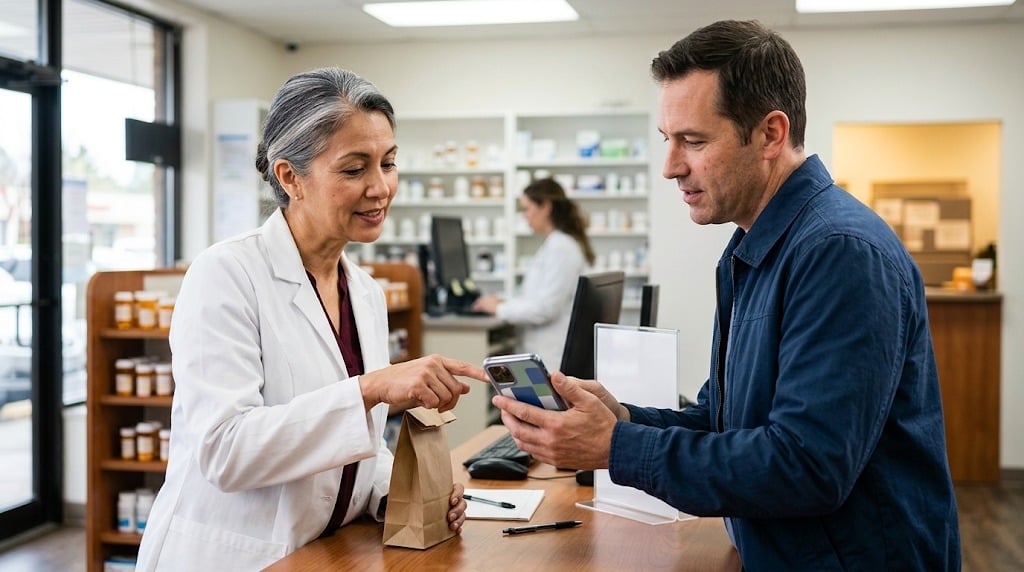
Patients who receive text updates between visits stay connected to your pharmacy year-round.
The cost of that silence is measurable. According to research published in NIH's PubMed Central, approximately 50% of patients with chronic conditions don't take medications as prescribed, contributing to roughly $528 billion in annual morbidity and mortality costs in the US. Your pharmacy can't fix the entire adherence crisis, but automated refill reminders, medication-due alerts, and pharmacist check-in messages directly reduce the portion of non-adherence caused by forgetfulness and disengagement.
There's a satisfaction issue too. The J.D. Power 2024 US Pharmacy Study found that brick-and-mortar pharmacy customer satisfaction fell more than 10 points in a single year, with long wait times and trust cited as the leading drivers. Communication software doesn't fix wait times directly, but it does address the trust gap. A pharmacy that texts patients when their prescription is ready, follows up after a new medication starts, and sends a birthday message once a year feels different from one that only talks to patients when they're standing at the counter.
What Are the Types of Pharmacy Patient Communication Tools?
Pharmacy patient communication tools fall into five categories: two-way texting, branded mobile apps, email marketing, automated refill reminders, and IVR outbound calls. Most pharmacies don't need all five on day one, but understanding what each one does helps you pick the right combination for your patients and your workflow.
Here's how the channels compare:
Channel
What It Does
Patient Benefit
Best For
Two-Way Texting
Real-time SMS conversations between pharmacy and patient
Instant answers without calling or visiting
Refill-ready alerts, quick questions, transfer requests
Mobile App
Branded pharmacy app with refill, tracking, push notifications
The critical technical requirement across all channels: integration with your pharmacy management system (PMS). Whether you run Pioneer Rx, Liberty, PharmaServ, or McKesson EnterpriseRx, your communication platform needs to pull prescription data, patient demographics, and refill due dates automatically. Manual data entry defeats the purpose. If a platform can't connect to your PMS, keep looking.
Research backs up the investment. A study in the American Journal of Managed Care found that pharmacist-led adherence interventions raised the proportion of adherent patients from roughly 74% to 84% in community pharmacy refill-program trials. Communication software is how you deliver those interventions at scale without adding staff hours.
Your patients expect a digital pharmacy experience
RevealSite gives independent pharmacies a custom mobile app and website that puts refills, messaging, and scheduling in every patient's pocket.
How Does Two-Way Texting Transform Pharmacy Communication?
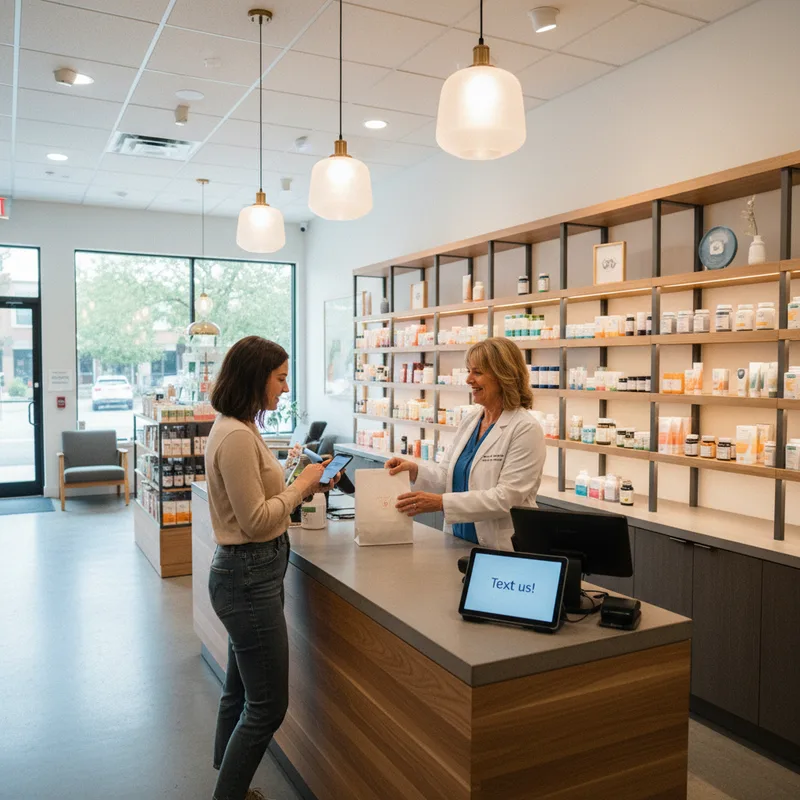
Two-way texting is the single highest-impact communication channel for pharmacies because it reaches patients where they already are, on their phones, with a 98% open rate and an average response time under three minutes. No other channel comes close to that combination of reach and speed. For the full setup, including opt-in, 10DLC registration, and compliant message templates, see our guide to pharmacy text message marketing.
The use cases go well beyond "your prescription is ready." Here's what two-way texting looks like in a pharmacy that's using it well:
Refill-ready alerts that include a one-tap "on my way" response so your team can have the bag waiting
New prescription follow-ups sent 7 days after a patient starts a new medication: "How are you feeling on your new prescription? Any questions for the pharmacist?"
Appointment reminders for immunizations, MTM consultations, and point-of-care testing
Prescription transfer requests where a patient texts their current pharmacy info and your team handles the rest
Health tip broadcasts timed to flu season, allergy season, diabetes awareness month, or back-to-school vaccine schedules
According to the Journal of the American Pharmacists Association, 88.9% of the US population lives within 5 miles of a pharmacy. Texting closes that last mile digitally. A patient who would never call your pharmacy to ask a question about a side effect will text it in 10 seconds.
Two compliance details to get right: use a dedicated healthcare texting platform with HIPAA-compliant encryption and a signed Business Associate Agreement, not a personal phone or consumer app. And collect explicit opt-in consent before sending any messages. A simple checkbox on your intake form or a text-to-join keyword on in-store signage handles this.
Why Should Your Pharmacy Offer a Mobile App?
A pharmacy-branded mobile app puts refill requests, prescription tracking, push notifications, and direct pharmacist messaging in every patient's pocket. It matches the digital experience patients get from chain pharmacy apps without the corporate overhead, and it gives your pharmacy a permanent presence on the device patients check 150 times a day. With mobile devices generating over 62% of all web traffic, a native app meets patients exactly where they already spend their time.
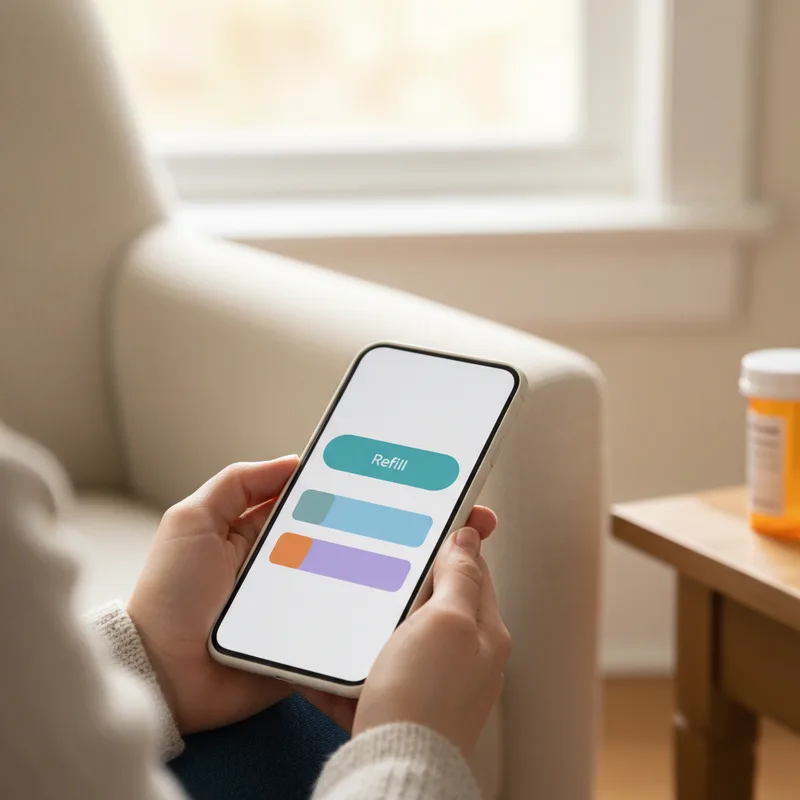
A branded pharmacy app gives patients self-service refills without calling or visiting.
Think about what happens without an app. A patient wants to refill a prescription at 9 PM on a Sunday. Your pharmacy is closed. Without an app, they open the CVS app and submit the refill there because it's convenient. With your app, they tap the refill button, it syncs with your pharmacy management system, and the prescription is ready when you open Monday morning. That single interaction, repeated across hundreds of patients, is the difference between retaining patients and leaking them to chains.
The features that matter most for pharmacy apps:
One-tap refill requests synced with your PMS so prescriptions queue automatically
Prescription status tracking so patients see "submitted," "processing," and "ready for pickup" without calling
Push notifications for refill-ready alerts, health reminders, and promotional messages (higher engagement than SMS because they're free to send and rich-formatted)
Direct messaging with the pharmacist for medication questions, side effect concerns, or insurance issues
Appointment scheduling for immunizations, MTM consultations, and health screenings
Loyalty program integration that rewards refill consistency, flu shot visits, and referrals
The CDC reported that pharmacies were the top setting for adult flu shots in the 2023-2024 season, accounting for 48% of all administered doses. A mobile app with integrated vaccine scheduling turns that seasonal surge into a year-round patient touchpoint. Patients who book their flu shot through your app in October are the same patients who get their COVID booster in January and their shingles vaccine in March.
RevealSite builds custom mobile apps for independent pharmacies that include all of these features, branded to your pharmacy and integrated with your existing systems. You get the same digital experience that chains spend millions developing, built specifically for your practice and your patients.
How Do Email Marketing and Automated Reminders Boost Retention?
Email marketing and automated refill reminders serve different roles in your communication stack, but together they form the backbone of long-term patient retention. Email nurtures the relationship over weeks and months. Automated reminders protect it at the critical moment when a patient might forget a refill and drift to a competitor.
Email marketing: the underrated retention channel
Email gets overlooked in pharmacy because it feels old-fashioned next to texting and mobile apps. That's a mistake. According to HubSpot's email marketing benchmarks, B2B services email campaigns average a 39% open rate, and pharmacy patient emails often exceed that because they contain information patients actually need: health tips, seasonal vaccine schedules, new service announcements, and medication safety updates. For a step-by-step walkthrough of building your list from zero, see our guide to pharmacy email marketing.
An effective pharmacy email program includes three types of campaigns:
Monthly newsletters with 2-3 health topics, a pharmacist tip, and a link to your latest blog post. This positions your pharmacist as a trusted resource and drives traffic to your pharmacy website content.
Seasonal campaigns timed to flu season, allergy season, back-to-school immunizations, and Medicare open enrollment. These drive foot traffic during high-value periods.
Service launch announcements when you add compounding, point-of-care testing, medication delivery, or other new offerings. Email is the most efficient way to tell 2,000 existing patients about a new service in a single send.
Segment your email list by medication type, health condition, or service history so patients receive relevant messages rather than generic blasts. A diabetes management tip sent to patients on metformin performs far better than the same tip sent to your entire list. Most modern platforms handle segmentation through PMS integration, pulling prescription data to build targeted lists automatically.
Automated refill reminders: the adherence engine
Automated reminders sent 3-5 days before a prescription is due reduce missed refills by 15-25% depending on the patient population and channel. The best setups use a cascade: push notification first (free and instant), then a text message if no response within 24 hours, then an IVR call for patients who haven't engaged digitally.
The NCPA 2024 Digest reported that 81% of independent pharmacy respondents offered medication therapy management services. Communication software makes MTM scalable by automating the follow-up: an initial adherence check at 7 days, a satisfaction message at 30 days, and a pharmacist consultation prompt at 90 days. Without automation, those touchpoints require manual phone calls that your staff doesn't have time to make.
IVR (Interactive Voice Response) systems still have a role, particularly for patients over 70 who may not engage with text or app notifications. An automated outbound call that says "Your prescription for [medication] is ready for pickup at [pharmacy name], press 1 to confirm" costs pennies and reaches the patients that digital channels miss.
Stop losing patients to chain pharmacy apps
RevealSite builds branded mobile apps that let your patients request refills, track prescriptions, and message your pharmacist directly. The same convenience chains offer, with the personal touch they can't.
How Do You Choose the Right Pharmacy Communication Platform?
Choose a pharmacy patient communication software platform based on five criteria: pharmacy management system integration, HIPAA compliance, multi-channel support, analytics and reporting, and cost per patient per month. Shiny features mean nothing if the platform can't connect to your PMS or meet basic compliance standards.
Analytics show which messages drive refills and which ones patients ignore.
Here's how to evaluate each one:
PMS integration depth. Ask specifically: does the platform pull real-time prescription status, patient demographics, and refill due dates from your system? Surface-level integrations that only sync patient names aren't useful. You need prescription-level data flowing automatically.
HIPAA compliance. The platform must encrypt all patient data, offer access controls and audit logs, and sign a Business Associate Agreement. Ask for their most recent security audit or SOC 2 report. If they hesitate, walk away.
Multi-channel capability. Your platform should support texting, app push notifications, email marketing, and IVR from a single dashboard. Running separate tools for each channel creates data silos and doubles your management time.
Analytics and reporting. You need to see open rates, response rates, refill conversion rates, and patient engagement trends by channel. Without data, you can't tell which messages work and which ones patients ignore.
Cost structure. Most platforms charge $200-$800 per month for a single location. Some price per patient per month ($0.50-$2.00), others by message volume. Calculate total cost based on your patient count and expected message volume, not just the base subscription. Factor in setup fees, training, and any hardware for IVR.
One more consideration: build vs. buy. Off-the-shelf pharmacy communication platforms get you running faster. Custom solutions, like a branded mobile app from RevealSite paired with a communication layer, cost more upfront but give you full control over the patient experience and your data. For pharmacies planning to grow to multiple locations or differentiate heavily on digital experience, custom is usually worth the investment. For a single-location pharmacy that needs to start communicating better this month, an established platform with strong PMS integration is the right move.
Don't forget that your communication strategy connects directly to your reputation management. Patients who receive consistent, helpful communication are the same patients who leave five-star Google reviews when asked. According to the BrightLocal 2025 survey, 85% of consumers use Google to evaluate local businesses. A well-timed review request sent via text after a positive pharmacy interaction, like a successful vaccine visit or a helpful medication counseling session, converts at 3-5x the rate of a generic review email.
Not sure where to start with patient communication?
Talk to our team about what makes sense for your pharmacy. Whether you need a mobile app, a better website, or a full marketing plan, we'll map out the right next step.
The pharmacies winning patient loyalty in 2026 aren't the ones with the lowest prices or the most convenient locations. They're the ones that communicate like the rest of the patient's digital life. Start with two-way texting because it's the fastest to implement and delivers the highest open rates. Add a branded mobile app to give patients self-service refills and push notifications that keep your pharmacy on their home screen. Layer in email marketing for monthly health content and seasonal campaigns. Then automate refill reminders to protect adherence and reduce the phone calls your staff is already drowning in. Every month you wait is another month where patients drift to a chain app because it was the only pharmacy that talked to them.
Give Your Patients the Digital Pharmacy They're Looking For
RevealSite pairs a pharmacy-branded mobile app with a high-performing website and local marketing so your patients stay engaged and your practice keeps growing.
Pharmacy patient communication software is a platform that connects your pharmacy to patients through automated and manual channels including text messages, mobile app notifications, email campaigns, IVR phone calls, and patient portal messages. It integrates with your pharmacy management system to trigger communications based on prescription activity, appointment schedules, and health reminders.
How much does pharmacy patient communication software cost?▼
Most platforms charge $200-$800 per month for a single-location pharmacy, depending on the number of patients, channels included, and integration complexity. Some charge per message or per patient per month. Factor in setup fees, training, and any hardware for IVR systems when comparing total cost of ownership.
Is texting patients HIPAA compliant?▼
Texting can be HIPAA compliant if you use a platform designed for healthcare communication with encryption, access controls, audit logs, and a signed Business Associate Agreement. Standard consumer texting apps like iMessage or WhatsApp are not compliant. Use a dedicated pharmacy communication platform that meets HIPAA requirements for electronic protected health information.
Can a pharmacy have its own mobile app?▼
Yes. Independent pharmacies can offer branded mobile apps that include prescription refill requests, Rx status tracking, push notifications, appointment scheduling, and direct messaging with the pharmacist. RevealSite builds custom pharmacy mobile apps that give independents the same digital convenience patients expect from chain pharmacy apps.
How does email marketing work for pharmacies?▼
Pharmacy email marketing sends targeted campaigns to patient lists segmented by medication type, health condition, or service history. Monthly newsletters with health tips, seasonal vaccine reminders, new service announcements, and refill prompts keep your pharmacy top of mind. Email works best as a nurture channel alongside texting and app notifications for immediate alerts.
What pharmacy patient communication software integrates with Pioneer Rx?▼
Several platforms integrate with Pioneer Rx and other major pharmacy management systems including Liberty, PharmaServ, and McKesson EnterpriseRx. When evaluating options, ask vendors specifically about the depth of integration: real-time prescription status sync, automatic refill triggers, and patient demographic imports save the most staff time.
Do automated refill reminders actually improve adherence?▼
Yes. Studies published in the American Journal of Managed Care found that pharmacist-led refill reminder programs raised the proportion of adherent patients from roughly 74% to 84%. Automated reminders sent via text, app notification, or IVR call 3-5 days before a prescription is due consistently reduce missed refills and improve medication adherence rates.