Independent Pharmacy Marketing Services: What to Expect
RevealSite Team
May 14, 2026 · 13 min read
Key Takeaways
✓A full-service marketing engagement for an independent pharmacy covers six to eight channels managed under one monthly retainer.
✓Local SEO and Google Business Profile optimization deliver the highest return for most pharmacies because 42% of local searchers click inside the Maps Pack.
✓Expect a 90-day ramp-up period before meaningful SEO and content results appear, though paid ads can generate leads within the first week.
✓Pharmacy marketing services range from $500 per month for single-channel work to $5,000 or more for a fully managed marketing department.
✓Track new patient phone calls, GBP actions, website form submissions, keyword rankings, and review velocity to measure whether your marketing is working.
✓Content marketing compounds over time: businesses publishing 16 or more posts per month generate 4.5 times more leads than those that publish rarely.
Build the presence your community trusts
Let us be your first step. Get in touch with our team today.
If you've never hired a marketing provider before, independent pharmacy marketing services can feel like a black box. You sign a contract, pay a monthly fee, and hope something good happens to your phone volume and foot traffic. That uncertainty keeps a lot of pharmacy owners stuck. Doing nothing is worse than doing almost anything. At its core, this is just outsourced pharmacy marketing: paying someone else to consistently do what most owners never have time to do at all.
Here's the reality: independents represent 35% of all retail pharmacies in the US, according to the NCPA's 2024 Digest, but most of them spend less than 1% of revenue on marketing. Chain pharmacies outspend them by orders of magnitude on advertising, digital presence, and brand awareness. The right marketing services close that gap without requiring you to become a marketer yourself. That gap is almost entirely a pharmacy digital marketing gap, not a product or care gap. The prescriptions and service are already there. The visibility isn't.
This article breaks down exactly what independent pharmacy marketing services include, which channels matter most, what a typical engagement looks like month to month, and how to tell whether your investment is actually working.
What Are Independent Pharmacy Marketing Services?
Independent pharmacy marketing services are the specific digital marketing activities a provider executes on your behalf to attract new patients, retain existing ones, and grow revenue from clinical and front-end services. They replace the in-house marketing department that most small pharmacies can't afford to staff.
A full-service engagement typically covers six to eight channels working together. No single channel wins on its own. The power comes from the overlap: your website converts the traffic your SEO generates, your Google Business Profile captures the patients your reputation earns, and your content builds the authority that makes all of it rank higher over time. That overlap is what full-service pharmacy marketing actually means in practice, not just a longer list of line items on an invoice.
Here's what the standard service menu looks like for most pharmacy-focused providers:
Website design and local SEO to make your pharmacy visible in Google search and Maps results for your service area
Paid advertising on Google Search, Google Maps, Facebook, and Instagram with geo-targeting to your zip codes
Social media management with pharmacy-compliant content calendars, community engagement, and performance tracking
Content creation, including blog posts, patient education articles, email newsletters, and video scripts
Reputation management covering review generation workflows, monitoring, and HIPAA-compliant response
Some providers also handle email and SMS marketing, pharmacy app promotion, and seasonal campaign planning. The scope depends on your budget and what's already in place. If you already have a decent website, you might skip the redesign and put that money toward paid ads or content instead. This is why a pharmacy marketing package rarely looks identical from one pharmacy to the next: the right mix depends on what's already working and what still needs to be built.
All Six Channels Under One Roof
RevealSite manages website, SEO, GBP, paid ads, social, content, and reputation for independent pharmacies nationwide.
Which Marketing Channels Matter Most for Independent Pharmacies?
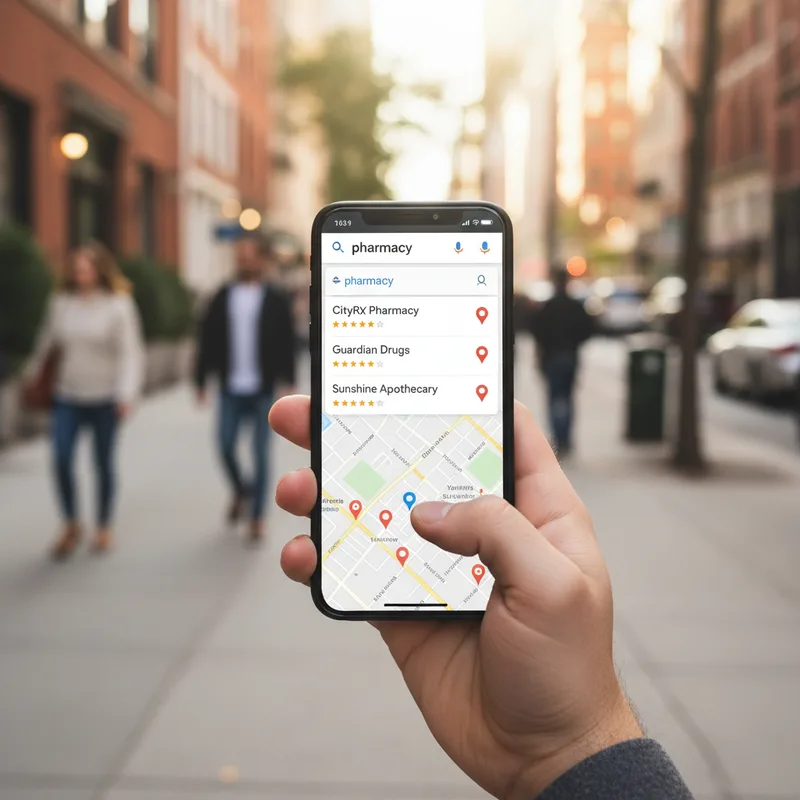
Local SEO and Google Business Profile optimization deliver the highest return for most independent pharmacies because pharmacies are intensely local businesses, and the patients who search "pharmacy near me" are ready to act within hours. Every other channel supports and amplifies that local visibility.
Over 42% of local searchers click inside the Maps Pack, making it the most valuable real estate for pharmacies.
Not all channels are equal, and your budget probably can't cover everything at once. Here's how to prioritize.
Tier 1: Local SEO and Google Business Profile
This is where you start. Backlinko's 2024 local SEO research found that 42% of all local searchers click a result inside the Google Maps Pack. If your pharmacy doesn't appear in that top-three Maps listing for your area, you're invisible to nearly half the people actively looking for a pharmacy right now. Pharmacy SEO and GBP work together: your website authority helps your Maps ranking, and your Maps listing drives traffic back to your site.
Tier 2: Online Reputation
Reviews are both a trust signal for patients and a ranking factor for Google. BrightLocal's 2025 consumer survey reported that 85% of consumers used Google to evaluate local businesses, up from 81% the year before. A review generation system that consistently asks patients for feedback after positive interactions can move your pharmacy from 15 reviews to 100 in a few months. That volume difference changes how your listing looks and how Google ranks it.
Tier 3: Paid Advertising
Google Ads and Facebook Ads produce the fastest results. You can have phone calls within 48 hours of launch. WordStream's 2024 benchmarks put the average Facebook Lead Ad cost-per-lead at $21.98 for service businesses. For a pharmacy running a flu shot campaign or promoting compounding services, that's a strong return when each new patient relationship is worth $2,000 or more in annual prescription revenue.
Tier 4: Content and Email
Blog content and email marketing are slower to produce results but they compound. Semrush's 2024 content marketing data shows businesses publishing 16 or more posts per month generate 4.5 times more leads than infrequent publishers. You don't need 16 posts a month as a pharmacy, but two to four well-targeted articles per month build the kind of topical authority that Google rewards with higher rankings across your entire site. Email keeps your existing patients engaged between visits: refill reminders, seasonal health tips, new service announcements. HubSpot's 2025 benchmarks show B2B services email campaigns averaging a 39.48% open rate, which means your messages actually get read when they're relevant.
What Does a Typical Marketing Engagement Look Like Month to Month?
A well-structured marketing engagement follows a predictable arc: audit and setup in the first month, build and launch in months two and three, optimize based on data in months four through six, then scale what's working in the second half of the year. Knowing this timeline prevents the frustration that comes from expecting instant results. Ask any provider to put that arc in writing before you sign anything. A real pharmacy marketing plan should read like a roadmap, not a vague promise.
A clear month-by-month plan sets expectations and keeps both sides accountable.
Double down on high-performing channels, add new service campaigns, expand geo-targeting, seasonal pushes
Measurable increase in new patient calls, Maps Pack ranking, and website leads vs. baseline
The first month feels slow because most of the work is invisible. Your provider is auditing your current site, fixing technical SEO issues, researching what your competitors rank for, and setting up the analytics that will measure everything going forward. Think of it like a contractor inspecting the foundation before building. It's not exciting, but skipping it leads to expensive problems later.
Months two and three are when things start moving. Your website gets rebuilt or optimized, your GBP listing gets updated with the right categories and services, and your first ad campaigns go live. This is usually when the first new patient calls from paid ads start coming in.
By month six, you should have enough data to see clear trends. If something isn't working, a good provider adjusts the strategy rather than running the same playbook and hoping for different results.
See the 90-Day Ramp in Action
Request a free demo, and we'll walk you through exactly what happens in months one through six for a pharmacy like yours.
How Long Before You See Results from Pharmacy Marketing?
The timeline for results depends entirely on which channel you're asking about. Paid ads produce leads in days. SEO and content take months. That's normal. Understanding the difference prevents you from killing a strategy that hasn't matured yet.
Here's a realistic channel-by-channel breakdown:
Google and Facebook Ads: Leads within 1-7 days of launch. Cost-per-lead stabilizes by week three or four as the algorithm learns your audience. Expect ongoing optimization for the first 60 days.
Google Business Profile: Impressions and discovery searches improve within 4-8 weeks of optimization. Ranking in the Maps Pack for competitive terms can take 2-4 months, depending on your review count and local competition.
Local SEO: Meaningful ranking improvements for target keywords usually appear between months three and six. Some low-competition long-tail keywords move faster. High-competition terms like "pharmacy near me" in a dense metro area can take six to twelve months.
Content marketing: Individual blog posts start ranking within 4-8 weeks, but the real payoff comes from volume. After 20 to 30 published posts, your site builds topical authority that lifts every page. Think of it as a 6-12 month investment. The dividends last for years.
Email marketing: Open rates and click-through rates are measurable from the first send. The impact on refill volume and patient retention builds over three to six months as your list grows and patients develop the habit of reading your emails.
Reputation management: New reviews start appearing within 2-4 weeks of activating a review request system. Getting from 20 reviews to 100 typically takes three to five months, depending on your patient volume.
The biggest mistake pharmacy owners make is judging SEO performance at the 60-day mark. That's like planting a tree and checking for fruit after two months. The root system is still growing. If your provider can show you that impressions are increasing, new keywords are entering the index, and your domain authority is climbing, those are leading indicators that results are on the way.
What Should You Expect to Pay for Independent Pharmacy Marketing Services?
Pricing for pharmacy marketing services varies widely based on how many channels you need and whether you're hiring a solo consultant, a software platform, or a full-service agency. Here's what the market looks like in 2026. Comparing pharmacy marketing pricing across providers only works if you're comparing like for like: a solo pharmacy marketing consultant charging $400 a month isn't offering the same scope as a team charging $2,500.
Service Type
Monthly Range
What's Included
SEO Only
$500-$1,500
On-page optimization, local citations, GBP management, monthly reporting
Campaign setup, targeting, creative, optimization, reporting (ad budget is separate)
Content Marketing
$500-$2,000
Blog posts, patient education articles, email newsletters, social content
Full-Service Bundle
$1,500-$5,000+
Website, SEO, GBP, ads, social, content, reputation, monthly strategy calls
A few things to watch. First, ad spend is almost always separate from management fees. If a provider quotes you $2,000 per month "all-in" for Google Ads, find out how much of that actually goes to Google versus their management fee. A common split is 60-70% to ad spend and 30-40% to management, but some agencies charge a flat fee regardless of budget. Understanding that split is the single most useful thing you can do to keep your total pharmacy marketing cost honest and comparable across quotes.
Second, ask about setup fees. Many providers charge a one-time fee of $500 to $2,500 for the initial website build, audit, and campaign setup. That's normal. What isn't normal is a $5,000 setup fee with no clear deliverables attached to it.
Third, don't automatically choose the cheapest option. A $500 per month SEO provider managing 50 clients can't give your pharmacy the same attention as a pharmacy-specialized team managing 15. The math just doesn't work. If you're paying below-market rates, you're getting below-market effort.
How Do You Measure Whether Pharmacy Marketing Is Working?
You measure pharmacy marketing the same way you'd measure any business investment: by tracking specific numbers that connect marketing activity to revenue. Gut feelings and vague impressions don't count. If your provider can't show you data, they can't show you results. Every metric below exists to answer one question: what's the actual pharmacy marketing ROI on what you're paying each month.
Here are the five metrics that matter most for independent pharmacies:
New patient phone calls. This is the clearest signal. Call tracking software assigns a unique number to each marketing channel so you know exactly which calls came from Google Ads, which came from your GBP listing, and which came from organic search. If total new patient calls aren't increasing quarter over quarter, something needs to change.
Google Business Profile actions. Track direction requests, website clicks, and phone calls from your GBP listing. These actions represent patients who found you on Maps and took a step toward visiting. A healthy pharmacy GBP profile should show consistent month-over-month growth in total actions.
Website lead submissions. Refill requests, contact form fills, and appointment bookings. Every form on your site should be tracked. If your website gets 1,000 visits a month but zero form submissions, the traffic isn't converting and your site needs work. Keep in mind that Statista reports mobile devices now generate over 62% of all website traffic, so test your forms on a phone screen first.
Local keyword rankings. Monitor where you rank for your target terms: "pharmacy near me," "compounding pharmacy [city]," "24-hour pharmacy [zip code]." Rankings should trend upward over the first six months. Flat or declining rankings mean the SEO strategy needs adjustment.
Review velocity and rating. How many new reviews are you getting per month, and what does your average rating look like. Steady growth in review count with a 4.5 or higher average rating is the target. This directly affects your Maps ranking and patient trust.
J.D. Power's 2024 US Pharmacy Study found that brick-and-mortar pharmacy customer satisfaction dropped more than 10 points, with wait times and trust as the leading factors. That's relevant to measurement because your marketing should address those pain points. If your content highlights short wait times, personalized care, and trusted pharmacist consultations, you should see those themes reflected in your reviews and website engagement metrics.
A good marketing provider sends a monthly report covering all five of these areas. Great ones get on a call with you to walk through the numbers and adjust strategy based on what the data says. If you're getting a PDF once a month with no context or recommendations, that's a reporting checkbox, not a strategic partnership. That gap in reporting quality is often the clearest early signal of what kind of pharmacy marketing provider you actually hired.
The most valuable thing a marketing partner gives your pharmacy isn't any single channel or tactic. It's the ability to see what's working and do more of it while someone else handles the execution. Your job is to take care of patients. Your marketing provider's job is to make sure those patients find you in the first place. Hold them accountable to the five metrics above, give the strategy 90 days to establish a baseline, and make decisions based on data rather than hope.
If you don't have a marketing partner yet, start by understanding what's available and what it should cost. Then talk to a provider who specializes in pharmacy.
Ready to See What Marketing Services Look Like for Your Pharmacy?
Get a free walkthrough with real pharmacy results, transparent pricing, and a custom plan built for your market.
What do independent pharmacy marketing services include?▼
A typical engagement includes website design and optimization, local SEO, Google Business Profile management, paid ads on Google and Facebook, social media management, blog and email content, and online reputation management. The exact mix depends on your budget and goals.
How much do pharmacy marketing services cost per month?▼
Single-channel services like SEO or social media management start around $500 to $1,000 per month. Full-service packages that bundle website, SEO, ads, content, and reputation management typically run $1,500 to $5,000 per month depending on market size and scope.
How quickly will I see results from pharmacy marketing?▼
Paid ads can produce phone calls within days of launching. Google Business Profile improvements often show within four to eight weeks. SEO and content marketing take three to six months for measurable ranking gains, but the results compound over time.
What's the difference between pharmacy marketing services and pharmacy marketing software?▼
Marketing services give you a team that builds and executes strategy on your behalf. Software gives you tools to do it yourself. Services cost more but require almost none of your time, while software is cheaper but needs 5 to 10 hours per week of your attention.
How do I know if my pharmacy marketing services are working?▼
Track five key metrics: new patient phone calls, Google Business Profile actions like direction requests and clicks, website lead form submissions, local keyword rankings, and monthly review velocity. A good provider reports all five in a monthly dashboard.
Should I start with one marketing channel or go full-service?▼
If budget is tight, start with local SEO and Google Business Profile optimization because they produce the most durable results. Add paid ads when you want faster lead flow, then layer in content and social as your budget allows.
Do I need a pharmacy-specific marketing provider?▼
Yes, for most pharmacies. HIPAA compliance, PBM margin pressure, and pharmacy-specific search behavior create requirements that generic agencies miss. A provider with pharmacy experience avoids the costly trial-and-error phase that wastes your first three to six months of budget.