How to Choose a Pharmacy Marketing Agency (2026 Guide)
RevealSite Team
May 14, 2026 · 12 min read
Key Takeaways
✓Independent pharmacies lost more than one store per day in 2024, making marketing a survival skill rather than an optional expense.
✓A pharmacy-specialized agency understands HIPAA, PBM pressure, and local search behavior that generic firms miss entirely.
✓Full-service pharmacy marketing typically costs $1,500 to $5,000 per month, with SEO alone returning an average of $22 for every $1 spent.
✓Evaluate agencies on pharmacy-specific case studies, GBP expertise, transparent reporting, and flexible contract terms before signing.
✓Red flags include guaranteed rankings, no pharmacy clients, long lock-in contracts, and zero mention of HIPAA compliance.
✓75% of small businesses now invest in AI-powered marketing tools, but software alone won't replace the strategy an experienced agency provides.
Choosing a is one of the highest-stakes decisions an independent pharmacy owner makes. Pick wrong, and you're out thousands of dollars with nothing to show for it. Pick right, and you get a partner who fills your pipeline with new patients while you focus on the counter.
Build the presence your community trusts
Let us be your first step. Get in touch with our team today.
The problem is that most pharmacy owners don't evaluate marketing agencies for a living. You evaluate drug interactions, insurance claims, and staffing schedules. So when a slick sales rep promises "page one rankings" or "more patients guaranteed," it's hard to know what's real. According to the NCPA's 2024 Digest, the US lost more than one independent pharmacy per day last year, dropping from 19,432 to 18,984 stores. Marketing isn't optional anymore. It's a survival tool.
This guide walks you through exactly what a pharmacy marketing agency does, how to evaluate one, what it should cost, and which warning signs mean you should walk away.
What Does a Pharmacy Marketing Agency Actually Do?
A pharmacy marketing agency manages the digital channels that bring patients to your door: your website, local SEO, Google Business Profile, paid advertising, social media, email campaigns, and online reputation. Think of it as an outsourced marketing department built specifically for pharmacy.
That distinction matters. A general digital agency might run Facebook ads for a pizza shop on Monday and a law firm on Tuesday. A pharmacy-focused agency understands that your patients search differently, your compliance requirements are stricter, and your revenue model depends on refill volume over time rather than one-time purchases.
Google Business Profile management to rank in the Maps pack for "pharmacy near me" and related local searches.
Paid advertising on Google and Facebook, targeting patients within your service radius.
Social media management with pharmacy-compliant content that builds trust without crossing HIPAA lines.
Reputation management, including review generation, monitoring, and compliant response strategies.
Content creation, such as blog posts, patient education articles, and email newsletters, positions your pharmacist as the local health authority.
Not every agency offers all six. Some specialize in pharmacy SEO alone. Others bundle everything into a single monthly retainer. The key question isn't how many services they list on their website. It's whether they can connect those services to measurable outcomes: more phone calls, more new patient registrations, more refills.
See What a Pharmacy-Focused Agency Looks Like
RevealSite combines website design, local SEO, paid ads, social, and content under one roof for independent pharmacies.
Why Do Independent Pharmacies Need a Specialized Agency?
Independent pharmacies operate under constraints that generic marketing firms don't understand, and those blind spots cost you money. A pharmacy-specialized agency knows your margins, your compliance obligations, and the exact search behavior that drives patients to choose one pharmacy over another.
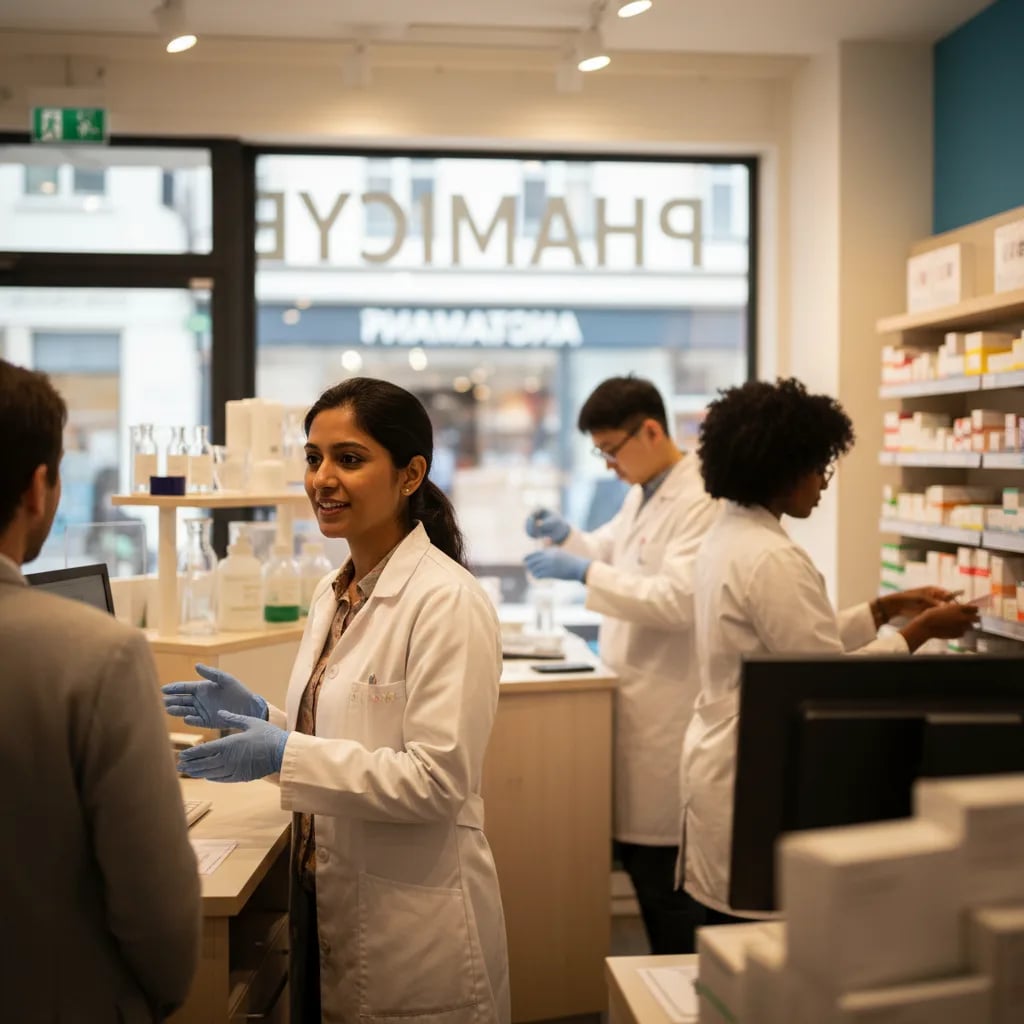
A specialized agency understands the pharmacy business model from counter to search results.
Start with the economics. The FTC's 2024 PBM Staff Report confirmed that three PBMs control nearly 80% of US prescription drug claims, pushing reimbursement rates below acquisition cost for many independents. You can't out-negotiate the PBMs. But you can grow your front-end revenue, attract cash-pay patients, and market high-margin clinical services like compounding, immunizations, and MTM. A pharmacy-specific agency knows how to position those services online.
Then there's HIPAA. A general agency might reply to a negative Google review by confirming the reviewer is a patient or referencing their prescription. That's a violation. A pharmacy-specialized agency trains its team to respond without disclosing protected health information. Sounds basic, but it's a mistake that happens constantly when non-pharmacy firms manage your reputation.
And your reviews? They're a ranking factor and a trust signal at the same time. BrightLocal's 2024 survey found that 88% of consumers will use a business that responds to all its reviews, compared to just 47% who'll use one that ignores them. A pharmacy-specific agency knows how to build a review generation system and respond to every review without tripping over HIPAA. A generic firm doesn't think about that until it's too late.
The Local Search Factor
Pharmacy is one of the most local businesses in healthcare. According to Backlinko's 2024 local SEO data, 76% of consumers who run a "near me" search visit a related business within one day. Your agency needs to understand how Google's local algorithm works for pharmacies specifically, not just in theory. That means Google Business Profile optimization, local citation building, and geo-targeted content that mentions your city, your neighborhood, and your specific services.
A generic agency will optimize your site for "pharmacy" as a broad keyword. A pharmacy-specialized agency will target "compounding pharmacy in [your city]" or "pharmacy with immunizations near [your zip code]" because those are the searches that actually convert.
How Should You Evaluate a Pharmacy Marketing Agency?
Evaluate a pharmacy marketing agency the same way you'd evaluate a new wholesaler: look at their track record with businesses like yours, ask for references, and read the contract line by line before you sign anything.
Most pharmacy owners skip this step. They get a polished pitch, hear a few impressive numbers, and sign a 12-month contract without asking the hard questions. Here's a framework that protects you.
The Seven-Point Evaluation Checklist
Evaluation Criteria
What to Ask
Green Light
Pharmacy Experience
How many pharmacy clients do you serve right now?
5+ current pharmacy clients with verifiable results
HIPAA Awareness
How do you handle review responses and patient data?
Written HIPAA protocols for every client-facing activity
GBP Expertise
Can you show GBP ranking improvements for pharmacy clients?
Before/after Maps screenshots with dates and data
Reporting
What metrics do you report and how often?
Monthly reports with calls, clicks, rankings, and leads
Contract Terms
What's the minimum commitment and cancellation policy?
Month-to-month or 90-day terms with a clear exit clause
Case Studies
Can you share results from a pharmacy similar to mine?
Named pharmacies with specific metrics, not just testimonials
Pricing Transparency
What's included in my monthly fee? What costs extra?
Itemized scope of work with no hidden fees or add-ons
Why does GBP expertise matter so much? Because Semrush's 2024 local SEO data shows pharmacies ranking in Google's local 3-pack receive 126% more traffic and 93% more action clicks than those in positions four through ten. Your agency's ability to move your listing into the top three directly affects how many patients call, click for directions, or visit your website.
If an agency can't answer these questions clearly, that tells you something. Good agencies welcome scrutiny because they know their numbers hold up. The ones who get defensive or vague are usually the ones who churn through clients every six months.
One more thing worth checking: ask whether the agency outsources its work overseas. There's nothing wrong with distributed teams, but you should know who's writing your content and managing your reputation. The person responding to a patient review about your pharmacy should understand American healthcare terminology, not just English grammar.
Ready to See How RevealSite Stacks Up?
Get a free walkthrough of our pharmacy marketing services, including real case studies and transparent pricing.
What Should Pharmacy Marketing Services Cost in 2026?
Pharmacy marketing services typically range from $1,500 to $5,000 per month for a full-service agency, though pricing depends heavily on scope, market size, and how many channels you need managed. Understanding the tiers helps you spot both overpriced packages and suspiciously cheap offers.
Here's how the market breaks down:
Tier
Monthly Cost
What You Get
Best For
DIY Tools
$50-$200
Email platform, basic social scheduler, template website
Owners with 10+ hours/week for marketing
Software Platform
$300-$800
Pharmacy-specific website, automated social posts, review requests
Owners who want automation but will still manage strategy
Full-Service Agency
$1,500-$5,000+
Custom website, SEO, GBP, paid ads, social, content, reporting
Owners who want a done-for-you marketing department
The gap between the tiers isn't just about features. It's about who does the work. With DIY tools, you're the strategist, the writer, and the ad manager. With a software platform, the technology handles some tasks, but you're still making decisions and creating content. With a full-service agency, someone else builds and executes the strategy while you dispense prescriptions.
How to Think About ROI
Don't just compare monthly costs. Compare what each dollar produces. WordStream's 2024 benchmarks put the average Google Ads cost-per-lead at $66.69 across all industries. If your agency runs pharmacy paid ads that generate leads at $40 each, and one in five leads becomes a patient worth $2,000 in annual prescription revenue, that math works out fast.
SEO takes longer to produce results but compounds over time. Industry data from Conductor's 2025 State of SEO report found that businesses earn an average of $22 in revenue for every $1 spent on search optimization. The catch is that those returns take three to six months to materialize. Any agency promising SEO results in 30 days is either exaggerating or doing something Google will eventually penalize.
What Are the Red Flags When Hiring a Pharmacy Marketing Company?
Red flags in pharmacy marketing usually come disguised as bold promises. The agencies most likely to underdeliver are often the ones that oversell in the pitch meeting, and knowing what to watch for can save you months of frustration and wasted budget.
Reading the contract line by line protects you from lock-ins and hidden fees.
Here are the warning signs that should make you pause:
"We guarantee page one rankings." No agency controls Google's algorithm. Honest agencies explain what they'll do to improve your visibility and set realistic timelines. Guarantees are a sign they'll say anything to close the sale.
No pharmacy clients in their portfolio. If every case study is a restaurant, a dentist, or an e-commerce store, they don't understand your business. Pharmacy has unique compliance, reimbursement, and patient behavior patterns that generic experience doesn't cover.
12-month contracts with no exit clause. Confidence looks like a month-to-month term or a 90-day trial. A rigid annual lock-in usually means the agency knows clients would leave if they could.
No reporting dashboard or regular updates. If you can't see your own data, you can't verify whether the agency is doing anything. Ask to see a sample report before signing. It should include calls, website visits, keyword rankings, and leads by source.
Zero mention of HIPAA. This is non-negotiable for pharmacy. If the agency doesn't bring up HIPAA compliance during the sales process, they haven't thought about it. And that means they'll eventually make a mistake that puts your license at risk.
Vague pricing or constant upsells. A reputable agency tells you exactly what's included in your package and what isn't. If you're getting nickel-and-dimed for every small request three months in, the original scope was designed to be inadequate.
One pattern worth mentioning: some agencies buy pharmacy marketing software platforms, slap their logo on the dashboard, and call themselves specialists. That's not specialization. That's reselling. Ask whether they build custom strategies or just plug you into a template that every other client gets.
Should You Hire an Agency or Use Marketing Software Instead?
The agency-versus-software question comes down to one thing: how much of your time you're willing to spend on marketing each week. Software gives you tools. An agency gives you a team. Both can work, but they solve different problems.
Marketing software platforms designed for pharmacies typically cost $300 to $800 per month. They'll give you a templated website, automated social media posts, review request workflows, and sometimes basic email campaigns. The technology runs on autopilot, which sounds appealing until you realize that autopilot means generic. Every pharmacy on the same platform gets similar content, similar design, and similar strategies. Your local competitor might be using the same template.
A full-service pharmacy marketing agency costs more, but you're paying for a custom strategy, original content, and ongoing optimization. Your website doesn't look like anyone else's. Your blog posts target keywords specific to your market. Your paid ad campaigns adjust based on what's actually working in your zip code.
The Comparison at a Glance
Factor
Marketing Software
Full-Service Agency
Monthly Cost
$300-$800
$1,500-$5,000+
Your Time Required
5-10 hours/week
1-2 hours/month
Customization
Template-based
Custom strategy and creative
SEO Depth
Basic on-page optimization
Full local SEO, content strategy, link building
Results Timeline
Slower without strategic guidance
Faster with dedicated execution
Scalability
Limited to platform features
Scales with your growth goals
There's also a third path that's becoming more common. According to HubSpot's 2026 State of Marketing report, 80% of marketers now use AI for content creation, up from 64% the prior year. Some pharmacies use software for routine tasks like review requests and social scheduling while hiring an agency for the high-skill work: SEO, content strategy, and paid ad management. That hybrid approach can be a smart middle ground if your budget allows it.
The deciding factor? Be honest about your calendar. If you're working 50-hour weeks behind the counter and marketing is the thing that keeps sliding off your to-do list, software alone won't fix that. You need someone to do the work for you.
The right agency doesn't just run campaigns. It becomes the growth engine you don't have time to build yourself. The framework in this guide gives you the criteria to separate agencies that talk a good game from the ones that actually produce results for pharmacies like yours. Start by asking the seven evaluation questions. If an agency answers all of them with confidence, specifics, and pharmacy-relevant proof, you've likely found a partner worth your investment.
Your next step: request a walkthrough from an agency that specializes in independent pharmacy, review their case studies, and compare their answers against the checklist above.
See What RevealSite Can Do for Your Pharmacy
Get a free demo with real pharmacy case studies, transparent pricing, and a custom growth plan for your market.
How much does a pharmacy marketing agency cost per month?▼
Most full-service pharmacy marketing agencies charge between $1,500 and $5,000 per month depending on the scope. Basic packages covering SEO and GBP optimization start lower, while plans that add paid ads, social media, and content creation sit at the higher end.
What's the difference between a pharmacy marketing agency and a generic digital agency?▼
A pharmacy-specific agency understands HIPAA compliance, PBM reimbursement pressure, and how patients search for local pharmacies. Generic agencies often lack this context, which leads to wasted spend on strategies that don't fit pharmacy operations or regulations.
How long does it take to see results from pharmacy marketing?▼
Paid ads can produce leads within days, but SEO and content marketing typically take three to six months to show measurable ranking improvements. Most agencies set a 90-day baseline period before making major strategy shifts.
Should I hire a pharmacy marketing agency or do it myself?▼
If you can dedicate 10 to 15 hours per week to marketing, DIY tools work for basic tasks. Most pharmacy owners don't have that time, which is why a done-for-you agency model tends to produce faster and more consistent results.
What questions should I ask a pharmacy marketing agency before signing?▼
Ask how many pharmacy clients they currently serve, whether they understand HIPAA, how they report results, what their contract terms look like, and whether they can share case studies with measurable outcomes from real pharmacies.
Can a pharmacy marketing agency help me compete with CVS and Walgreens?▼
Yes. A good agency positions your pharmacy around services chains can't match, like compounding, personalized consultations, and faster service. They target hyper-local search terms where independents can outrank national brands in Google Maps.
Do pharmacy marketing agencies handle HIPAA compliance?▼
Reputable pharmacy-focused agencies build HIPAA awareness into every touchpoint, from website forms and review responses to social media content. Always ask for specifics on how they handle protected health information before you sign.