Pharmacy Email Marketing: Build a Patient Email List
RevealSite Team
June 15, 2026 · 11 min read
Key Takeaways
✓Pharmacy email marketing reaches patients through a channel you own, unlike social reach an algorithm can cut, and service-industry email averages a 39% open rate.
✓Decide what your emails do before collecting addresses; refill reminders alone justify the effort by recovering revenue you already earned.
✓Capture emails at natural moments: the pickup counter (highest volume), a website form, in-store QR codes, and flu clinics or events.
✓Make the opt-in worth it with a specific promise like refill reminders, and state the frequency, such as about two emails a month.
✓Stay compliant with CAN-SPAM (honest subject lines, real address, working unsubscribe) and HIPAA (no medications, conditions, or fill history in marketing email).
✓Measure against your goal: recovered refills, booked services, and review requests answered, not just opens and clicks.
Build the presence your community trusts
Let us be your first step. Get in touch with our team today.
Pharmacy email marketing is the one patient channel you fully own, yet most independent pharmacies leave it empty. Social reach rises and falls with an algorithm you don't control. An email list sits in your account, reaches the inbox, and costs almost nothing to send. Text message marketing shares that same ownership advantage and averages a 98% open rate, though email still wins on space for the kind of detail a refill reminder or newsletter needs.
Here's the catch. You can't send to a list you haven't built, and a stack of old phone numbers isn't a list. Most pharmacies have thousands of patients walking in every month and almost no permission to email any of them.
This guide builds a patient email list from zero: deciding what your emails do, where patients hand over an address, how to make the signup worth it, staying compliant, and sending your first campaigns. One owned channel, built the right way.
Why does pharmacy email marketing matter for independent pharmacies?
Pharmacy email marketing matters because email is an owned channel that reaches patients directly, unlike social media reach, which an algorithm can cut overnight. For an independent pharmacy competing on relationships, a direct line to the inbox is one of the cheapest retention tools you have.
The numbers back it up. Service-industry email campaigns average a 39% open rate, according to HubSpot benchmarks, far higher than the slice of followers who ever see a given social post. And the audience is loyal to begin with: almost 90% of adults trust their local pharmacist, per a CVS Health Rx Report, so a message from your pharmacy starts with credibility most brands would envy.
Email also targets a real revenue problem. Roughly half of patients with chronic conditions don't take medications as prescribed, contributing to an estimated $528 billion in avoidable costs, per research in the NIH PMC library. A well-timed refill reminder is a clinical nudge and a sales touch at the same time. Medication adherence is the clinical term for exactly this problem, and email is one of the lowest-cost tools a pharmacy has to move the number.
Owned vs. rented: why email wins on reliability
A list you own reaches patients on your terms. Social reach is borrowed.
Email list
Ownership: You own it
Reach: Lands in the inbox
Typical visibility: ~39% open rate
Social media
Ownership: Platform owns it
Reach: Algorithm decides reach
Typical visibility: Small % of followers
Open rate per HubSpot service-industry email benchmarks.
Before collecting a single address, decide the job your emails will do. A list with no purpose becomes a newsletter nobody opens. Pick one or two concrete outcomes first, and let those shape everything else.
For most independent pharmacies, email earns its keep in four ways:
Refill and pickup reminders: the workhorse. They protect revenue you've already earned and double as a clinical nudge.
Service promotion: vaccines, MTM, point-of-care testing, anything patients won't book if they don't know you offer it.
Review requests: a short ask after a good visit, sent to the right patient at the right time.
A light monthly newsletter: seasonal health notes that keep you top of mind between fills.
You don't need all four on day one. Refill reminders alone justify the effort, because they protect revenue you've already earned.
Write your goal down the way you would for any campaign. "Recover 20 lapsed refills a month" is a goal. "Send a newsletter" is a chore. The first tells you who to email and when. The second fills an outbox and little else. That specificity is also the seed of email segmentation, since a goal like recovering lapsed refills already tells you which group of patients that message belongs to.
Step 2: Where do patients give you their email?
Patients hand over an email at a handful of natural moments: at intake, at the counter during pickup, on your website, through in-store signage, and at events like flu clinics. The goal is to make the ask routine at every one of these touchpoints, not to chase it once a year.
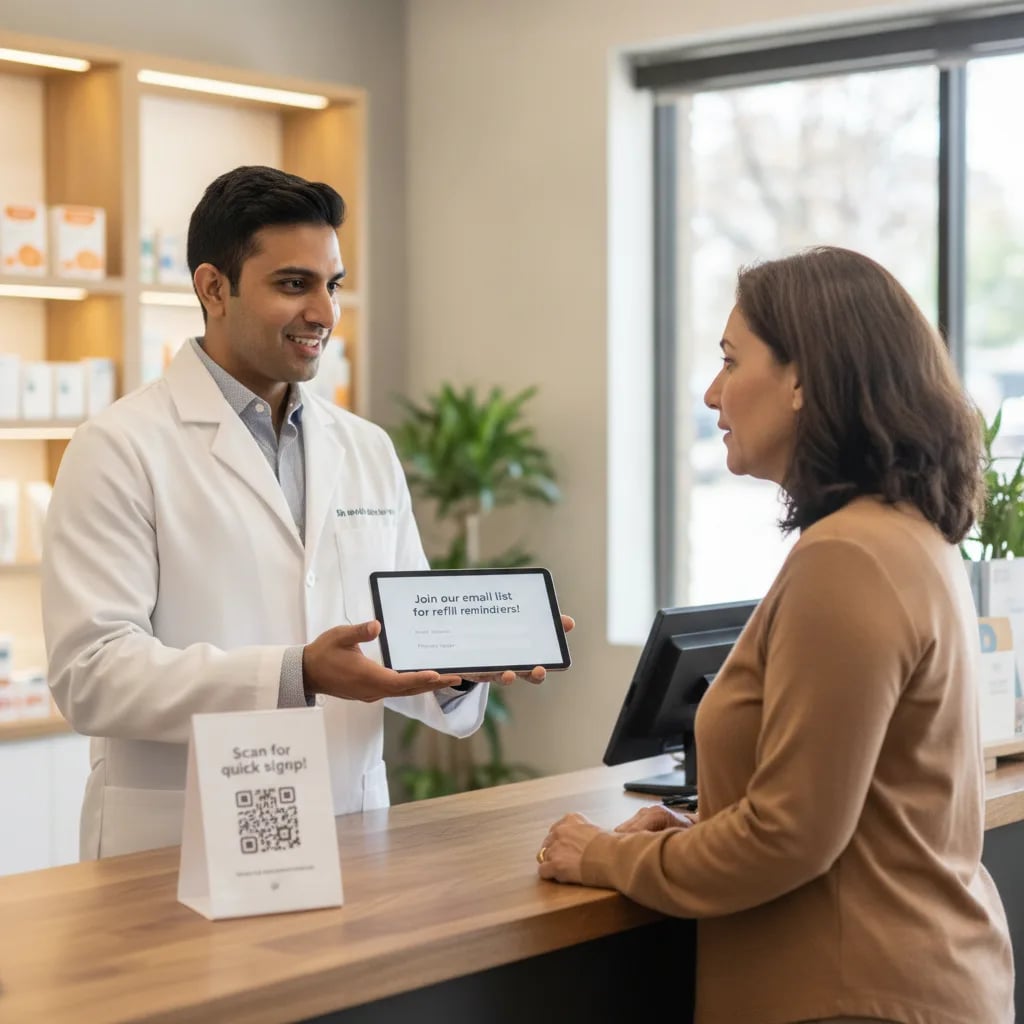
Your highest-volume capture point is the counter. Every pickup is a face-to-face moment where a quick "want refill reminders by email?" feels helpful, not salesy. Train the question into the workflow so it happens on autopilot. Your website is second: a visible signup form on the homepage and footer catches the people already searching for you. Some pharmacies frame this as email vs text message marketing right at the counter, asking which channel the patient prefers rather than defaulting to one.
Don't ignore the low-tech options. A tent card with a QR code at the register, a clipboard at a vaccine clinic, a line on your intake form. Pharmacies see heavy foot traffic, with 88.9% of Americans living within five miles of one, per the Journal of the American Pharmacists Association. That traffic is your list-building engine if you ask.
Four places patients hand over an email
Make the ask routine at each touchpoint, starting with the counter.
1
Pickup counter
Ask every patient: refill reminders by email?
Highest volume
2
Website form
Homepage + footer signup, always visible
Steady, passive
3
In-store QR code
Tent card at the register
Low effort, medium volume
4
Clinics & events
Clipboard at flu and vaccine clinics
Seasonal bursts
Turn on one this week; add the rest as the habit sticks.
Collection point
Volume
Effort to set up
Counter at pickup
High
Low, staff script
Website signup form
Medium, ongoing
Medium, one-time
QR code in store
Medium
Low
Clinics and events
Bursty, seasonal
Low
Need a signup form that actually fits your website?
RevealSite builds branded signup forms and landing pages for independent pharmacies, so capturing emails doesn't depend on a clunky third-party widget.
People give up an email when they get something back. A vague "join our list" converts poorly. A clear promise, like refill reminders or a members-only flu clinic heads-up, gives patients a reason to say yes and sets honest expectations for what lands in their inbox.
Lead with usefulness over discounts. A pharmacy isn't a coupon mill, and your patients aren't bargain hunting the way they would at a clothing store. The strongest opt-in offers are practical: never miss a refill, get first notice on vaccine availability, receive seasonal health reminders tied to their conditions. Those promises match why people chose you in the first place.
State the frequency too. "About two emails a month" reassures the patient who fears a flood. Small and mid-market businesses convert website visitors to signups at roughly 1.4%, double the enterprise rate, per a Chili Piper benchmark, and a specific, honest offer is how you beat that average rather than meet it.
Step 4: How do you collect emails without breaking compliance?
Collect emails with clear consent, keep marketing messages separate from protected health information, and give every email a working unsubscribe. Two rule sets apply: CAN-SPAM for commercial email and HIPAA for anything tied to a patient's health. Respect both, and email stays a safe channel.
CAN-SPAM is the straightforward one. The FTC's CAN-SPAM compliance guide requires honest subject lines, a valid physical address, and a clear way to opt out that you honor promptly. Get explicit permission at signup rather than adding people silently, and you clear most of the bar. A double opt-in, where the patient confirms via a follow-up email before they're added, raises that bar further and keeps your list cleaner from day one.
HIPAA is where pharmacies trip. Marketing email should not reveal a patient's specific medications, conditions, or that they filled a prescription at all. The U.S. Department of Health and Human Services treats individually identifiable health information as protected, so keep promotional sends generic and separate the marketing consent from the clinical communications your dispensing software handles. A refill reminder that names a drug is a HIPAA question, not just a marketing one.
Compliant by default: CAN-SPAM + HIPAA
Two rule sets, one habit. Build them into your signup and send process.
Do
✓Get explicit opt-in at signup
✓Honest subject lines and a real physical address
✓A working unsubscribe link in every send
✓Keep promotional content generic and helpful
Don't
✗Pre-checked boxes or silent adds to the list
✗Naming medications, conditions, or fill history
✗Mixing marketing with clinical refill messages
✗Ignoring or delaying an unsubscribe request
General guidance, not legal advice. Confirm with your own compliance resources.
A quick compliance gut check
Explicit opt-in, never pre-checked boxes or silent adds.
No medications, diagnoses, or fill history in a marketing email.
A working unsubscribe link in every send, honored fast.
Your pharmacy's real physical address in the footer.
This is general guidance, not legal advice. Confirm your process with your own compliance resources or counsel.
Want email campaigns built with compliance in mind?
RevealSite handles pharmacy email setup, consent flows, and campaign sends so your team can grow the list without second-guessing every message.
Step 5: Send your first emails and keep the list healthy
Start with a welcome email, send on a steady cadence, and clean your list regularly. The first message sets the tone, consistency builds the habit of opening, and list hygiene keeps your sends out of the spam folder. A small, engaged list beats a big, ignored one every time.
Start with a welcome email
Send on a steady cadence
Clean your list regularly
Your welcome email should thank the patient, restate what they'll get, and link to one useful thing. After that, segment as you grow: refill reminders to one group, vaccine season notices to another, a general newsletter to all. Generic tools make this harder than it should be for a pharmacy, which is the case our Mailchimp for pharmacy breakdown walks through in detail. A short welcome email sequence, two or three messages instead of one, gives you room to set expectations before the first real campaign lands.
Keep the list clean. Remove hard bounces, and stop emailing people who haven't opened anything in six months, because dead addresses drag your deliverability down for everyone else. Quality compounds. The same discipline that keeps a social media content calendar consistent applies here: steady, useful, and measured beats sporadic blasts. Email deliverability is the technical term for this, and it's an easy thing to protect once you know it's a list-hygiene problem, not a content problem.
How do you measure whether pharmacy email marketing is working?
Measure email against the goal you set in Step 1, not against vanity metrics. Open rate tells you whether subject lines land. Click rate tells you whether the content delivers. But recovered refills, booked vaccines, and review requests answered are the numbers that pay the rent.
Tie each campaign type to one outcome. Refill reminders: count recovered fills. Service promos: count bookings. Review requests: count new reviews, and remember that more than 1 in 3 Google reviews are healthcare-related, per a BrightLocal survey, so email is a reliable way to ask. Email's reach advantage compounds over time, the same way frequent publishing does: businesses that publish 16-plus content pieces a month generate 4.5 times more leads than infrequent ones, per Semrush.
Community pharmacy adherence programs have measurably improved how consistently patients take maintenance medications, according to research published in the American Journal of Managed Care. Email reminders are a low-cost way to run that play. If the numbers move, scale it. If you can't find time to send, that's the signal to get help. That's also when it's worth comparing Mailchimp alternatives for pharmacy, since a generic tool can only carry you so far once volume and compliance needs grow.
The pharmacies that win on retention treat their email list as an asset they own, not a nice-to-have. Pharmacy email marketing isn't about clever campaigns. It's about a direct line to people who already trust you, used consistently and within the rules.
Your next step is small. This week, pick one collection point, the counter is the easiest, and start asking every patient if they want refill reminders by email. One question, asked consistently, builds the list that everything else runs on.
Your patient list is worth building. We can build it with you.
RevealSite sets up signup forms, welcome sequences, and compliant email campaigns for independent pharmacies. See how it works in a quick demo.
Pharmacy email marketing is using an owned email list to communicate directly with patients through refill reminders, service promotions, review requests, and newsletters. Unlike social media, the list belongs to your pharmacy and reaches the inbox without an algorithm deciding who sees it.
How do I build a patient email list from scratch?▼
Start at your pickup counter by asking every patient if they want refill reminders by email, then add a website signup form, in-store QR codes, and a clipboard at clinics. The counter is the highest-volume source because every pickup is a natural moment to ask.
Is pharmacy email marketing HIPAA-compliant?▼
It can be, if you keep marketing email separate from protected health information. Never name a patient's medications, conditions, or fill history in a promotional send. Get explicit consent at signup and keep clinical refill messages in your dispensing software, separate from marketing.
How often should a pharmacy send marketing emails?▼
About two to four emails a month works for most independent pharmacies. State the frequency at signup so patients know what to expect. Consistency matters more than volume, and a steady, useful cadence beats sporadic blasts that get ignored or marked as spam.
What should a pharmacy put in its first email?▼
Send a welcome email that thanks the patient, restates what they signed up to receive, and links to one useful resource. Keep it short and free of any specific health information. The welcome message sets the tone for whether future emails get opened.
How do I measure if pharmacy email marketing is working?▼
Tie each campaign to one outcome rather than tracking opens alone. Count recovered refills from reminders, bookings from service promos, and new reviews from review requests. Open and click rates show whether subject lines and content land, but business outcomes prove value.
Do I need special software for pharmacy email marketing?▼
You need a tool that handles consent, segmentation, and unsubscribes, but generic platforms often miss pharmacy-specific needs. Purpose-built or properly configured systems make compliance and refill-reminder workflows far easier than a one-size-fits-all email tool.