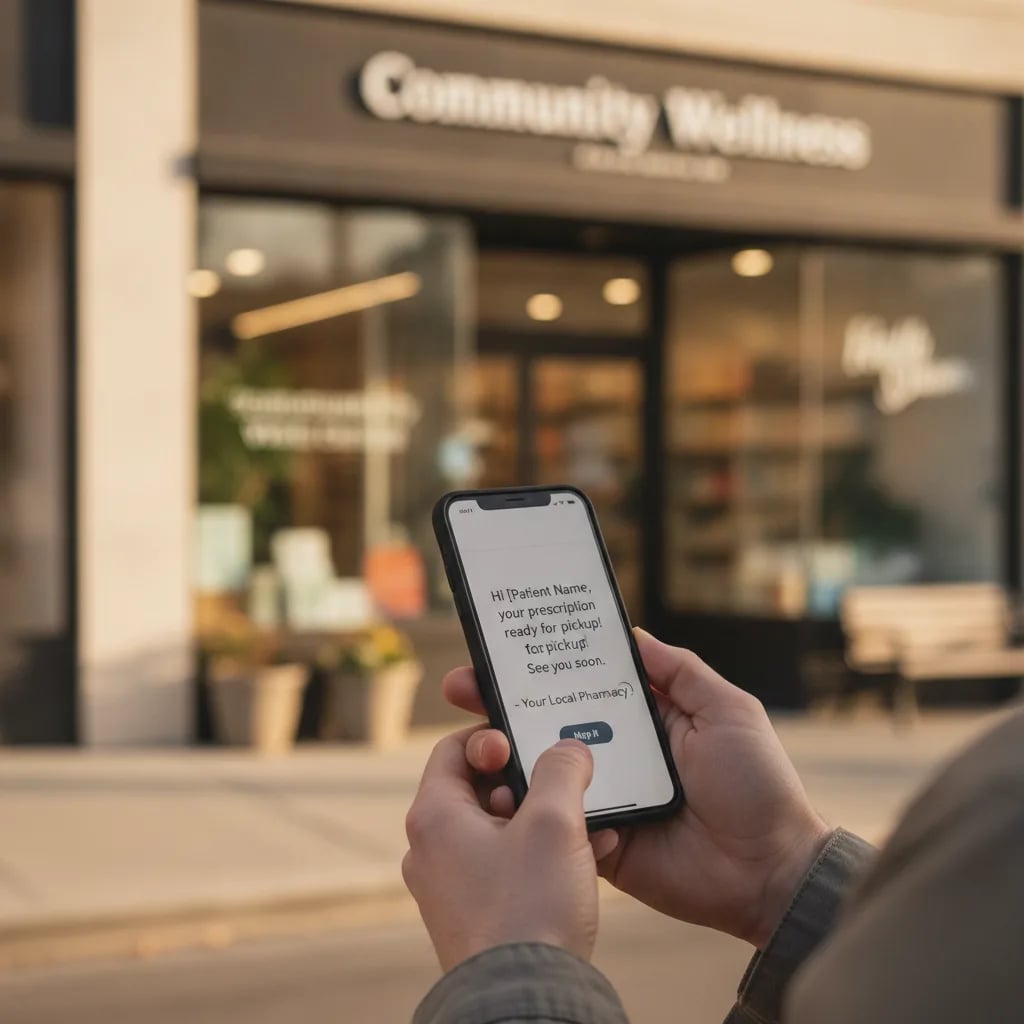
Pharmacy text message marketing reaches a patient in seconds, which is why it has become the fastest owned channel an independent pharmacy can run. A text gets read almost immediately. An email waits for the next inbox check, and a social post hopes the algorithm cooperates.
That speed comes with strings. Business texting is heavily regulated, and a pharmacy that sends without proper consent and carrier registration risks blocked messages, fines, or worse, a HIPAA problem.
This guide sets up pharmacy texting the right way: choosing the messages that matter, collecting opt-ins, registering for 10DLC, staying inside TCPA and HIPAA rules, and writing texts patients act on. Fast channel, built on a compliant foundation. If you'd rather have this handled for you, RevealSite's pharmacy marketing services cover the full setup end to end.
Why does pharmacy text message marketing work so well?
Pharmacy text message marketing works because texts reach patients on the device they check most, almost the moment you send. For time-sensitive messages like a ready refill or an appointment tomorrow, nothing beats a channel patients open within minutes rather than hours.
Compare it to your other channels. A strong email open rate sits around 39% for service businesses, and that's considered good. Texting routinely clears that by a wide margin because a phone buzzing in a pocket is hard to ignore. For a pharmacy, that immediacy maps directly to revenue and care. Gartner research puts that gap in hard numbers: SMS averages a 98% open rate and a 45% response rate, compared with roughly 20% and 6% for email.
The clinical case is just as strong. Roughly half of patients with chronic conditions don't take medications as prescribed, contributing to an estimated $528 billion in avoidable costs, per research in the NIH PMC library. A one-line refill nudge sent at the right moment is among the cheapest interventions you have against that gap. It is a direct, low-cost lever on medication adherence, which is why texting works best as one piece of a broader pharmacy patient engagement strategy rather than a standalone tactic.
How fast each channel reaches a patient
For anything time-sensitive, speed is the whole point.
Text messageFASTEST
Speed: Read within minutes Best for: Time-sensitive alerts
Email
Speed: Read within hours Best for: Newsletters, nurture
Phone call
Speed: Often missed Best for: Complex questions
Use text for urgency, email for depth, calls for complexity.
Decide what your texts will do before you send one. Texting is too immediate and too regulated to use as a broadcast megaphone. Pick a small set of high-value, time-sensitive jobs, and patients will keep the channel open instead of texting STOP.
For most independent pharmacies, four jobs earn their place:
Refill-ready alerts
Pickup reminders for prescriptions sitting on the shelf
Appointment reminders for vaccines and MTM
Short review request after a good visit
Each is timely and useful, which is exactly what keeps an opt-in list healthy. Promotional blasts about a sale do the opposite. The lift from this kind of message is measurable: in a Kaiser Permanente Southern California pilot, Medicare patients who received refill-reminder texts refilled at a 44% rate versus 30% for those who did not, a gap published in JMIR mHealth and uHealth.
Rank them by revenue impact. Refill-ready and pickup reminders recover fills you've already earned, so they pay for the whole program on their own. Layer the rest on once the basics run smoothly. The guide to automated refill reminders for pharmacies goes deeper on timing and channel choices if you want to build this one job out further.
How do you get patients to opt in to texts?
Patients opt in through express written consent collected at clear moments: the pickup counter, your intake form, a web signup, or a keyword they text to your number. For SMS specifically, the consent bar is higher than email, so the ask must be explicit and recorded, never assumed from a phone number on file.
The counter is your best opt-in source. A staff line like "want a text when your prescription is ready?" is genuinely helpful, and most patients say yes on the spot. Capture it on the tablet or POS so consent is logged with a timestamp. Your intake form should include a separate, unchecked box for text messaging, worded plainly.
Give patients a reason and set expectations. "Refill alerts and pickup reminders, a few texts a month" tells them what they're agreeing to. Pharmacies have heavy foot traffic, with 88.9% of Americans living within five miles of one, per the Journal of the American Pharmacists Association, so the opt-in opportunities are there every single day if your team asks. That foot traffic also means most patients already expect two-way texting, a quick reply instead of a callback, so framing the ask that way tends to raise your yes rate.
Need a clean opt-in flow that logs consent properly?
RevealSite builds compliant signup forms and keyword opt-ins for independent pharmacies, so every text you send rests on recorded consent.
Before sending business texts from a standard 10-digit number, you must register for 10DLC, the carrier framework that approves application-to-person messaging. Skip it, and US carriers will filter or block your texts, so the messages you carefully wrote never reach the patient. This step trips up most pharmacies.
What registration actually involves
Registration has two parts: a brand registration that verifies your pharmacy as a legitimate business, and a campaign registration that describes the kind of messages you'll send, such as refill alerts and appointment reminders. Carriers review both before assigning throughput. It usually takes a few business days, and your texting platform or marketing partner submits it on your behalf.
Don't treat this as optional fine print. An unregistered number that starts blasting texts looks like spam to the carrier network and gets throttled fast. Registering once, correctly, is what keeps your delivery rate high for years. It is the single most overlooked step in pharmacy texting, and the one that quietly kills programs that skipped it. If your pharmacy management system already bundles basic texting, such as PioneerRx's RxLocal, Digital Pharmacist, or BestRx, confirm whether that vendor or your team is the one handling 10DLC registration, since assuming it's already covered is a common gap.
The pharmacy texting setup, in order
Each step gates the next. Skip 10DLC and your texts get blocked.
1
Collect opt-in
Express written consent, logged with a timestamp
↓
2
Register 10DLC
Brand + campaign approval before any send
↓
3
Send compliant texts
Pharmacy name, one action, STOP opt-out, no PHI
↓
4
Measure & adjust
Watch delivery, response, and opt-out rate
Collect opt-in, get express written consent, logged with a timestamp, before the first text.
Register for 10DLC, complete brand and campaign registration so carriers approve your messages.
Send compliant texts, pharmacy name, one clear action, working STOP opt-out, no PHI.
Measure and adjust, track delivery, response, and opt-out rate, then refine cadence.
Which phone number type should a pharmacy use for texting?
Most independent pharmacies should register their existing local number for 10DLC rather than buy a new toll-free or short code number. 10DLC keeps the number patients already recognize, works for the message volume a single-location pharmacy sends, and avoids the extra verification and cost of the alternatives.
Toll-free numbers are the middle option. They typically clear carrier review faster than 10DLC and support higher throughput, which suits a pharmacy running multiple locations or a high volume of appointment reminders. The tradeoff is a number patients don't already associate with your pharmacy, and a separate verification process with the toll-free registry.
Short codes sit at the other end: five- or six-digit numbers built for very high volume, national-scale senders. The application process takes weeks, carries a recurring leasing cost, and is built for enterprise senders, not a single independent location. For the refill alerts and pickup reminders this guide focuses on, a short code is almost always more than a pharmacy needs.
Independent pharmacies make up roughly a third of all US retail locations, according to the NCPA 2024 Digest, and the large majority operate from a single storefront. The same NCPA report counted nearly 19,000 independent community pharmacies operating in the US as of mid-2024, almost all single-location businesses rather than multi-site chains. That single-location, moderate-volume profile is exactly what 10DLC on an existing number is built for, which is why it's the default recommendation here rather than a toll-free or short code number.
Number type
Best for
Setup time
10DLC (existing number)
Most independent pharmacies, single location
Typically a few business days
Toll-free
Multi-location or higher-volume senders
Often faster review, separate verification
Short code
National-scale, very high-volume senders
Weeks, plus a recurring lease cost
Step 3: How do you text patients without violating TCPA or HIPAA?
Send only to patients who gave express consent, honor every opt-out immediately, and keep protected health information out of the message body. Two rule sets govern pharmacy texting: the TCPA for consent and contact rules, and HIPAA for anything tied to a patient's health. Respect both and texting stays safe.
The TCPA side mirrors good manners. Get prior express written consent, include your pharmacy's name, offer a clear opt-out like replying STOP, and avoid messaging outside reasonable hours. The FTC's guidance on commercial messaging reinforces the same principles around honest content and easy opt-out that apply across email and text alike. Treat this as the backbone of your pharmacy texting compliance program, not a one-time checklist, since carriers and regulators both revisit these rules over time.
HIPAA is where pharmacies must be most careful. A text should not state a patient's medication name, condition, or that a specific prescription is ready in identifiable detail. The U.S. Department of Health and Human Services treats individually identifiable health information as protected, so use neutral wording like "an order is ready for pickup" and put anything sensitive behind a secure portal link rather than in the SMS body itself.
Keep a record of every opt-in: phone number, date, and consent method. Retain it while the number stays active, plus a buffer after an opt-out.
Texting compliance: TCPA + HIPAA
Two rule sets, one habit built into how you send.
Do
✓Express written consent before the first text
✓Pharmacy name in every message
✓A working STOP opt-out, honored immediately
✓Neutral wording: an order is ready for pickup
Don't
✗Texting a number on file without SMS consent
✗Medication names, diagnoses, or fill details
✗Two requests crammed into one message
✗Sending outside reasonable hours
General guidance, not legal advice. Confirm with your own compliance resources.
A quick texting compliance gut check
Express written consent on file before the first text, never assumed.
Pharmacy name in the message and a working STOP opt-out.
No medication names, diagnoses, or fill details in the text body.
Sensitive information behind a secure link, not in the SMS.
This is general guidance, not legal advice. Confirm your process with your own compliance resources or counsel.
Want texting set up with TCPA and HIPAA handled?
RevealSite manages consent capture, 10DLC registration, and compliant message wording for independent pharmacies, so your team can text patients with confidence.
Write short texts that identify your pharmacy, give one clear action, and respect the patient's time. A text has seconds to land. The best pharmacy messages read as a helpful note from a neighbor, not a marketing campaign squeezed into 160 characters.
Lead with who you are, because an unknown number gets ignored or reported. Then state the single thing you need: a pickup, a reply, a tap to confirm. One message, one action. Burying two requests in one text cuts response on both. Keep your cadence honest too, a few texts a month for most patients, and never let reminders blur into spam.
A few patterns that work in practice:
Refill-ready: "Hi from [Pharmacy] - an order is ready for pickup. Reply C to confirm or call us with questions."
Pickup nudge: "[Pharmacy] - your order has been waiting a few days. Stop by anytime, or reply if you'd like it held longer."
Review request: "Thanks for visiting [Pharmacy]! If we did well, a quick Google review helps neighbors find us: [link]"
The review matters more than it looks. More than 1 in 3 Google reviews are healthcare-related, per a BrightLocal survey, and a polite text is one of the most reliable ways to ask. A one-star bump in your rating can lift calls and directions by 44%, per Semrush local search data.
How do you measure pharmacy text message marketing?
Measure texting on delivery rate, response rate, recovered refills, and opt-out rate, with opt-outs as your early warning system. A rising STOP rate means your cadence or content is wrong long before patients complain. Watch it like a vital sign.
Tie each message type to one outcome. Refill alerts: count recovered fills. Pickup nudges: count shelf orders cleared. Review requests: count new reviews. These business numbers prove value far better than vanity counts. Texting also pairs naturally with the rest of your owned channels, and the same steady discipline that keeps a content calendar consistent applies here. Most dedicated text message marketing platforms surface these numbers automatically, so the real discipline is acting on them, not just collecting them.
Message type
The one metric to watch
Refill-ready alert
Recovered fills
Pickup nudge
Shelf orders cleared
Review request
New Google reviews
Any message
Opt-out (STOP) rate, your warning sign
If the numbers move, expand to more message types. If you can't keep up with consent logging and registration, that's the signal to bring in help. Texting works hardest alongside your other owned channels, and email is the natural partner: service-industry email still averages a 39% open rate, per HubSpot, making it the slower-burn complement to instant SMS. Patients reward pharmacies that make their lives easier, which is largely why patients choose one pharmacy over another. The same goodwill fuels word of mouth, so an engaged texting list also strengthens your pharmacy referral program.
The pharmacies that win with texting treat it as a fast, trusted utility, not a billboard. This channel rewards restraint: the right message, to a patient who opted in, sent the moment it's useful. That is what keeps STOP rates low and pickups high.
Your next step is small. This week, turn on refill-ready alerts with a proper opt-in at the counter, and register your number for 10DLC before the first send. One useful text, sent the right way, is where the whole channel starts. Get pharmacy text message marketing right, and every other channel you run gets easier too.
Texting is powerful, but the setup trips most pharmacies up.
RevealSite handles 10DLC registration, opt-in flows, and compliant message templates for independent pharmacies. See it work in a quick demo.
Pharmacy text message marketing is using opt-in SMS to reach patients with timely messages like refill-ready alerts, pickup reminders, appointment notices, and review requests. Because texts are read within minutes, it is the fastest owned channel an independent pharmacy can run.
Is pharmacy text message marketing HIPAA-compliant?▼
It can be, if you keep protected health information out of the message body. Never state a patient's medication, condition, or specific prescription in identifiable detail. Use neutral wording like an order is ready, and put sensitive information behind a secure portal link.
Do pharmacies need 10DLC registration to text patients?▼
Yes. To send business texts from a standard 10-digit number, you must register for 10DLC, which includes a brand and a campaign registration. Unregistered numbers get filtered or blocked by US carriers, so the texts never reach patients. Your platform submits it for you.
How do I get patients to opt in to pharmacy texts?▼
Ask at the pickup counter, on your intake form, through a web signup, or with a keyword patients text to your number. SMS requires express written consent, so log it with a timestamp and never assume consent from a phone number already on file.
How often should a pharmacy text patients?▼
A few texts a month works for most patients, focused on timely, useful messages rather than promotions. Watch your opt-out rate closely. A rising number of STOP replies signals your cadence or content is wrong before patients formally complain.
What should a pharmacy text message say?▼
Identify your pharmacy first, give one clear action, and keep it short. For example, a refill-ready alert naming the pharmacy with a reply-to-confirm option. Avoid two requests in one text, and never include medication names or health details in the message.
How do I measure pharmacy text message marketing?▼
Track delivery rate, response rate, recovered refills, and opt-out rate. Tie each message type to one outcome: count recovered fills from refill alerts and new reviews from review requests. Opt-out rate is your earliest warning that something needs adjusting.
Should a pharmacy use a toll-free number or 10DLC for texting?▼
Most independent pharmacies should use 10DLC on their existing local number rather than a toll-free number. It keeps the number patients already recognize and easily handles the volume of a single-location pharmacy. Toll-free suits higher-volume, multi-location senders.
How long should a pharmacy keep SMS consent records?▼
Keep consent records for as long as the phone number stays active, plus a reasonable buffer after a patient opts out. Log the phone number, date, and method of consent. TCPA disputes can surface well after the last message was sent.