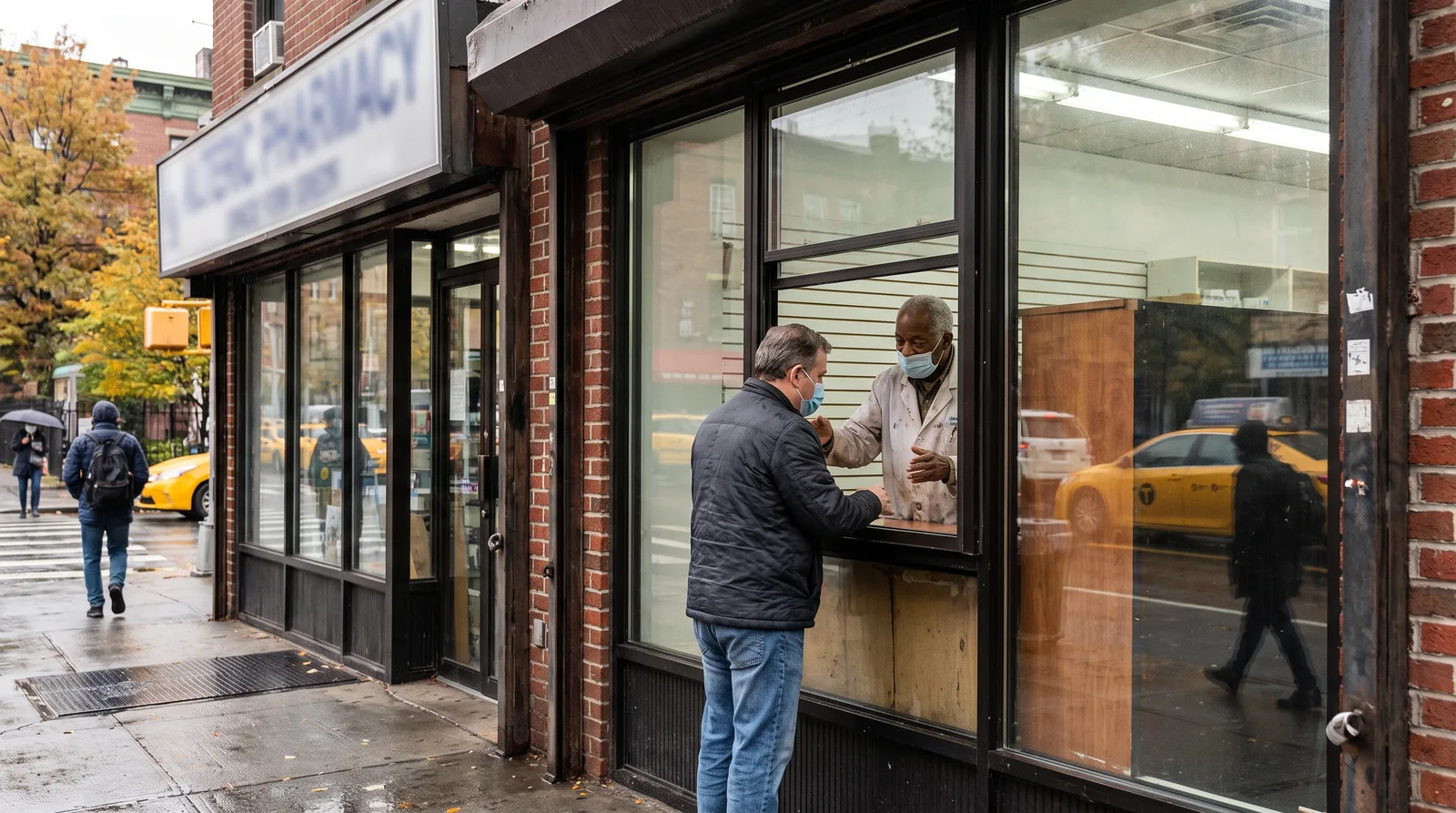
New York Pharmacy Marketing Agency for Independent Stores
RevealSite Team
October 1, 2026 · 10 min read
Key Takeaways
✓Start with your Google Business Profile, because 42% of local searchers click a result in the Maps Pack.
✓Treat New York as many small markets: neighborhood, language, and delivery habits change block to block.
✓Respond to every review, since 88% of consumers will use a business that replies to all of them.
✓Budget for ads separately from agency fees, and use a $66.69 Google Ads cost per lead as a rough yardstick.
✓Ask who owns your website, Google profile, and ad accounts before you sign any contract.
✓Judge the first 90 days on foundation and momentum, then on prescriptions, calls, and direction requests.
A New York pharmacy marketing agency can close the gap between an excellent pharmacist and the patient two blocks away who has never heard of you. Most owners don't have hours to spare for ads, review replies, and website updates. exists for that reason: it works only with independent and compounding pharmacies.
Build the presence your community trusts
Let us be your first step. Get in touch with our team today.
The stakes are real. The NCPA 2024 Digest counted 18,984 independent community pharmacies in June 2024, down from 19,432 a year earlier. Independents still make up 35% of US retail pharmacies, but each one has to earn its visibility.
This guide covers what an agency does, why New York is its own market, which channels pay off, how to measure results, and how to pick a partner without compliance surprises.
What Does a New York Pharmacy Marketing Agency Do for Independent Stores?
A pharmacy marketing agency in New York plans and runs the digital work that brings local patients to your counter, including your website, Google Business Profile, reviews, ads, social media, email, and content. Think of it as an outsourced marketing department that understands prescriptions, services, and privacy rules.
The work splits into two halves. Infrastructure comes first: a fast, mobile-friendly website, a complete Google profile, and accurate listings. Active marketing sits on top, with campaigns that promote flu shots, medication synchronization, compounding, delivery, and other services patients can't find at a chain counter.
Typical deliverables include:
Website and local SEO: pages for each service and neighborhood you serve, plus schema markup so search engines understand your pharmacy.
Google Business Profile management: categories, hours, posts, photos, and Q&A kept current.
Reputation work: review requests and replies written with patient privacy in mind.
Paid and social campaigns: Google Ads, Facebook, and Instagram, tuned to your service area.
Content and email: patient education, newsletters, and short videos that position your pharmacist as the local expert.
That's a lot for a two-pharmacist store to handle alone. For a closer look at scope and timelines, read what independent pharmacy marketing services typically include.
Why Is Marketing an Independent Pharmacy in New York Different?
New York compresses dense neighborhoods, heavy chain presence, many languages, and delivery expectations into small areas, so marketing has to be hyper-local. A campaign that works in Buffalo won't automatically work in Brooklyn.
Foot traffic and transit shape how New York patients choose a neighborhood pharmacy.
Patients choose pharmacies on convenience first. Nearly 70% of Americans pick a pharmacy for its location and its weekend or evening hours, according to the 2024 CVS Health and Harris Poll Rx Report. In a city where several chain locations can sit within a few blocks, convenience alone rarely sets you apart.
Trust does that work. A 2024 Wolters Kluwer Pharmacy Next survey found that 58% of Americans would first seek non-emergency care at a pharmacy. Your pharmacist's face, language skills, and neighborhood knowledge are the story. Your marketing has to tell it.
Four local factors that shape your strategy
Neighborhood-level competition. Patients in Astoria, Park Slope, and along the Grand Concourse search differently and compare different options.
Language. Spanish, Chinese, Russian, Haitian Creole, and Bengali are common across the five boroughs. Bilingual pages and ads can reach whole patient groups that chains overlook.
Delivery and walk-up habits. Many patients rely on transit or foot traffic, so same-day delivery is a real selling point. See how pharmacy delivery service marketing turns that service into new patients.
Regional spread. Long Island, the Hudson Valley, and upstate cities like Rochester, Syracuse, and Albany behave nothing like Manhattan.
A good agency maps these differences before it spends a dollar. Ask how it would treat your block, not just your borough.
See how RevealSite builds a local search foundation for pharmacies
RevealSite pairs pharmacy websites with Google Business Profile and local SEO work, so patients in your neighborhood can find you when they search.
How Does Local SEO Help New York Pharmacies Win 'Near Me' Searches?
Local SEO places your pharmacy in Google's map results when patients search for a pharmacy nearby. Because 42% of local searchers click a result in the Maps Pack, according to Backlinko, your Google Business Profile often matters more than your homepage.
Intent is the reason. The same research found that 76% of people who run a 'near me' search visit a related business within one day. Those patients are ready to walk in.
Position matters just as much. Data from Semrush local SEO statistics, citing SOCi, shows that businesses in the local 3-pack get 126% more traffic and 93% more calls, clicks, and direction requests than those in positions 4 to 10.
And here's a twist. Most searches don't include your name at all: roughly 5.9 million US keywords contain 'near me,' driving about 800 million US searches a month, according to JS Interactive's local SEO statistics. Most patients don't know your name yet.
Three basics move the needle first:
Complete your Google Business Profile. Choose accurate categories, list every service, add photos, and post weekly.
Build service and neighborhood pages. A page about flu shots in Bay Ridge earns different searches than a generic services page.
Keep your name, address, and phone number identical everywhere. Inconsistent listings confuse both patients and search engines.
Local SEO builds gradually. It's also the channel that keeps working between campaigns, which is why it anchors most pharmacy plans.
Which Channels Should a New York Pharmacy Marketing Agency Run Beyond SEO?
A balanced plan pairs local SEO with review generation, Google Ads, Facebook and Instagram campaigns, email, and patient-education content. Start with channels closest to a decision, such as map listings and search ads, then add awareness channels as your budget grows.
Channel
Main use
What to track
Local SEO and Google Business Profile
Patients searching 'pharmacy near me'
Calls, directions, website clicks
Review generation
Trust and map ranking
Review count, star rating, response rate
Google Ads
Urgent needs like flu shots or compounding
Cost per lead, calls booked
Facebook and Instagram
Service awareness and community presence
Reach, cost per lead, messages
Email and newsletters
Refills, vaccines, retention
Open rate, click-through, store visits
Reviews deserve extra attention. BrightLocal's 2024 survey found that 88% of consumers will use a business that responds to all reviews, versus 47% for one that ignores them. A pharmacy can't discuss care details publicly, so replies must be warm, brief, and free of protected health information.
Paid search needs a realistic budget. WordStream's 2024 benchmarks put Google Ads cost per lead at $66.69 across industries, versus $21.98 on Facebook lead ads for service businesses. Pharmacy results vary, so treat those figures as a starting yardstick, not a forecast.
One caution on Meta. Facebook and Instagram policies on prescription-medication content are strict, and pages can be restricted without much warning. Ask any agency how it keeps ad copy and posts inside those rules.
Put the RevealSite marketing team to work for your pharmacy
RevealSite runs Google Ads, social media, email, and review campaigns as an outsourced department built for independent pharmacies.
What Should You Expect to Pay and Measure From a Pharmacy Marketing Agency?
Expect a monthly retainer or tiered package, with ad spend billed separately, and judge the agency on prescriptions, calls, and direction requests instead of impressions. Pricing varies by location and services, so insist on a written scope before you sign anything.
Calls and direction requests tell you more than raw website clicks.
Common pricing structures include:
Flat monthly retainer covering a defined list of deliverables.
Tiered packages that add channels as you grow.
One-time build fees for a new website, billed apart from monthly work.
Ad spend paid directly to Google or Meta, separate from agency fees.
Avoid any contract that hides ad spend inside the retainer. You can't judge efficiency if you can't see where the dollars go.
Then there's measurement. Clicks are easy to count, but they aren't prescriptions. Track the numbers that tie back to your counter: phone calls from your Google profile, direction requests, refill-form submissions, and new patient transfers. Ask every new patient how they found you, and log the answer.
Measurement is also shifting. Pew Research Center found that users click a traditional result on just 8% of visits when Google shows an AI summary, versus 15% without one. Visibility can matter even when no click happens, so ask your agency to report profile views and branded searches next to traffic.
How Do You Choose a New York Pharmacy Marketing Agency Without Risking Compliance?
Choose an agency that works only with pharmacies, explains how it handles HIPAA and patient data, shows pharmacy case studies, and reports on prescriptions instead of vanity metrics. Get contract terms and account ownership in writing before you start.
Pharmacy marketing carries risks that general agencies often miss. Patient reviews, intake forms, and retargeting audiences can all touch protected health information. New York adds its own data-security law, the SHIELD Act, on top of HIPAA. Your attorney should confirm what applies to your pharmacy, and your agency should be able to explain its process plainly.
Option
Strength
Trade-off
In-house hire
Knows your store day to day
One person can't cover SEO, ads, design, and content
Freelancer
Flexible, with lower overhead
Coverage gaps and limited capacity
General agency
Broad creative range
Thin pharmacy and compliance knowledge
Pharmacy specialist
Industry and privacy know-how
Fewer references outside pharmacy
Ask these five questions before you sign:
How many independent pharmacies do you serve today?
How do you handle patient data in forms, reviews, and ad audiences?
Who owns the website, Google profile, and ad accounts if we part ways?
What will you report each month, and what counts as a win?
What's the minimum contract length, and how do we exit?
What Does a 90-Day Launch Plan Look Like for a New York Independent Pharmacy?
A 90-day launch moves from audit and fixes in month one, to local SEO and review momentum in month two, to paid campaigns and reporting in month three. The order matters because ads work harder once your profile and website convert visitors.
A written 90-day plan keeps everyone focused on the same milestones.
Days 1 to 30: audit and repair. Review your website, Google profile, listings, and reviews. Fix wrong hours, missing categories, and slow mobile pages.
Days 31 to 60: build visibility. Launch service and neighborhood pages, start review requests, and publish your first Google profile posts.
Days 61 to 90: add campaigns and reporting. Turn on Google Ads for high-intent searches, test one social campaign, and agree on a monthly scorecard.
Picture a two-location independent in Queens. Month one fixes a wrong Saturday-hours listing and a clunky refill form. Month two adds Spanish-language service pages. Month three promotes flu shots with a modest search budget. None of it is flashy. All of it compounds.
Set expectations early. Local rankings and reviews take months to build, so judge the first quarter on foundation and momentum, not a final verdict.
Visibility in New York builds neighborhood by neighborhood and review by review. A good agency earns its fee by making your pharmacy easy to find, easy to trust, and easy to reach on the first search.
Start with one move this week: search 'pharmacy near me' from your own block and see who appears. If it isn't you, that gap is your first project. Then talk with a team that works only with independent pharmacies.
Ready to be the pharmacy your neighborhood finds first?
RevealSite builds websites, local SEO, and campaigns for independent pharmacies. Request a free demo to see where your pharmacy stands today.
How much does a New York pharmacy marketing agency cost?▼
Costs vary by number of locations and services, and most agencies charge a monthly retainer or tiered package. Ad spend is usually billed separately. Ask for a written scope that lists deliverables, fees, and contract length so you can compare proposals fairly.
Do I need an agency based in New York for my independent pharmacy?▼
No, but local knowledge helps. A pharmacy-only agency can learn your neighborhoods, languages, and competitors, whether it sits in New York or elsewhere. Ask how it researches your block, and which independent pharmacies it already serves.
How long does pharmacy SEO take to work in New York?▼
Most pharmacies see early movement in Google Business Profile activity within a few months, while stronger map rankings take longer. Dense markets like New York City are competitive, so judge the first quarter on foundation, review growth, and profile actions rather than final rankings.
Can a pharmacy marketing agency stay HIPAA compliant?▼
Yes, when it limits protected health information in reviews, forms, and ad audiences, and follows documented processes. Ask how it handles patient data, then have your attorney confirm what applies to your pharmacy under HIPAA and New York's SHIELD Act.
Should I hire an agency or a freelancer for pharmacy marketing?▼
A freelancer fits a narrow task, such as a website refresh. An agency fits ongoing work across SEO, ads, reviews, and content because it spreads the load across specialists. Choose based on how many channels you need covered each month.
Can marketing help an independent pharmacy compete with chain pharmacies in New York?▼
Yes, because independents can win on service, language, delivery, and relationships that chains rarely match. Marketing makes those strengths visible in local search, reviews, and campaigns, so patients see a clear reason to choose your pharmacy over the closest chain.