Pharmacy SEO: The Complete Guide for Independent Pharmacies
RevealSite Team
May 6, 2026 · 14 min read
Key Takeaways
✓Businesses earn an average of $22 in revenue for every $1 spent on SEO, delivering a 550% average ROI that outperforms most paid advertising channels over time.
✓42% of all local searchers click a result inside the Google Maps Pack, making Google Business Profile optimization the most impactful single activity in pharmacy SEO.
✓Each pharmacy service should have its own dedicated website page targeting a local keyword like 'compounding pharmacy in [city]' to capture service-specific search traffic.
✓Pharmacies responding to every Google review see 88% consumer willingness to use them, versus just 47% for pharmacies that ignore reviews, according to BrightLocal's 2024 data.
✓Content-driven SEO takes 3-6 months to produce ranking improvements, but the traffic compounds over time and doesn't stop when you pause your budget.
Build the presence your community trusts
Let us be your first step. Get in touch with our team today.
Pharmacy SEO determines whether patients in your area find you or drive past your door to a chain location that showed up first on Google. It's not a luxury marketing tactic. For most independent pharmacies, it's the single highest-return investment available, and it works around the clock without a monthly ad budget attached.
Here's the core problem: Backlinko's analysis of Google data shows that 76% of consumers who search "near me" visit a related business within 24 hours. If your pharmacy isn't ranking in those results, you're invisible during the exact moment a patient is ready to act. This guide covers everything you need to fix that: local search, Google Business Profile, on-page optimization, authority building, content strategy, and how to measure what's actually working.
Why Does Pharmacy SEO Matter More Than Paid Ads Alone?
Pharmacy SEO builds a patient acquisition channel that compounds over time instead of disappearing the moment you stop paying. Paid ads generate leads immediately, but the traffic stops when the budget stops. SEO traffic keeps flowing because the rankings you build are persistent assets, not rented placements.
Conductor's 2025 State of SEO research found that businesses earn an average of $22 in revenue for every $1 spent on SEO. That's a 550% average ROI. Compare that to Google Ads, where WordStream's 2024 benchmarks put the average cost-per-lead at $66.69 across all industries. Both channels have a place in your marketing strategy, but organic search is the foundation that makes every other channel more effective.
SEO (Organic Search)
Paid Ads (Google/Facebook)
Average ROI
$22 per $1 spent (550%)
Varies; avg CPL $66.69 (Google Ads)
Time to Results
3-6 months for content; 30-60 days for GBP
Immediately once campaigns launch
When You Stop Paying
Traffic continues from existing rankings
Traffic stops immediately
Cost Structure
Fixed monthly investment in optimization
Per-click or per-lead; scales with budget
Compounds Over Time
Yes — each page and review builds on the last
No — results reset when budget pauses
Best For
Long-term patient acquisition foundation
Launching new services, seasonal promotions
There's a broader shift happening too. SparkToro's 2024 Zero-Click Search Study found that 58.5% of all US Google searches end without a click to the open web. Google is answering more queries directly on the search results page through featured snippets, AI Overviews, and knowledge panels. For your pharmacy, this means two things:
Your Google Business Profile matters more than ever. Map pack results, reviews, and GBP posts are all visible without a click. If your profile is thin, you're losing patients before they even reach your website.
Structured, answer-ready content wins. Blog posts and service pages that directly answer patient questions in the first paragraph are more likely to be featured in snippets and AI summaries. Generic content gets buried.
The pharmacies investing in search optimization now are building a moat that gets wider every month. The ones waiting are falling further behind competitors who started six months ago. And the gap is harder to close than most owners realize, because SEO rewards accumulated effort. A site with 50 optimized pages, 200 reviews, and 12 months of content history has a ranking advantage that a brand-new effort can't overcome overnight.
How Does Local SEO Drive New Patients to Your Pharmacy?
Local SEO is the most important subset of pharmacy SEO because pharmacy services are inherently local. No one drives 45 minutes for a flu shot. Patients search for what they need nearby, and Backlinko reports that 42% of all local searchers click a result inside the Google Maps Pack. Winning that map placement is the fastest path to new patients.
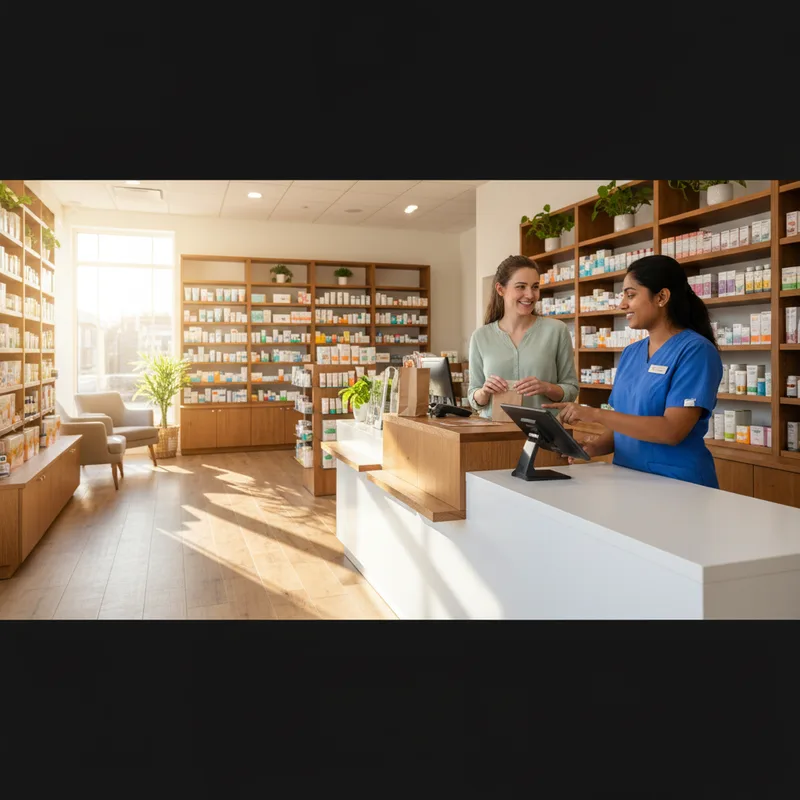
Local SEO puts your pharmacy on the map when patients search for services nearby.
Google Business Profile Optimization
Your Google Business Profile is the single most valuable asset in your local search strategy. It controls what patients see in the map pack, the knowledge panel, and "near me" results. Birdeye's 2025 State of Google Business Profiles report found that 86% of profile views come from discovery searches like "pharmacy near me," not branded queries. Patients aren't searching for your name. They're searching for what you do.
Complete every field: business name, address, phone, hours (including holiday hours), every service category that applies, and a detailed business description. Upload fresh photos monthly. Post weekly updates about flu shot availability, new services, or seasonal health reminders. Each post and photo signals freshness to Google's algorithm. Chain pharmacies rarely update their profiles more than once a quarter. That's your opening.
"Near Me" Keyword Strategy
Semrush's 2024 data shows businesses in Google's local 3-pack receive 126% more traffic and 93% more calls than positions 4-10. The keywords driving those results are variations of "[service] near me" and "[service] in [city]." For your pharmacy, that means targeting phrases like "pharmacy near me," "compounding pharmacy in [city]," "flu shot walk-in [city]," and "24 hour pharmacy [city]."
You don't need to stuff these phrases into every page. Google understands local intent from your GBP listing, your NAP (name, address, phone) data, and your website's location signals. But you do need dedicated service pages on your site that mention the city and service naturally. More on that in the next section.
Local Citations and NAP Consistency
A local citation is any online mention of your pharmacy's name, address, and phone number. Directories like Yelp, Healthgrades, the Better Business Bureau, and pharmacy-specific listings all count. The key rule: your NAP must be identical everywhere. "123 Main St" on your GBP and "123 Main Street" on Yelp is a mismatch that confuses Google's location algorithms. Audit your top 20 citations once a year and fix any inconsistencies you find.
One tactic that works particularly well for pharmacies: claim your profiles on healthcare-specific directories like Healthgrades, Vitals, and your state board of pharmacy's public listing. These carry extra authority weight because Google treats healthcare directories as high-trust sources. Also, make sure your pharmacy appears in Apple Maps and Bing Places, not just Google. Patients using iPhones default to Apple Maps for directions, and missing from that index means missing a meaningful share of local traffic that would have walked through your door.
Need Help With Local SEO?
RevealSite builds pharmacy websites paired with Google Business Profile optimization, so you rank for "pharmacy near me" in your service area.
What On-Page SEO Should Every Pharmacy Website Get Right?
On-page SEO covers everything on your actual website that affects how Google understands and ranks your pages. For independent pharmacies specifically, the biggest wins come from service page architecture, keyword targeting, and technical fundamentals that most pharmacy websites still get wrong.
Service Page Architecture
Every service your pharmacy offers should have its own dedicated page. Don't lump compounding, immunizations, MTM, pet medications, and point-of-care testing onto a single "Services" page. Each service page should target a specific local keyword in its title tag, meta description, H1 heading, and body text. The NCPA 2024 Digest reported that 81% of independent pharmacies offer MTM. If you're one of them, you need a page targeting "medication therapy management [city]" so patients searching for that service can find you.
A strong service page includes:
A clear H1 heading with the primary keyword and your city name
A 2-3 sentence overview answering "what is this service and who is it for"
Practical details patients need: hours, pricing, insurance accepted, what to bring
Your pharmacy's full NAP (name, address, phone) matches your GBP exactly
A prominent call-to-action to call or visit
Schema markup identifying the page as a MedicalBusiness or Pharmacy service
Keep service pages under 800 words. Patients want answers, not essays.
Title Tags and Meta Descriptions
Your title tag is the blue link patients see in search results. Keep it under 60 characters and put the primary keyword near the front. Example: "Compounding Pharmacy in Austin, TX | [Pharmacy Name]." Your meta description is the gray text below the title. Keep it under 155 characters, include the keyword, and write it like a mini-ad that makes patients want to click. These two elements have an outsized impact on click-through rates from search results.
Mobile Optimization and Page Speed
Google completed its mobile-first indexing rollout in July 2024. Every site is now ranked based on its mobile version first. Statista reported that mobile devices generated 62.54% of global website traffic in Q4 2024. If your pharmacy website loads slowly on a phone, has text that's too small to read, or has buttons too close together to tap accurately, you're penalizing yourself in the rankings and losing patients who give up before the page finishes loading.
Run your site through Google's PageSpeed Insights. Fix anything flagged as "poor" for Core Web Vitals, particularly Largest Contentful Paint (LCP) and Interaction to Next Paint (INP). These are the metrics Google uses to evaluate how your site feels to real users. A site that scores "good" on all three Core Web Vitals has a measurable ranking advantage over competitors that don't.
Image optimization is another quick win most pharmacy websites miss. Compress all images to WebP format, add descriptive alt text to every photo (including team headshots and storefront images), and make sure no single image file exceeds 200KB. These changes typically improve page load speed by 30-50% and give Google additional context about your site's content through the alt text.
How Do You Build Authority and Trust Signals for Pharmacy SEO?
Authority signals tell Google that your pharmacy is a credible, trustworthy business that deserves to rank above competitors. The three strongest authority signals for local search are online reviews, structured data markup, and consistent local citations.
Every positive patient interaction can become a review that strengthens your local search rankings.
Online Reviews
Reviews affect both rankings and conversions directly. BrightLocal's 2024 survey found that 88% of consumers will use a business that responds to all its reviews, versus just 47% for businesses that don't respond. Semrush's local SEO data cited research showing a one-star improvement in average Google rating boosts calls, clicks, and direction requests by 44%.
Build a review habit: ask every satisfied patient at checkout, respond to every review within 48 hours, and never disclose protected health information in your responses. Volume matters more than perfection. A pharmacy with 150 reviews and a 4.7 average will outrank a competitor with 15 reviews and a perfect 5.0 every time. BrightLocal's 2025 data shows 85% of consumers now use Google specifically to find local business reviews. That percentage has increased every year for the past five years.
Schema Markup and Structured Data
Schema markup is code you add to your website that helps Google understand exactly what your pharmacy offers. Add LocalBusiness and Pharmacy schema to your homepage, and MedicalBusiness schema to your service pages. Include your name, address, phone, hours, services offered, and accepted insurance networks. Schema won't dramatically change your rankings on its own, but it can trigger rich results in search (stars, hours, phone number displayed directly) that increase your click-through rate from the results page.
E-E-A-T for Pharmacy Websites
Google evaluates healthcare content through its E-E-A-T framework: Experience, Expertise, Authoritativeness, and Trustworthiness. For your website, this means clearly identifying the pharmacist or pharmacy team, including credentials and licensing information, linking to authoritative health sources when citing medical information, and maintaining HTTPS encryption. An About page with pharmacist bios and credentials isn't vanity. It's an SEO asset that signals expertise to Google's quality algorithms.
Build Your Pharmacy's Online Authority
RevealSite manages review generation, reputation monitoring, and local visibility campaigns for independent pharmacies.
Content is how you rank for the hundreds of long-tail keywords that service pages alone can't cover. Every blog post creates a new indexed page targeting a specific search query, and over time, those pages build a web of topical authority that lifts your entire site's rankings, including your service pages and homepage.
Blog Topic Selection
Write about what your patients actually ask at the counter. Medication interactions, supplement safety, blood pressure management, immunization schedules, chronic disease tips, and medication storage questions all make strong blog topics. Each post should target a specific long-tail keyword like "can I take ibuprofen with blood pressure medication" or "what to expect at a flu shot appointment." Semrush's 2024 content data found that businesses publishing 16 or more posts per month generate 4.5 times more leads than those publishing sporadically.
You don't need 16 posts. That's enterprise volume. Two to four well-researched articles per month is a strong cadence for a single pharmacy. Consistency matters more than volume. A pharmacy that publishes two posts per month for 12 months has 24 indexed pages working for it. That's 24 chances to rank for patient questions your competitors aren't answering.
Internal linking between blog posts and service pages is the step most pharmacy websites skip entirely. When your blog post about "managing type 2 diabetes with medication" links to your MTM service page, it passes ranking authority from the blog to the service page and helps Google understand the topical relationship between them. Every blog post should link to at least one relevant service page. This is free SEO value that requires nothing more than adding a sentence with a link.
Content Structure for AI and Search
Structure every post so the answer appears in the first paragraph. AI search engines and Google's featured snippets pull short, direct answers from the top of the page. Follow the answer with supporting detail, data points, and practical guidance. Use H2 headings phrased as questions whenever possible, because Google matches question-format headings to voice search and AI queries at a higher rate than declarative headings.
Blog content feeds your email strategy too. HubSpot's 2025 benchmarks show B2B services averaging a 39.48% open rate. Repurpose your strongest blog posts into a monthly patient newsletter. This drives repeat traffic to your site (a positive ranking signal), keeps your pharmacy top-of-mind between visits, and gives patients a reason to share your content with family and friends.
RevealSite's Creative & Content service handles blog production, social media, and email newsletters for pharmacies that don't have the bandwidth to produce content in-house.
How Do You Measure Pharmacy SEO Performance?
Measuring SEO performance means tracking the metrics that connect your optimization work to actual patient acquisition. Without measurement, you're guessing which efforts matter, and guessing leads to wasted time on tactics that feel productive but don't move the needle.
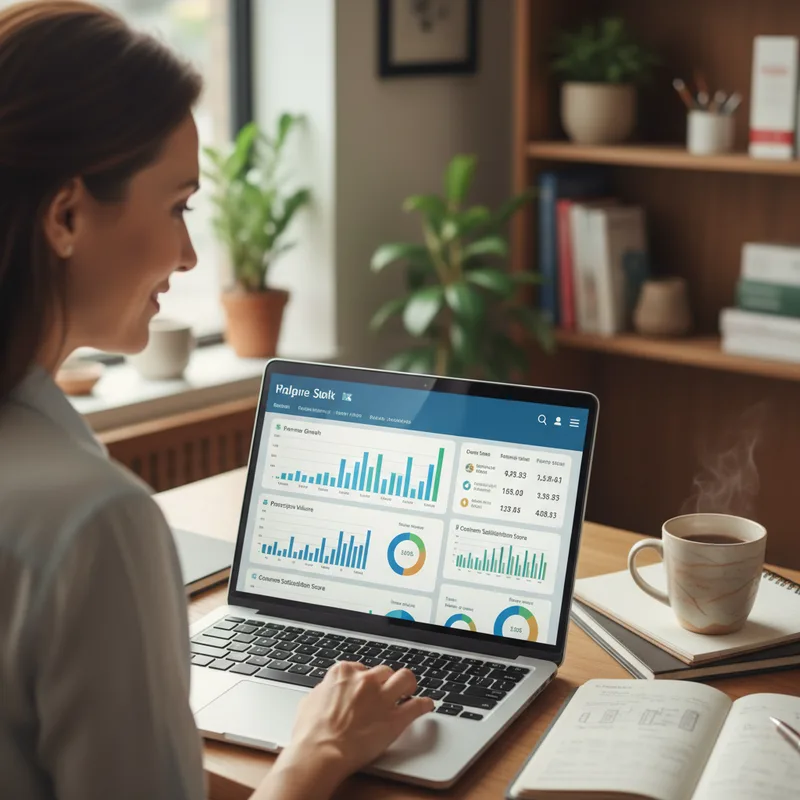
Monthly tracking of GBP actions and organic traffic reveals which SEO efforts are paying off.
The Monthly SEO Dashboard
Track these numbers every month:
Google Business Profile actions: calls, direction requests, and website clicks from your GBP. This is your best proxy for local search performance. A month-over-month increase means your local visibility is improving.
Organic traffic: check Google Analytics for sessions from organic search. Filter by landing page to see which service pages and blog posts drive the most traffic.
Keyword rankings: use Google Search Console or a rank tracker to monitor your position for target keywords like "pharmacy near me" and your service-specific terms. Focus on movement trends, not daily fluctuations.
Review volume and average rating: track new reviews per month and your running average. Both influence map pack rankings directly.
New patient inquiries: calls, form fills, and walk-ins attributed to online discovery. Ask new patients how they found you. That single intake question generates attribution data no analytics tool can replicate.
Realistic Timeline Expectations
GBP optimization produces visible changes in 30-60 days. On-page improvements like title tags, service pages, and technical fixes typically take 60-90 days to affect rankings. Blog content and link building are the slowest channels, usually taking 3-6 months to produce meaningful organic traffic increases. But here's the tradeoff worth accepting: paid ads stop the moment you stop paying, while SEO compounds. The blog post you publish this month can drive traffic for years.
If you're starting from scratch with no optimization history, expect the first 90 days to feel slow. That's normal. The ranking improvements accelerate as Google builds confidence in your site's authority and you accumulate content, reviews, and citation signals. The pharmacies seeing the biggest returns in 2026 started 12-18 months ago and stayed consistent.
A useful benchmark: most independent pharmacies see their GBP calls and direction requests increase by 15-30% within the first 90 days of active optimization. Organic website traffic from blog content typically doubles between months 6 and 12. These aren't guarantees, but they're realistic expectations based on patterns across pharmacy clients in competitive suburban and small-city markets.
The most common mistake isn't choosing the wrong tactic. It's quitting after 60 days because the results haven't matched expectations yet. Pharmacy SEO is a compounding investment. If you're starting now, pick one area: your Google Business Profile, your service pages, or your review strategy. Execute it well for 90 days, then layer on the next priority. The pharmacies that built this way are the ones dominating local search today.
Ready to Invest in SEO That Compounds?
See how RevealSite builds search foundations that bring patients to independent pharmacies month after month.
Google Business Profile optimizations can produce measurable increases in calls and direction requests within 30-60 days. On-page SEO and blog content typically take 3-6 months to rank. The timeline depends on local competition and how much optimization your site needs upfront.
How much does pharmacy SEO cost?▼
Professional pharmacy SEO services typically range from $500 to $2,500 per month depending on scope. Google Business Profile optimization alone can be done in-house for the cost of staff time. The average ROI is $22 for every $1 spent on SEO.
What is the most important part of pharmacy SEO?▼
Google Business Profile optimization. It directly controls your visibility in the local map pack where 42% of local searchers click. Complete every field, add photos monthly, post weekly updates, and actively manage your reviews.
Do pharmacies need a blog for SEO?▼
A blog is not strictly required but significantly improves organic rankings over time. Each blog post creates a new indexed page targeting a specific keyword. Pharmacies publishing consistently see measurably more organic traffic than those relying on service pages alone.
Can a small independent pharmacy outrank CVS or Walgreens in local search?▼
Yes. Chain pharmacy Google profiles are managed by distant corporate teams and updated infrequently. An independent pharmacy with a complete GBP, active review management, and service-specific website pages can outrank nearby chain locations in the local map pack.
What keywords should pharmacies target for SEO?▼
Start with local service keywords: 'pharmacy near me,' 'compounding pharmacy in [city],' 'flu shot walk-in [city].' Then expand into patient education topics your audience searches for, like medication management or chronic condition questions.