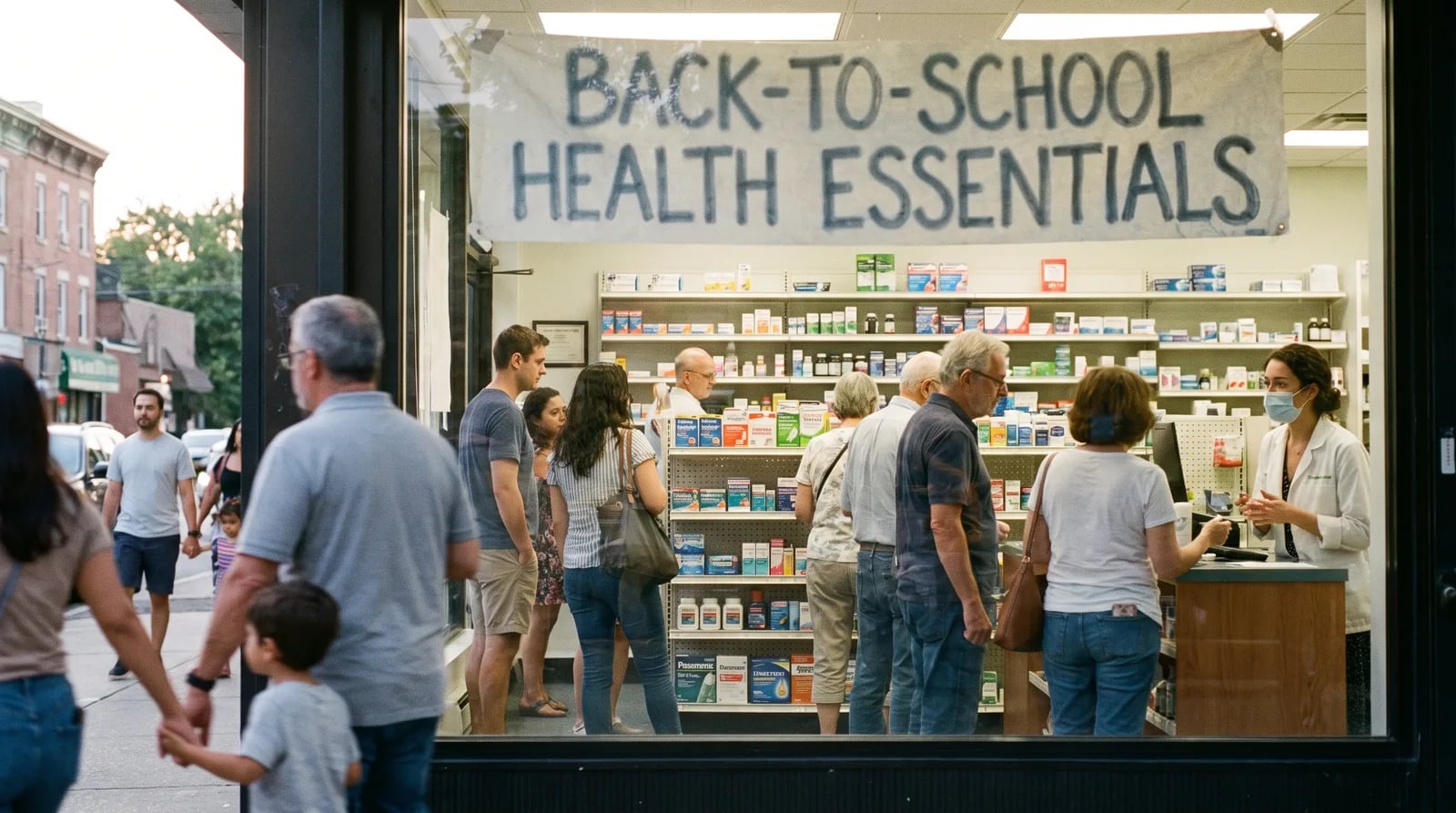
How to Win Back-to-School Pharmacy Marketing Season
RevealSite Team
July 14, 2026 · 9 min read
Key Takeaways
✓Launch back-to-school campaigns by mid-July, since most parents start scheduling vaccinations four to six weeks before the first day of school.
✓School vaccine requirements vary by state, so pull your state's specific list before writing any campaign copy.
✓ADHD medication refills need earlier reminders than usual because stimulant prescriptions often require new prior authorizations each school year.
✓76% of content marketers use blogs to generate leads, and businesses publishing 16+ posts monthly generate 4.5x more leads, according to Semrush.
✓Track vaccination appointments booked, refill reminders converted, and website traffic from campaign-specific pages to measure real success, not just impressions.
✓Layer email, social, and in-store signage together rather than relying on a single channel for back-to-school messaging.
Build the presence your community trusts
Let us be your first step. Get in touch with our team today.
Back-to-school pharmacy marketing has a short runway. Parents start scheduling vaccine appointments and refilling ADHD prescriptions weeks before the first bell rings, and pharmacies that wait until August are competing with a flooded inbox and a shrinking window to convert.
This playbook covers what to promote (vaccines, ADHD refills, allergy meds, and school supplies), which channels actually work for each, and how to know afterward whether the campaign paid off. It builds directly on the seasonal framework from RevealSite's pharmacy marketing calendar, so if you haven't built your full-year plan yet, that's the place to start.
What Is Back-to-School Pharmacy Marketing?
Back-to-school pharmacy marketing is a focused campaign promoting school vaccine requirements, ADHD medication refills, and seasonal supplies during the July through September window. It differs from general seasonal marketing because it has a hard deadline: the first day of school. Miss that window and the urgency behind your messaging disappears overnight.
Most independent pharmacies treat this as a single push in August, which is exactly the problem. Parents who wait until the week before school starts often can't get a vaccine appointment anywhere, chain or independent, because everyone is booking at once. Pharmacies that start in July capture the patients who plan ahead, and those patients tend to be more loyal year-round. Independents represent 35% of all US retail pharmacies, according to the NCPA 2024 Digest. Repeat patients are what keep that share steady against the chains.
Your RevealSite marketing services should treat this as its own mini-campaign with a start date, not a footnote inside your regular social calendar. Give it a dedicated landing page, a specific email sequence, and its own budget line.
Which School Vaccine Requirements Should Pharmacies Promote?
Pharmacies should promote the vaccines their state requires for school enrollment, typically Tdap, meningococcal, and varicella, alongside recommended options like the flu shot. Requirements shift by state and grade level, so pull your current state health department list before writing a single word of campaign copy.
Confirm your state's specific requirements by grade (kindergarten, 7th grade, and college entry often carry different rules)
Check for any new requirements added since last school year, since state legislatures update these regularly
Note which vaccines require multiple doses spaced weeks apart, since those need earlier outreach than a single-dose shot
Vaccine Type
Typical Grade Requirement
When to Promote
Tdap
Often required at 7th grade entry
Early July
Meningococcal
Often required at 7th and 12th grade
Early July
Varicella
Kindergarten entry (if not previously had chickenpox)
Mid-July
Flu (recommended)
Not typically required, widely recommended
Late August into September
Always confirm current requirements against your state health department or the CDC's SchoolVaxView data before finalizing any campaign copy. Requirements change often enough that last year's flyer can be wrong this year. Building trust matters just as much as accuracy here: pharmacists remain one of the most effective sources for countering vaccine hesitancy among parents, according to a recent Pharmacy Times feature on back-to-school vaccinations.
Vaccine campaigns need more than a flyer
RevealSite's Creative & Content team builds the landing pages, email sequences, and reminders that turn vaccine awareness into booked appointments.
How Should Pharmacies Market ADHD Medication Refills for Back-to-School?
Pharmacies should send ADHD refill reminders in early July, since many stimulant prescriptions require a new prior authorization each school year. This is earlier than most other back-to-school messaging because insurance approval alone can take one to two weeks, sometimes longer if the prescriber's office is slow to respond.
Parents don't always realize their child's ADHD prescription needs fresh paperwork until the pharmacy tells them. That makes this one of the few back-to-school messages where you're providing information the patient genuinely didn't know, not just reminding them of something obvious. Frame the message around avoiding a gap in medication during the first week of school, when routine and focus matter most.
Flag patients with ADHD prescriptions in your system by late June
Send a direct message (not a blanket email) explaining the prior authorization timeline
Offer to contact the prescriber's office directly if authorization hasn't come through by early August
Follow up by phone for any patient who hasn't responded to the initial outreach
What Allergy and Seasonal Supplies Belong in a Back-to-School Campaign?
Fall allergy season and school supply shopping overlap directly with back-to-school timing, making both natural additions to the same campaign. Ragweed and mold counts climb through August in most regions, right as kids head back into classrooms full of new allergens and germs.
Nearly 70% of Americans choose pharmacies for healthcare needs because of convenient locations and flexible hours, according to a CVS Health and Harris Poll survey. That makes your pharmacy a logical stop for allergy relief and first-aid supplies parents are already buying elsewhere. Bundle antihistamines, first-aid kits, and hand sanitizer into a single "back-to-school health kit" display near the front of the store.
Timing matters here too. Put the health kit display up by the last week of July, ahead of the heaviest school supply traffic in early August. Pair it with a short in-store sign about your pharmacist's availability for quick allergy consultations. Parents grabbing tissues and folders are an easy audience to convert into a same-visit allergy medication sale, but only if the display and the offer are already in place when they walk in.
Which Channels Work Best for Back-to-School Pharmacy Campaigns?
Email and in-store signage work best for reaching existing patients about vaccines and refills, while social media and paid ads work better for reaching new families in your area. Most pharmacies see stronger results layering all three together instead of picking just one.
Email for Existing Patients
Email is the strongest channel for patients already in your system, since you can target ADHD prescription holders or families with school-age kids directly. Keep subject lines specific: "Your child's Tdap requirement" outperforms a generic "Back-to-school reminders" every time.
Social Media and Paid Ads for New Families
Social media and paid ads reach families who haven't used your pharmacy before but live nearby. 76% of content marketers use blogs to generate leads, and businesses publishing 16+ posts per month generate 4.5x more leads than infrequent publishers, according to Semrush. A short blog post or social series on school vaccine requirements gives you content to promote through paid social while also building organic search visibility.
Keep paid ad budgets modest for this window since back-to-school is a short, predictable spike rather than a year-round spend. The average cost-per-lead in Google Ads runs $66.69 across industries, according to WordStream's benchmark data. A tightly targeted local campaign beats a broad one during this narrow window.
In-Store Signage for Walk-In Conversion
In-store signage catches parents already inside for something else, like school supplies or a prescription pickup. A simple sign near the pharmacy counter listing your state's required vaccines converts walk-in traffic without any additional ad spend.
Layering channels takes coordination most pharmacies don't have time for
RevealSite's Marketing & Visibility team runs your email, social, and paid campaigns together so back-to-school season doesn't fall on one overworked staff member.
When Should a Pharmacy Start Back-to-School Marketing?
A pharmacy should start back-to-school marketing by mid-July, roughly six to eight weeks before the first day of school in most districts. This buffer accounts for multi-dose vaccine schedules, ADHD prior authorization delays, and the simple fact that early planners book first.
Work backward from your district's first day. If school starts the last week of August, mid-July gives you enough runway for two-dose vaccines and slow insurance approvals. Waiting until the first week of August cuts that runway roughly in half, right when demand is climbing across every pharmacy in your area, chain and independent alike.
Set three internal checkpoints instead of one launch date. Flag ADHD refill patients by late June, launch vaccine messaging across email and social by July 10, and confirm inventory and staffing levels by the first week of August. Pharmacies that treat this as a single deadline tend to scramble in the final two weeks. Pharmacies that build in checkpoints spread the workload and catch supply gaps before they become a problem at the counter.
How Do You Know Your Back-to-School Campaign Succeeded?
You know a back-to-school campaign succeeded when vaccination appointments booked, refill conversions, and campaign page traffic all show measurable lift over last year's numbers. Vague engagement metrics like likes or impressions don't tell you whether the campaign actually moved patients to act.
Track these three numbers specifically, and compare them against the same back-to-school window last year, not against your general monthly average:
Vaccination appointments booked: count appointments scheduled through your campaign-specific link or phone line, separate from walk-ins
Refill reminder conversions: the percentage of ADHD or maintenance-medication patients who acted on your early outreach before their prescription lapsed
Campaign page traffic: visits to your dedicated back-to-school landing page, which tells you whether your email and social promotion actually drove people to look
Back-to-School Campaign Tracker
Check each metric your pharmacy is currently tracking.
Your score: count your checks out of 4
If none of these three moved compared to last year, the problem usually traces back to timing or channel mix, not the offer itself. A campaign that launches in July across email, social, and in-store signage together will almost always outperform an August-only push, even with identical messaging. That gap matters more than it might seem: businesses publishing 16+ blog posts a month generate 4.5x more leads than infrequent publishers, according to Semrush, and the same compounding effect applies to layered campaign channels rather than a single late push.
Back-to-school pharmacy marketing rewards pharmacies that start early and track the right numbers. Vaccine requirements, ADHD refill timing, and allergy season all converge into a single window, and the pharmacies that treat it as a coordinated campaign, not a scattered set of reminders, capture the patients who plan ahead. Start building your July launch now, using the same approach that works for flu season as the framework, so next year's version takes hours to update instead of weeks to rebuild.
Ready to launch your back-to-school campaign?
RevealSite builds and runs the email, social, and landing pages that turn back-to-school awareness into booked appointments.
When should pharmacies start back-to-school marketing?▼
Pharmacies should start back-to-school marketing by mid-July, roughly six to eight weeks before the first day of school. This gives parents time to schedule vaccination appointments before the August rush. Waiting until August means competing with school supply ads and a flooded parent inbox.
What vaccines do pharmacies typically promote for back-to-school?▼
Pharmacies typically promote required school vaccines like Tdap, meningococcal, and varicella, along with recommended options like the flu shot and HPV vaccine. Exact requirements vary by state and grade level. Always confirm your state's current school immunization requirements before finalizing campaign messaging.
How should pharmacies handle ADHD medication refills for back-to-school?▼
Pharmacies should send ADHD refill reminders earlier than usual, since many stimulant prescriptions require a new prior authorization each school year. Start outreach in early July instead of waiting for the prescription to lapse. This prevents the common August scramble when school starts and medication runs out.
What channels work best for back-to-school pharmacy campaigns?▼
Email and in-store signage work best for vaccine and refill reminders, since they reach existing patients directly. Social media and paid ads work better for reaching new families in your area. Most pharmacies see the strongest results combining all three rather than relying on just one channel.
How do you measure a successful back-to-school pharmacy campaign?▼
Measure success through vaccination appointments booked, refill reminder conversions, and website traffic to campaign-specific pages. Compare these numbers against last year's back-to-school season, not just general monthly averages. A successful campaign should show measurable lift in each category, not just higher social media engagement.
Should back-to-school marketing include allergy and OTC products?▼
Yes, fall allergy season overlaps directly with back-to-school timing, making it a natural addition to the same campaign. Bundle allergy medication guidance with first-aid supply reminders for a fuller back-to-school health message. This also gives you content to run before vaccine demand peaks in August.