Point of Care Testing Marketing for Pharmacies: A Full Guide
RevealSite Team
September 7, 2026 · 8 min read
Key Takeaways
✓Only 52% of pharmacies operating a lab currently offer point of care testing, leaving most of the market unclaimed
✓Lead with influenza, glucose, and HbA1c testing since they match existing patient behavior and staff workflows
✓List each test by name on your Google Business Profile rather than a generic "clinical services" category
✓Google Ads costs roughly $66.69 per lead on average versus $21.98 on Facebook, so match channel to intent stage
✓Track bookings per channel monthly for the first quarter to see which tests and channels actually convert
✓Pair testing promotion with seasonal campaigns like flu season or heart health month instead of running it standalone
Point-of-care testing marketing for pharmacies works best when it treats testing as a clinical service, not a walk-in convenience. Only 52% of pharmacies running a lab currently offer point-of-care testing, according to a 2025 AMCP Foundation survey, which means most independent stores still leave this revenue stream untouched. Patients already trust their local pharmacist with everyday health questions. That trust is the opening.
Build the presence your community trusts
Let us be your first step. Get in touch with our team today.
This guide walks through how to build awareness, choose which tests to lead with, and turn a lab investment into a steady stream of bookings. You'll see where a coordinated marketing plan outperforms a single flyer taped to the counter, and how to measure whether the effort is paying off.
What Is Point of Care Testing, and Why Should Pharmacies Market It?
Point-of-care testing is diagnostic screening performed on-site at the pharmacy with results available in minutes rather than days. Marketing matters because it converts foot traffic into a billable clinical visit instead of a single prescription pickup.
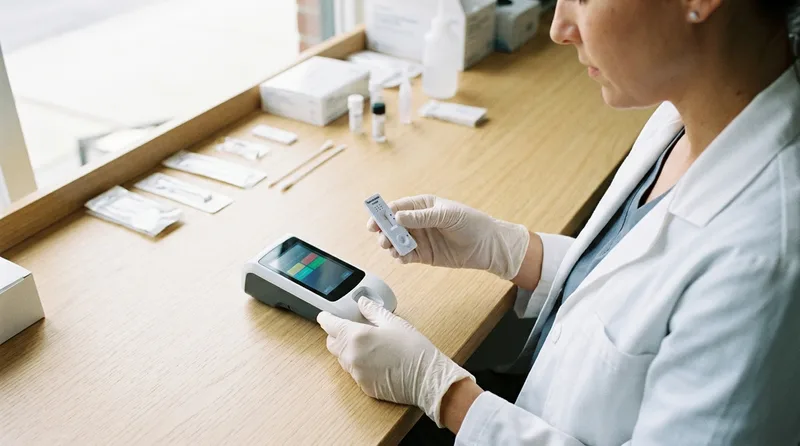
A quick screening at the counter can turn a routine visit into a billable clinical service.
The Awareness Gap
Most pharmacies already have the equipment. Fewer have told anyone about it. That gap is the opportunity. A pharmacy offering flu, glucose, and A1c screening is running a genuine clinical service, comparable to what an urgent care clinic charges for, but few patients know to ask for it at the counter. Signage alone rarely closes that gap. It takes a deliberate mix of in-store messaging, local search visibility, and patient education content repeated across channels until testing becomes something patients associate with your store by name.
Audit Your Current Testing Capabilities
Start by auditing what you already offer. List every test your pharmacy can run today. Then check whether that list appears anywhere on your website, Google Business Profile, or social channels. If it doesn't, you're sitting on inventory nobody knows to buy. Most independent pharmacies discover during this audit that they're already equipped to run three or four tests they've never actively promoted.
Not sure where clinical services fit in your marketing plan?
See how NCPA-recommended services, including point-of-care testing, get promoted the right way.
Which Point of Care Tests Should a Pharmacy Promote First for Testing Marketing?
Lead with the tests your community already searches for: influenza, blood glucose, and HbA1c. These three account for the largest share of pharmacy-based testing volume nationwide, so patients are more likely to already understand what they do.
The Core Three: Flu, Glucose, and A1c
According to the AMCP Foundation, among pharmacies that run point-of-care testing, 58% offer influenza screening, 46% offer glucose testing, and 40% offer HbA1c. Those numbers aren't random. Flu testing rides on top of an immunization visit patients already expect from a pharmacy, and glucose or A1c testing fits naturally with the medication conversations pharmacists already have with diabetic patients. A 2025 AMCP Foundation survey found this pattern held across independent and chain settings alike.
Expanding Beyond the Core Tests
Once those three are established, expand based on local demand. A pharmacy near a senior community may see faster uptake on cholesterol or INR monitoring. One near a college campus might do better promoting strep or COVID panels during peak season. Track which tests generate the most walk-in questions for two or three months before committing marketing dollars to a fourth or fifth offering.
Influenza: pair with flu shot campaigns each fall
Blood glucose and HbA1c: tie into diabetes management and medication sync conversations
Strep and respiratory panels: promote during school-year illness season
Cholesterol and blood pressure: bundle with heart health screenings
Related: Flu season is the single easiest on-ramp for point-of-care testing awareness, since patients are already walking in for a shot. See the Flu Season Playbook →
How Do You Build Local Awareness for Point of Care Testing?
Local awareness starts with your Google Business Profile, since that's where most patients check before walking in. Add each test as a named service, not a generic "clinical services" listing, so searches for specific tests can actually surface your store.
Naming each test on your profile helps the right search find your store first.
Optimize Your Google Business Profile
Nearly 90% of the US population lives within 5 miles of a community pharmacy, which means the competition for local visibility is dense. If a patient searches "flu test near me" or "A1c test [your city]" and your listing doesn't mention it by name, a competitor's will. Google's algorithm favors specificity. Vague service categories rarely rank for the exact query a symptomatic patient types at 9pm.
Beyond the profile itself, weekly posts describing available tests, paired with photos of your testing area, keep the listing active and signal relevance to Google's local ranking factors. Consistency matters more than volume here. One clear post a week outperforms a burst of five posts followed by three months of silence.
Where Else to Build Awareness
Channel
Best Use for POCT
Google Business Profile
List named tests as services, post weekly updates
Website service page
Dedicated page for each major test with pricing and wait time
In-store signage
Reinforce what's available at the point of decision
Which Paid and Social Strategies Work Best for Promoting Point of Care Testing?
Google Ads captures the highest-intent searches, since someone typing "same day strep test pharmacy" is ready to act now. Facebook and Instagram work better for awareness before that intent forms.
Google Ads for High-Intent Searches
The average cost-per-lead across all industries on Google Ads was $66.69 in 2024, according to WordStream's benchmark report, while Facebook Lead Ads ran closer to $21.98. That gap matters for budget allocation. Use Google Ads sparingly, targeted at high-intent test names, and lean on Facebook or Instagram for the broader "did you know we offer this" messaging that builds long-term awareness. Geofencing around nearby urgent care clinics or emergency rooms can also intercept patients who assumed testing meant a wait and a copay.
Balancing Your Channel Budget
Budget roughly 60% toward awareness-stage social content and 40% toward intent-driven search ads, then adjust based on which channel actually books appointments, not just clicks. Review this split every quarter, since seasonal test demand shifts the ratio that works.
Running ads without a testing-specific landing page?
A dedicated marketing plan connects search, social, and your website so testing campaigns don't dead-end on your homepage.
How Should a Pharmacy Talk About Point of Care Testing in Patient Education Content?
Patient education content should explain what a test measures, why it matters, and what to expect during the visit, in plain language a non-clinician can follow in under two minutes.
Plain-language explanations build the trust that turns a test into a repeat visit.
What Every Test Explainer Should Include
Almost 90% of adults trust their local pharmacist, and 75% would discuss a personal or family health issue with one, according to CVS Health's Rx Report. That trust doesn't transfer automatically to testing services unless you say so directly. A short blog post explaining "what your A1c number means" does more for booking conversions than a product photo ever will, because it answers the question a hesitant patient is actually asking themselves before they walk in.
Explain the test in one sentence: what it measures and why it's checked
State the process: how long it takes, whether fasting is required
Address cost and whether insurance or a cash rate applies
Include a clear next step: walk-in, appointment link, or phone number
Tie Content to Seasonal Campaigns
Heart-health screening events pair especially well with this format, since patients arrive already curious about a specific number. If you already run a seasonal heart health campaign, point-of-care blood pressure and cholesterol testing slots naturally into that content calendar rather than needing a separate one. The same principle applies to diabetes awareness campaigns, where an A1c reminder post can run alongside medication sync outreach for the same patient list.
How Do You Measure the ROI of a Point of Care Testing Marketing Push?
Measure point-of-care testing ROI by tracking bookings per channel against the cost to generate them, not just impressions or likes. A campaign with high reach but zero scheduled tests isn't working, regardless of how it looks on a report.
What to Track
Set up a simple tracking sheet: source, test type, booking date, and whether the visit converted into an additional service like a follow-up consult or a new prescription. Businesses publishing consistent content generate meaningfully more leads than infrequent publishers, per Semrush's content marketing research, which suggests testing-related blog posts and GBP updates need a steady cadence rather than a one-time push to move the needle.
How Often to Review Results
Review results monthly for the first quarter, then quarterly after that. If one test type consistently underperforms after two full seasons of promotion, it may not fit your patient base. That budget is better spent doubling down on what already books, rather than propping up a service nobody's asking for.
For a broader look at what "good" looks like across pharmacy marketing spend, this ROI benchmarks and KPI guide breaks down typical ranges by channel.
Point-of-care testing marketing for pharmacies pays off when it's treated as an ongoing clinical service program, not a seasonal promotion. The pharmacies capturing this revenue aren't the ones with the fanciest lab equipment. They're the ones who tell patients, repeatedly and clearly, exactly what's available and why it's worth a visit. Start with your top three tests, get them onto your Google Business Profile this week, and build outward from there.
Ready to Turn Testing Services Into Booked Visits?
RevealSite builds the local SEO, ads, and content that put your point-of-care testing services in front of the patients searching for them.
Point of care testing is diagnostic screening performed on-site with results available in minutes, covering tests like flu, strep, glucose, HbA1c, and cholesterol. Pharmacies with a CLIA waiver can offer these without sending samples to an outside lab.
How do independent pharmacies market point of care testing?▼
Independent pharmacies market point of care testing through named Google Business Profile listings, patient education blog content, and targeted local ads. The most effective approach ties testing into visits patients already make, like flu shots or medication pickups.
Which point of care tests should a pharmacy offer first?▼
Start with influenza, blood glucose, and HbA1c testing, since these account for the largest share of pharmacy-based testing nationally. They also connect naturally to services patients already expect from a pharmacist.
Does point of care testing marketing require a big ad budget?▼
No, a small but consistent budget works better than a large one-time push. Weekly Google Business Profile posts and patient education content cost little and build awareness before any paid ads run.
How long does it take to see results from POCT marketing?▼
Most pharmacies see initial booking increases within one to two months of consistent local SEO and content updates. Full seasonal patterns, like flu or heart health testing, typically take one full cycle to evaluate properly.
Can point of care testing improve pharmacy revenue?▼
Yes, point of care testing adds a billable clinical service on top of existing prescription revenue. Pharmacies that market it consistently convert routine visits into additional appointments and follow-up care.