Allergy Season Pharmacy Marketing: A Complete Playbook
RevealSite Team
July 15, 2026 · 9 min read
Key Takeaways
✓About 25% of US adults have a diagnosed seasonal allergy, according to CDC data, making this a reliable recurring campaign rather than a guess.
✓Launch allergy messaging two to three weeks before your region's typical pollen peak, since symptoms usually prompt a same-week purchase decision.
✓Point-of-care allergy testing gives pharmacies a clinical service to promote alongside OTC sales, not just a product push.
✓MTM consultations catch drug interactions between allergy medications and existing prescriptions, a detail chain pharmacies often skip.
✓81% of independent pharmacies now offer MTM services, according to the NCPA 2024 Digest, making this a service most pharmacies already have to promote.
✓Track OTC allergy sales lift, testing appointments booked, and MTM consultation requests against the same window last year to measure real success.
Build the presence your community trusts
Let us be your first step. Get in touch with our team today.
Allergy season pharmacy marketing is the practice of promoting OTC relief, testing, and consultations around regional pollen peaks, on a schedule set by nature rather than your marketing calendar. About 25% of US adults have a diagnosed seasonal allergy, according to the CDC, and most of them buy relief the week symptoms start, not before.
This playbook covers which OTC products to promote and how testing and MTM consultations extend the opportunity beyond antihistamine sales. You'll also get the channels that convert fastest and how to know afterward whether the campaign worked. It slots into the same seasonal marketing calendar as your other recurring campaigns.
Your RevealSite marketing services team can treat allergy season like any other predictable seasonal window. Give it a launch date, dedicated content, and its own success metrics, not a scattered set of shelf tags.
What Is Allergy Season Pharmacy Marketing?
Allergy season pharmacy marketing is a focused campaign promoting OTC antihistamines, point-of-care testing, and MTM consultations during regional pollen peaks. Unlike flu season, which has one clear national window, allergy season varies by climate zone and can hit twice a year in some regions, once for tree pollen and again for ragweed.
That variability is exactly why most independent pharmacies under-market it. Chains run generic seasonal displays without adjusting for local pollen timing, which leaves an opening for pharmacies willing to track their specific region's pollen forecast and launch ahead of it. Patients rewards the pharmacy that has relief in stock and visible before symptoms peak, not after.
Why Timing Beats Product Selection
Most pharmacies already stock the right antihistamines and nasal sprays. The differentiator is rarely the product mix, it's whether your marketing reaches patients before or after symptoms start. A patient searching for allergy relief mid-sneeze converts fast, but only if your pharmacy shows up in that moment.
This is where allergy season pharmacy marketing differs sharply from a generic seasonal push. A pharmacy that waits for a corporate marketing calendar to say "it's spring" is already behind the pharmacy tracking a live regional pollen count. Set a simple internal trigger, such as a specific pollen index reading for your zip code, and launch your campaign the day it's crossed rather than on a fixed calendar date.
Which OTC Allergy Products Should Pharmacies Promote?
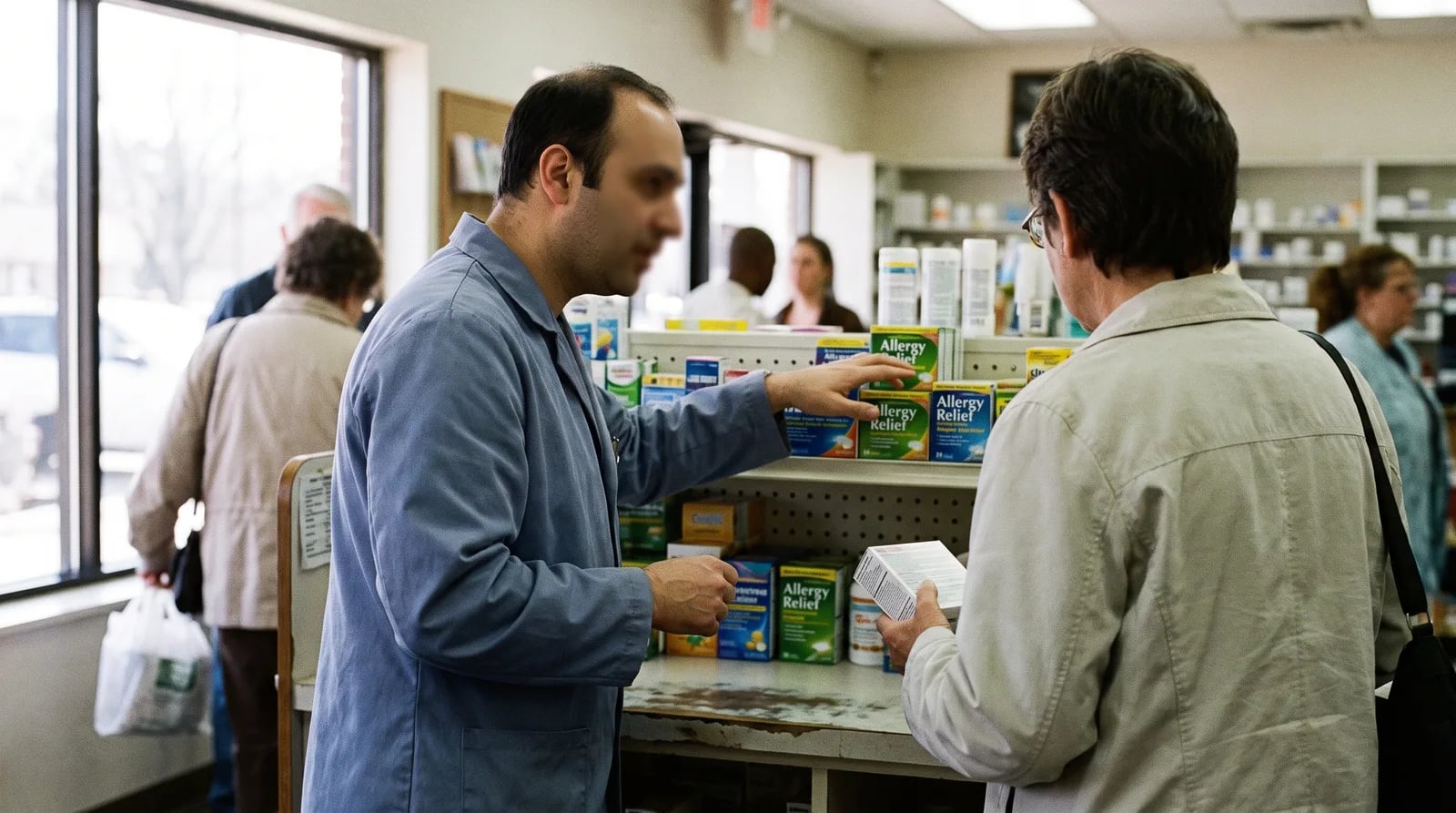
Pharmacies should promote antihistamines, nasal sprays, and eye drops together, since these cover the three symptoms patients search for most. Group them by symptom rather than by brand name. A patient with itchy eyes doesn't want to compare five antihistamine brands first; they want the eye drop aisle clearly marked.
Oral antihistamines for sneezing, runny nose, and general symptom relief
Nasal sprays for congestion, often paired with antihistamines for combination relief
Eye drops for itchy or watery eyes, frequently overlooked in generic seasonal displays
Region
Typical Peak
Launch Campaign By
South
Tree pollen, February to March
Mid-January
Midwest and Northeast
Tree and grass pollen, April to May
Mid-March
Nationwide
Ragweed, August to September
Late July
Check a regional pollen forecast rather than relying on a single national date, since a Texas pharmacy and a Minnesota pharmacy are marketing to two different calendars entirely.
Seasonal displays need content behind them
RevealSite's Creative & Content team builds the email sequences, social posts, and landing pages that turn a seasonal shelf display into a marketing campaign.
How Should Pharmacies Market Point-of-Care Allergy Testing?
Pharmacies offering point-of-care testing should market it as a fast alternative to guessing whether symptoms are allergies or a cold. Patients frequently delay treatment because they're unsure what they're dealing with, and a quick in-pharmacy test resolves that uncertainty without a doctor's appointment.
This works especially well early in the season, before patients have self-diagnosed through trial and error. Position the test as the first step, not an upsell after an OTC purchase. Once a patient knows what they're treating, they're far more likely to buy the specific product your pharmacist recommends, rather than grabbing whatever's on the shelf.
Positioning the Test as a Service, Not a Sale
Frame in-store signage and social posts around the uncertainty itself: "Allergies or a cold? Find out in minutes." That framing draws in patients who wouldn't respond to a straightforward product ad. It speaks to the actual question in their head, not an assumption they already know what they need.
Keep the ask small. A five-minute test with a clear price and a walk-in option removes the biggest reason patients hesitate: not knowing what a pharmacy visit for testing actually involves. Once that friction is gone, allergy season pharmacy marketing built around testing tends to bring in patients who become regulars for other services too, not just repeat allergy customers.
How Can MTM Consultations Support Allergy Season Campaigns?
MTM consultations give patients a simple reason to talk to your pharmacist before buying: check your new OTC allergy pick against everything else you're already taking. Most patients never think to ask, they just grab whatever's on the shelf. 81% of independent pharmacies already offer MTM services, according to the NCPA 2024 Digest, making this an easy service to promote.
Frame the offer around that one question: "Taking other medications? Let's make sure your allergy pick is a good fit." A short consultation positioned alongside your allergy display catches patients at the exact moment they're deciding what to buy, turning a quick shelf decision into a conversation with your pharmacist instead.
This works especially well for patients managing multiple prescriptions or conditions, who are often the most hesitant to grab something new off the shelf without asking. A quick, no-pressure check builds the kind of trust that keeps them coming back for refills, not just allergy season purchases.
Which Channels Work Best for Allergy Season Pharmacy Campaigns?
Email and in-store signage work best for reminding existing patients, while paid search and social media reach new, symptomatic patients actively searching for relief. Layering all three typically outperforms relying on a single channel, especially since allergy-related searches spike suddenly rather than building gradually.
Email and In-Store Signage for Existing Patients
Email works well for reminding patients who bought allergy relief last year, since you already know their likely symptom window. In-store signage catches walk-in traffic already at the counter for something else, converting them into a same-visit allergy purchase.
Paid Search and Social for New, Symptomatic Patients
Paid search targeting allergy symptom terms converts quickly, since searchers in the middle of symptoms have immediate purchase intent. The average cost-per-lead in Google Ads runs $66.69 across industries, according to WordStream's benchmark data. Allergy-symptom searches tend to convert faster than broader health queries because the need is immediate, not exploratory.
Local SEO Optimization
Local SEO catches the patient searching "allergy relief near me" or "pharmacy allergy testing" the moment symptoms start, often before they've decided which pharmacy to visit. Keep your Google Business Profile updated with allergy season hours, testing availability, and current stock, since incomplete profiles lose that moment to a chain pharmacy with a more complete listing. Add allergy-specific keywords to your website's service pages too, not just your homepage, so a symptom-specific search has a page to land on.
Educational Content Marketing
A short blog post or FAQ page on regional pollen timing, common symptom triggers, or how to tell allergies apart from a cold gives patients a reason to find your pharmacy online before they're ready to buy anything. This content also feeds your local SEO and paid social efforts, since the same page can rank organically and get promoted as an ad. Publish it a few weeks ahead of your region's pollen peak so it has time to be indexed before search volume climbs.
Regional timing makes this campaign harder to run solo
RevealSite's Marketing & Visibility team tracks your region's pollen forecast and runs the email, social, and paid campaigns together so the timing never slips.
When Should a Pharmacy Start Allergy Season Marketing?
A pharmacy should start allergy season marketing two to three weeks before its region's typical pollen peak, since most patients buy relief reactively rather than stocking up in advance. Waiting until symptoms are already widespread means competing with every other pharmacy and big-box store running the same generic seasonal push.
Content marketing compounds this advantage over time. 76% of content marketers use blogs to generate leads, and businesses publishing 16+ posts per month generate 4.5x more leads than infrequent publishers, according to Semrush. A short blog post or social series on regional pollen timing, published ahead of the season, builds organic visibility that a same-week paid push can't replicate.
Set a firm internal deadline instead of watching the calendar drift. Pick a date two to three weeks ahead of your region's typical peak, put it on the schedule now, and treat it the same way you'd treat a hard deadline for any other campaign. Pharmacies that leave the launch date loose tend to notice the season has already started before anything goes out.
How Do You Know Your Allergy Season Campaign Succeeded?
You know an allergy season campaign succeeded when OTC allergy sales, testing appointments, and MTM consultation requests all show measurable lift over the same weeks last year. General store traffic or social engagement numbers don't confirm the campaign actually drove allergy-specific behavior.
Track these three numbers specifically, and compare them to the same seasonal window last year rather than a flat monthly average:
OTC allergy sales lift: compare antihistamine, nasal spray, and eye drop sales during the campaign window against the same weeks last year
Testing appointments booked: count point-of-care allergy testing appointments scheduled through your campaign, separate from walk-ins
MTM consultation requests: track how many patients request a medication review tied specifically to a new allergy purchase
Allergy Season Campaign Tracker
Check each metric your pharmacy is currently tracking.
Your score: count your checks out of 4
If none of the three numbers moved compared to last year, check your launch timing first. A campaign that starts after symptoms peak is competing with every other pharmacy running the same reactive push, no matter how strong the offer is.
Allergy season pharmacy marketing rewards pharmacies that track regional timing instead of running one generic national campaign. OTC sales, point-of-care testing, and MTM consultations all sit inside the same predictable window every year, and pharmacies that plan for it consistently outperform the ones scrambling once symptoms hit. Build it into your full seasonal calendar now, so next year's version takes an afternoon to update instead of a season to rebuild.
Ready to launch your allergy season campaign?
RevealSite tracks regional pollen timing and runs the email, social, and paid campaigns that turn seasonal symptoms into pharmacy visits.
When does allergy season pharmacy marketing typically start?▼
Allergy season pharmacy marketing typically starts two to three weeks before your region's pollen peak, which varies by climate zone. Southern states often see early tree pollen by February, while northern regions peak later in April or May. Check regional pollen forecasts rather than using a single national date.
What OTC products should pharmacies promote during allergy season?▼
Pharmacies should promote antihistamines, nasal sprays, and eye drops, since these cover the three most common allergy symptoms. Bundle these into a single seasonal display rather than scattering them across separate aisles. Grouping products by symptom, not by brand, helps patients self-select faster at the shelf.
Is point-of-care allergy testing worth marketing?▼
Yes, if your pharmacy already offers point-of-care testing, allergy season is the strongest window to promote it. Patients unsure whether their symptoms are allergies or a cold are more likely to book a quick test than wait for a doctor's appointment. This also creates a natural upsell into OTC or prescription treatment.
How can MTM consultations fit into an allergy season campaign?▼
MTM consultations catch interactions between new allergy medications and a patient's existing prescriptions, something patients rarely check themselves. Promote a quick consultation offer alongside your OTC allergy display. This positions your pharmacist as a safety resource, not just a checkout point for antihistamines.
Which channels work best for allergy season pharmacy marketing?▼
Email and in-store signage work best for reminding existing patients, while social media performs well for reaching new, symptomatic patients searching for relief. Paid search ads targeting allergy symptom terms convert quickly since the intent behind those searches is immediate. Layering all three typically outperforms relying on one channel alone.
How do you know if an allergy season campaign worked?▼
Measure OTC allergy sales lift, point-of-care testing appointments, and MTM consultation requests against the same weeks last year. Vague engagement metrics like impressions don't confirm patients actually acted. A successful campaign shows measurable lift in at least two of these three numbers.