17 Pharmacy Marketing Tips, Ranked by Return on Spend
RevealSite Team
August 15, 2026 · 11 min read
Key Takeaways
✓Rank every activity by cost per new prescription, not by how modern it feels.
✓Google Business Profile sits at number one because 86% of profile views come from category searches like 'pharmacy near me', not from your brand name.
✓Reviews compound: 88% of consumers will use a business that responds to every review, against 47% for one that ignores them.
✓Run paid ads only after your profile, reviews, and phone coverage are working, or you pay to send traffic into a leaky funnel.
✓Facebook lead ads average $21.98 per lead against $66.69 on Google Ads, which changes the order you test channels in.
✓Track monthly transfers, new-patient scripts, and call answer rate. Follower counts tell you nothing about revenue.
Most pharmacy marketing tips arrive as flat lists, where a $4,000 mailer sits beside a free Google Business Profile update as though the two carry equal weight. They don't. The activities with the highest return are the nearly free ones closest to patient intent: your Google listing, your reviews, and your phone coverage. One of those can pay for itself inside a month. The mailer may never pay back at all.
Build the presence your community trusts
Let us be your first step. Get in touch with our team today.
Ranking matters more for independents than for anyone else. Gross margin for independent pharmacy fell to 19.7% in the NCPA 2024 Digest, the lowest in a decade of that report. At that margin, a wasted $3,000 campaign isn't a rounding error. It's dozens of scripts you now have to fill just to break even, which is why the sequencing behind good pharmacy marketing services matters as much as the tactics themselves.
So the pharmacy marketing tips below are 17 activities ordered by return on spend, from the ones that pay back fastest to the ones that quietly drain your budget. Each rank comes with the reasoning behind it.
What makes a marketing activity worth doing?
An activity earns its rank on three things: how close it sits to the moment a patient decides where to fill, what it costs per new prescription, and how long it takes to pay back. Proximity to intent beats reach every time. A patient searching for a pharmacy right now is worth more than a thousand impressions.
Think of your marketing in two buckets. Capture activities intercept demand that already exists, like someone typing "pharmacy near me" at 6pm. Creation activities build awareness among people who weren't looking yet. Capture is cheaper, faster, and easier to measure. Creation matters, but it's a second move, not a first one.
Most pharmacies get this backwards. They buy a billboard before they've finished their Google profile. That's paying to create demand while the demand you already have walks to a chain because your listing shows the wrong hours.
The other filter is durability. A Google review you earn this month keeps working next year. A boosted post stops the second the budget runs out. Given the margin pressure independents face, weight the durable ones heavily.
Which activities deliver the highest return?
The highest-return activities are free or nearly free, and they cluster around search visibility, reputation, and phone coverage. Paid channels sit in the middle. Untracked traditional media sits at the bottom, not because it never works, but because you can't tell when it does.
Sequence matters more than selection: work the list from the top down.
Activity
Cost
Time to result
Return tier
1. Google Business Profile
Free
2-6 weeks
Highest
2. Review generation
Free to low
4-8 weeks
Highest
3. Phone answer coverage
Staffing
Immediate
Highest
4. Online transfer form
Low
2-4 weeks
Highest
5. Local service pages
Low
3-6 months
High
6. Review response workflow
Free
4-8 weeks
High
7. Immunization campaigns
Low
Seasonal
High
8. Email to existing patients
Low
1-2 weeks
High
9. Text refill reminders
Low
1-2 weeks
High
10. Prescriber outreach
Time
1-3 months
Medium
11. Patient education content
Medium
3-6 months
Medium
12. Google Ads on transfer terms
Medium to high
Immediate
Medium
13. Facebook and Instagram ads
Medium
1-4 weeks
Medium
14. Organic social posting
Time
3-6 months
Medium
15. Community events
Medium
Seasonal
Lower
16. Tracked direct mail
High
4-8 weeks
Lower
17. Untracked print and radio
High
Unclear
Lowest
Read that table as a sequence, not a menu. Pharmacy marketing tips fail most often on ordering rather than on choice of tactic. Items one through four are the foundation, and running item twelve before item one is how pharmacies end up paying for clicks that land on a listing showing closed hours.
The five to start with
Complete your Google Business Profile. Every category, every service, every hour, plus real photos of your counter and storefront.
Build a review request habit. One ask at pickup, every day, from every staff member.
Fix phone coverage. Count how many calls go unanswered between 4pm and 6pm. That number is usually the biggest leak in the building.
Put a transfer form on your homepage. Name, date of birth, current pharmacy, medication. Four fields.
Write one page per service. Compounding, immunizations, delivery, med sync, and pet medications each need their own page.
Not sure which of the 17 applies to your pharmacy?
A short growth review shows which activities are already working, which are leaking budget, and what to sequence next.
Why does your Google Business Profile beat everything else?
Your profile ranks first because it's where local intent actually lands. About 42% of local searchers click a result inside the Google Maps pack, according to Backlinko's local search research. It costs nothing, updates in minutes, and reaches patients at the exact moment they're choosing.
Here's the part most owners underestimate. Birdeye's 2025 profile research found that 86% of Google Business Profile views came from category searches like "pharmacy near me" rather than from someone typing your business name. The people finding you this way have no loyalty yet. Your listing is the entire first impression, and an incomplete one loses to a chain listing that's filled out properly.
Backlinko's data also shows 76% of people who run a "near me" search visit a related business within a day. That's not a browsing audience. That's someone with a prescription in hand.
Practically, that means filling in every field you're given: primary and secondary categories, service list, accessibility attributes, holiday hours, and product entries for the front-end lines you want known. Photos matter more than owners expect, and a listing with current interior shots reads as open and staffed.
Reviews rank second because they affect both ranking and conversion at the same time. Semrush's local SEO research puts the effect plainly: a one-star improvement in average Google rating lifts calls, clicks, and direction requests by 44%. Few activities available to an independent pharmacy move two levers at once like that.
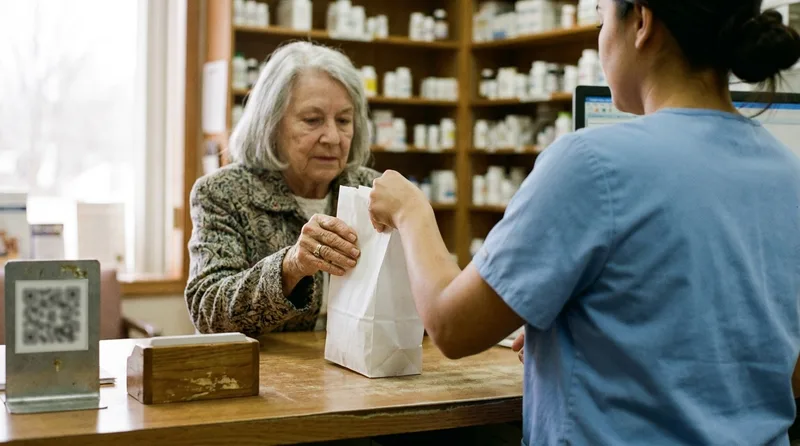
The pickup moment is when goodwill peaks and review asks land best.
Volume and recency matter more than a perfect score. A pharmacy with 180 reviews averaging 4.6 outperforms one sitting on 22 reviews at a flawless 5.0, because the larger count reads as an active business. Responses matter too. The BrightLocal Local Consumer Review Survey found 88% of consumers will use a business that responds to all reviews, against just 47% for a business that ignores them.
A workable review routine looks like this:
Ask at the counter, not by email blast. The moment of pickup is when goodwill peaks. A card with a QR code beside the register works better than any automated sequence.
Respond to every review inside 48 hours, including the four-star ones. Silence on positive reviews is a missed signal.
Answer negative reviews without clinical detail. Acknowledge, apologize for the experience, and move the conversation to a phone number. Never confirm someone was a patient.
Watch for themes. Three reviews mentioning wait times is operational feedback, not a marketing problem.
That last point is where reviews earn their rank twice. They tell you what to fix, and fixing it improves the next review.
Is paid advertising worth it for an independent pharmacy?
Yes, but later than most owners try it. Paid ads buy attention immediately, and they stop the moment you pause billing. That makes them a strong accelerator on top of a working foundation, and an expensive way to hide a broken one underneath.
Cost tells you where to start. WordStream's benchmark data puts the average cost per lead on Facebook lead ads at $21.98 across service industries. The same publisher's Google Ads benchmarks put the all-industry average at $66.69 per lead. Google reaches people already searching, which is worth a premium, but the gap is wide enough that a pharmacy with a small budget should usually test social first.
Where paid works well for independents:
Transfer campaigns aimed at a competitor's delivery radius, timed around a chain closure or a reimbursement change.
Seasonal immunization and clinical service pushes. The NCPA 2024 Digest reports 81% of independent respondents offered medication therapy management, so there's usually a billable service already in place to promote.
Specialty services with real margin, like compounding or pet medications, where one acquired patient stays for years.
Where it goes wrong is a boosted post with no offer, no landing page, and no tracking number. That's not advertising. That's a donation.
Paid ads only work on top of a working foundation.
RevealSite runs profile, review, and campaign work as one department, so spend goes out after the basics are earning.
The biggest waste isn't a bad channel. It's an untracked one. Direct mail, radio, and print can all work in the right market, but without a unique phone number or transfer code you learn nothing, and you repeat the buy next year on a hunch instead of a number.
Plenty of pharmacy marketing tips survive on habit alone. Four patterns burn budget consistently:
Boosting posts without an offer. Reach goes up, scripts don't. A boosted photo of your storefront gives nobody a reason to switch pharmacies.
Chasing follower counts. Two thousand followers who live outside your delivery zone are worth less than forty who don't.
Generic health blog content. A post on "10 tips for healthy eating" competes with the entire internet. A post on which local plans cover a service competes with almost nobody.
Discounting the front end to drive traffic. Front-end margin subsidizes thin script margin. Cutting it to pull foot traffic often trades your healthiest revenue for your weakest.
Search itself is shifting too, which changes the content calculation. Pew Research Center found that when an AI summary appears, users click a traditional search result on just 8% of visits, against 15% without one. Broad informational content gets summarized away. Specific local content that answers a question only your pharmacy can answer still earns the visit.
You measure four numbers monthly, and you ignore the rest of the noise. New prescriptions from new patients, transfers in, call answer rate, and Google Business Profile actions. Divide total spend by new patients acquired and you get a cost per patient you can defend or cut.
Four numbers monthly beat a dashboard nobody opens.
Set it up in this order:
Baseline before you change anything. Pull three months of transfer counts and new-patient scripts from your system. Without a baseline, every result is a guess.
Add one tracking number per paid channel. Direct mail gets its own. Google Ads gets its own. This single step separates the campaigns that work from the ones you assume work.
Log call answer rate weekly. Missed calls during the after-work rush are the most common leak, and no campaign can outrun it.
Review profile actions each month. Calls, direction requests, and website clicks from your listing show whether visibility work is landing.
Reallocate quarterly. Move budget toward whatever produced the lowest cost per new patient last quarter.
One caution on attribution. A patient who saw your mailer, checked your reviews, then called after a friend mentioned you is not a single-channel win. Judge channels on trend over a quarter rather than on any one week.
Start at the top of the list and go in order. Finish your Google Business Profile this week, start asking for reviews tomorrow, and count your unanswered calls for five days. Those three cost almost nothing and they decide whether anything you spend afterward has a chance of working.
The pattern behind every ranking here is the same. Activities that meet patients at the moment of decision beat activities that shout at them beforehand. That's the real lesson in these pharmacy marketing tips, and it's why the cheapest items sit at the top rather than the bottom.
Pick the highest-ranked activity you haven't finished yet. Not the most interesting one. The highest-ranked one.
See which pharmacy marketing tips fit your market
RevealSite works only with independent and compounding pharmacies. A short demo shows where your visibility, reviews, and campaigns stand today.
What are the most effective pharmacy marketing tips for a single location?▼
Claim and fully complete your Google Business Profile, build a steady review flow, and make sure someone answers the phone. Those three cost almost nothing and sit closest to the moment a patient decides where to fill.
How much should an independent pharmacy spend on marketing?▼
Most independents land between 1% and 3% of revenue. Start at the low end while you fix your profile and reviews, then increase spend once you can measure cost per new prescription and know which channel produces it.
Do pharmacy marketing tips about social media actually drive prescriptions?▼
Social media rarely drives a transfer on its own. It supports recognition and gives patients a reason to trust you before they call, but it converts best when paired with a specific offer and a clear next step.
How long before pharmacy marketing shows results?▼
Profile and review work often shows movement in calls and direction requests within four to six weeks. Content and organic search take three to six months. Paid ads produce leads immediately but stop the day you pause them.
Is print advertising dead for community pharmacies?▼
No, but it needs tracking. A local mailer with a unique phone number or transfer code can work in a dense delivery zone. Print without a tracking mechanism is where most wasted pharmacy budget goes.
What is the fastest way to win transfers from a chain pharmacy?▼
Make transferring feel like one step instead of five. A short online transfer form, a staff script for the counter, and a clear promise about wait times remove the friction that keeps patients where they are.
Should a pharmacy hire an agency or run marketing in house?▼
Run the free basics in house, because your staff knows the patients. Bring in outside help for the parts that need constant attention: paid campaigns, website performance, and consistent content production.
How do you measure whether marketing is working?▼
Track new prescriptions from new patients, monthly transfers in, call answer rate, and Google Business Profile actions. Compare those against total spend to get a cost per acquired patient you can act on.