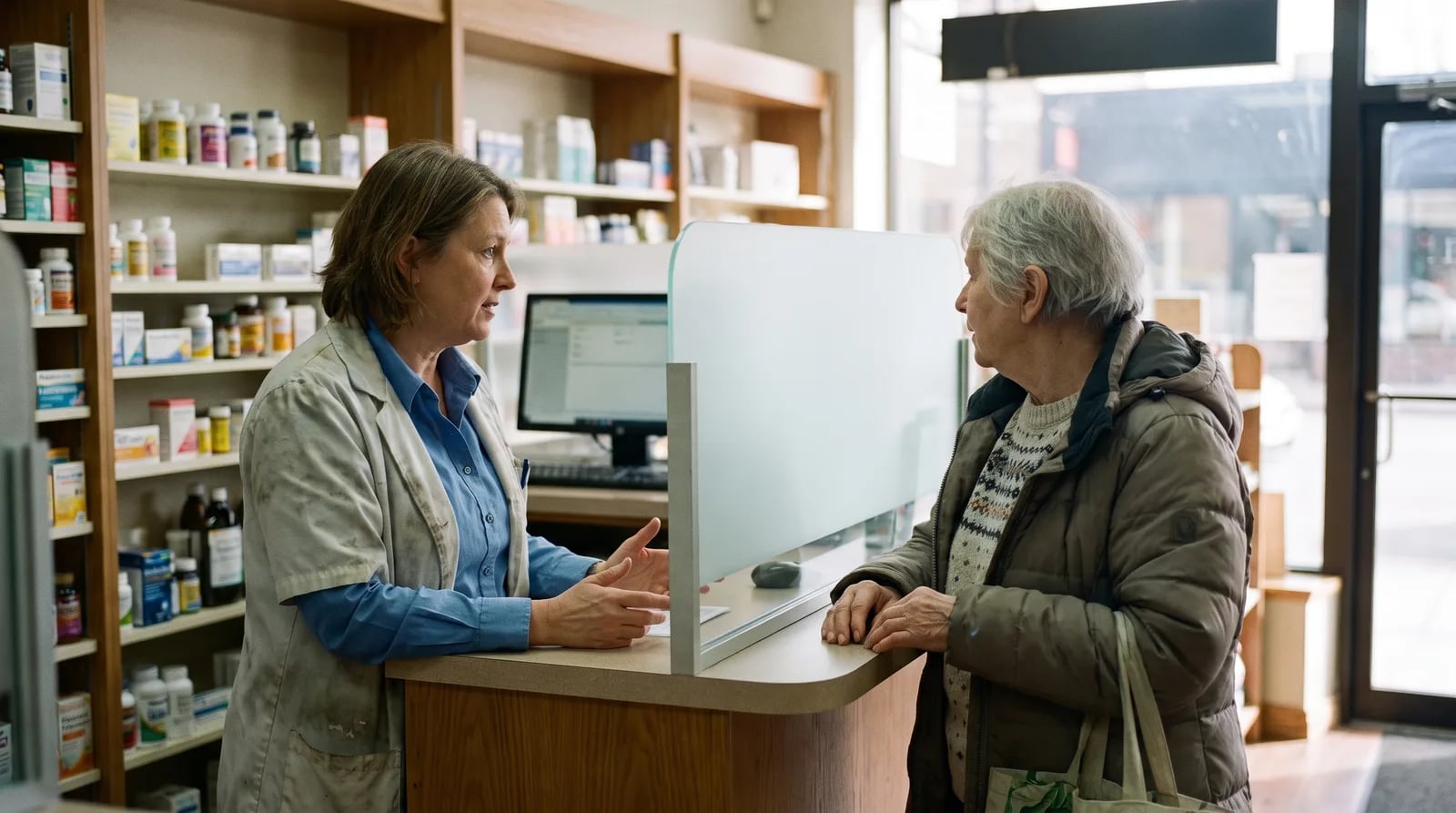
9 Patient Engagement Strategies for Independent Pharmacies
RevealSite Team
August 25, 2026 · 9 min read
Key Takeaways
✓Almost 90% of adults trust their local pharmacist, so counter interactions carry more weight than most marketing spend.
✓Roughly 50% of patients with chronic conditions skip doses as prescribed, which is why refill reminders matter more than a loyalty app.
✓A one-star improvement in Google rating can lift calls, clicks, and direction requests by 44%, making review response a growth lever, not a chore.
✓Offering MTM, point-of-care testing, or vaccines turns a transactional pickup into a recurring clinical relationship.
✓Tracking refill adherence rate, review response time, and repeat-visit rate tells you whether engagement work is actually landing.
Patient engagement strategies for independent pharmacies matter more than a punch card or a boosted Facebook post. Independent pharmacies win on relationships, not shelf space, and almost 90% of adults already trust their local pharmacist more than most other providers they see. That trust is real. It just does not spend itself.
Build the presence your community trusts
Let us be your first step. Get in touch with our team today.
The pharmacies that turn trust into repeat visits treat engagement as a system, not a single campaign: counter habits, digital reminders, clinical services, and review management working together. A full-service marketing program touches every one of those pieces, not just the one a vendor happens to sell that quarter.
Below are nine patient engagement strategies for independent pharmacies you can start this month, ranked roughly by how fast each one shows a result.
1. How Can Staff Personalize Every Counter Interaction?
Staff personalize a counter interaction by using the patient's name, referencing the last thing discussed, and flagging one detail worth mentioning next visit. Since pharmacists already carry high trust with patients, that small habit converts trust into loyalty faster than any coupon.
Personalization does not require a new system. It requires five seconds of prep before the patient reaches the counter: a glance at the profile, a note about a recent dose change, a question about how a new medication is sitting with them. Chains struggle to do this at scale. A three-person independent pharmacy can do it every single time, and patients notice the difference immediately. That is the actual competitive advantage over a big-box pharmacy counter, not price.
Train every staff member, not just the pharmacist, to ask one open-ended question per interaction. "How has the new inhaler been working?" beats "Anything else today?" every time.
2. What Actually Reduces Wait Times Without Cutting Corners?
Wait times drop when a pharmacy separates quick pickups from complex counseling instead of running one line for both. Pharmacy customer satisfaction fell more than 10 points in a recent year, and long waits were the top driver, according to the J.D. Power 2024 US Pharmacy Study, so this is not a minor fix.
A simple two-lane system works: a fast lane for will-call pickups with no questions, and a counseling lane where the pharmacist can actually talk. Staggering technician shifts around the known peak hours (usually right after school lets out and right after work) also helps more than hiring one extra body spread evenly across the day. Track your own peak windows for two weeks before assuming you know them. Most owners guess wrong.
Separate pickup-only and counseling queues
Text patients when a prescription is ready instead of making them ask
Staff technician shifts around your actual peak hours, not a guess
Struggling to keep patients engaged between visits?
Our Marketing & Visibility team builds the outreach cadence around your existing workflow, not a generic template.
3. How Do Refill and Adherence Reminders Keep Patients Engaged?
Refill and adherence reminders keep patients engaged by catching a gap before it starts, not after. Roughly half of patients with chronic conditions do not take medication as prescribed, a pattern linked to about $528 billion in annual US health costs, according to research published on NIH's PMC platform.
The timing matters more than the channel. A reminder sent three to five days before a refill is due gives patients enough runway to act without feeling nagged. Send it again once, not three times, if it goes unanswered. Cost is often the real barrier behind a missed refill, not forgetfulness, so pair the reminder with a quick note about generic options or a 90-day supply where it applies.
Send the first reminder 3 to 5 days before the refill date
Use text as the default channel, with a phone call for high-risk medications
Follow up once if there is no response, then flag the patient for a pharmacist call
4. Which Two-Way Digital Channels Build Ongoing Trust?
Two-way digital channels build trust when patients can reply, not just receive. A one-way blast feels like spam. A text thread where a patient can ask "can I pick this up after 6?" and get a real answer feels like a relationship.
Email works well for education, like a seasonal note on flu shots or a med sync reminder. Text works better for anything time-sensitive: refill alerts, pickup confirmations, or a quick answer to a dosing question. Keep the tone conversational and skip the corporate voice entirely. Patients can tell the difference between a form letter and a person, even in a text message. If you are building this from scratch, our patient engagement content library has channel-specific examples worth borrowing.
Start with one channel done well. Adding email, text, and an app all at once usually means none of them get maintained past the first month.
A two-way text thread turns a reminder into a real conversation.
5. What Clinical Services Turn a One-Time Visit Into a Relationship?
Clinical services turn a one-time pickup into a relationship because they give patients a reason to return that has nothing to do with a prescription running out. Medication therapy management is the clearest example: 81% of independent pharmacies already offer it, according to the NCPA's 2024 Digest Report.
Point-of-care testing and immunizations work the same way. Pharmacies were the top setting for both adult flu shots and updated COVID-19 vaccinations in a recent season, per CDC vaccination data. Every flu shot, blood pressure check, or MTM session is also a five-minute conversation, and those conversations are where engagement actually compounds. A patient who gets a flu shot at your counter is a patient who now has a second reason to walk through the door next year.
Clinical Service
Typical Setup Cost
Engagement Value
MTM sessions
Low, staff time mostly
High, recurring by design
Point-of-care testing
Moderate, equipment and training
High, brings in walk-ins
Immunizations
Low to moderate
Seasonal, high volume
Want the content that promotes these services written for you?
Our Creative & Content team builds the blog posts, social captions, and newsletters that turn clinical services into visible reasons to return.
6. How Should a Pharmacy Turn Reviews Into an Engagement Loop?
A pharmacy turns reviews into an engagement loop by replying to every one, good or bad, within a day or two. About 88% of consumers say they will use a business that responds to all reviews, versus just 47% for one that ignores them entirely, based on BrightLocal's 2024 review survey.
The loop works like this: a good counter interaction leads to a review, the review gets a specific reply (not a copy-pasted "thank you"), and the reply itself becomes proof for the next hesitant patient reading it. Skip generic responses. "Thanks for the kind words about how Maria handled your insurance mix-up" does more than "We appreciate your feedback." One-star reviews deserve the same specificity, minus any defensiveness.
7. How Can Pharmacies Segment Outreach for Chronic Condition Patients?
Pharmacies segment outreach for chronic condition patients by grouping them around the medication or condition, then adjusting message frequency and tone for each group. A diabetes patient on four medications needs different reminders than someone on a single blood pressure prescription.
Segmentation does not require expensive software. A tagged list in your pharmacy system, sorted by condition or medication class, is enough to start. Diabetes patients might get a monthly note about supply refills and A1C testing. Cardiac patients might get a seasonal reminder around flu season, since infection risk hits them harder. Out-of-pocket cost is the biggest driver of abandonment once it climbs past a few hundred dollars, so any segment showing cost sensitivity deserves a proactive call about generics before the refill date, not after. Review each segment quarterly, since a patient's condition, insurance, and medication list all change more often than most pharmacy systems get updated.
Grouping patients by condition lets outreach match the actual risk.
8. What Habits Help Staff Close the Loop After Every Service?
Staff close the loop by confirming the outcome of a service, not just delivering it. A flu shot without a follow-up question is a transaction. A flu shot plus "any soreness from last year's shot?" is a relationship checkpoint.
This habit takes seconds and changes almost nothing about workflow. After an MTM session, a quick note in the profile about what was discussed means the next staff member who sees that patient can reference it. After a point-of-care test, a short explanation of what the result means (not just the number) builds the kind of trust that turns into a five-star review without you asking for one. The pharmacies that skip this step are not doing anything wrong exactly. They are just leaving value on the table that costs nothing to collect.
Log a one-line note after every clinical service, not just refills
Ask one follow-up question tied to the last visit
Flag anything worth a callback within 48 hours
9. Which Metrics Prove Patient Engagement Strategies Are Working for Independent Pharmacies?
Four metrics prove patient engagement is working: refill adherence rate, review response time, repeat-visit rate, and enrollment in clinical services. Track these four every month, because a rising patient count alone can hide falling adherence, and that gap is exactly where a pharmacy loses long-term revenue without noticing.
Refill adherence rate tells you whether reminders are changing behavior or just generating texts nobody reads. Review response time (aim for under 48 hours) tracks whether your reputation loop is actually running. Repeat-visit rate, tracked monthly, separates patients who are truly engaged from those who happen to live nearby. Enrollment in MTM or point-of-care testing shows whether clinical services are growing or stagnant. Pull these four numbers monthly. If two of them are flat for three months running, something in the system above needs attention, not a new tactic.
Four numbers tell you more than any engagement dashboard's vanity metrics.
None of these nine patient engagement strategies for independent pharmacies work in isolation. Counter habits feed reviews, reviews feed trust, trust feeds clinical service enrollment, and adherence reminders keep the whole loop from leaking patients between visits. Start with the two or three that fit your current staffing, not all nine at once.
Pick one metric from the list above and check it again in 60 days. That single number will tell you more about whether your patient engagement strategy is working than any new app or campaign could.
Ready to put these strategies into action?
See how RevealSite builds patient engagement programs around your pharmacy's real workflow, not a generic template.
What are the most effective patient engagement strategies for pharmacies?▼
Personalized counter service, adherence reminders, and active review management rank highest. They cost little to run and touch the moments patients already trust most, which is why they outperform most paid promotions.
How do refill reminders improve patient engagement?▼
Refill reminders catch patients before a gap in therapy starts. Since about half of chronic condition patients miss doses, a text or call at the right moment keeps prescriptions active and keeps the pharmacy top of mind.
Should a small pharmacy respond to every online review?▼
Yes, because 88% of consumers say they will use a business that responds to all reviews, compared to 47% for one that ignores them. A short, specific reply works better than a generic thank-you.
Which clinical services help with patient engagement?▼
Medication therapy management, point-of-care testing, and immunizations give patients a reason to return outside of refills. Over 80% of independent pharmacies already offer MTM, making it a proven starting point.
How do you measure whether patient engagement efforts are working?▼
Track refill adherence rate, review response time, repeat-visit rate, and enrollment in clinical services month over month. Those four numbers show whether outreach is changing behavior, not just generating activity.
How often should a pharmacy contact patients about refills?▼
Most pharmacies see the best results with one reminder 3 to 5 days before a refill is due, plus a single follow-up if it goes unfilled. More frequent contact without new information tends to get ignored or opted out of.