
HomeBlogs
Georgia Independent Pharmacy Web Design Services Guide
RevealSite Team
October 12, 2026 · 9 min read
Key Takeaways
- ✓Design for phones first, since mobile devices generated 62.54% of global website traffic in Q4 2024.
- ✓Load fast, because web pages run 70.9% slower on mobile than on desktop.
- ✓Collect only what a refill or transfer requires, and keep health details out of open text fields.
- ✓Give each store its own location page, matched to its Google Business Profile.
- ✓Pick a partner that specializes in independent pharmacies and lets you own the domain, hosting, and site files.
A Georgia independent pharmacy web design project starts with one question: what does a patient need to do in the first ten seconds? Refill a prescription, find tonight's hours, or call the pharmacist. If your site makes any of those hard, the patient taps back to the map and calls the next pharmacy.
RevealSite builds fast, privacy-aware sites for independents through its pharmacy marketing services. This guide covers what a good build includes, which pages matter, how to handle forms and privacy, and how to choose a partner. You'll also see how your site fits into the bigger plan described in RevealSite's Georgia pharmacy marketing guide.
What Do Georgia Independent Pharmacy Web Design Services Include?
Georgia independent pharmacy web design services cover site strategy, mobile-first design, development, HIPAA-aware forms, local SEO setup, and ongoing care. The goal is a site that turns a nearby search into a call, a refill request, or a store visit.
A website isn't a brochure. For an independent, it's the front door that stays open at 2 a.m. Patients use it to check hours, request refills, read about immunizations, and decide whether to move a prescription to you.
A solid project delivers five things:
- Discovery. A review of your services, locations, patient mix, and current search visibility.
- Design and build. Fast, accessible pages that work on a phone first.
- Forms and tools. Refill requests, transfer forms, and contact forms with privacy safeguards.
- Local SEO setup. Page titles, schema markup, and links to your Google Business Profile.
- Launch and care. Redirects, security updates, backups, and monthly checks.
Georgia adds its own twist. A Savannah pharmacy may serve seasonal visitors who need accurate hours and a quick transfer. A South Georgia pharmacy may lean on delivery and phone-first access. Your site should reflect the patients you actually serve, not a generic template.
Scope depends on your stores. A single-location pharmacy needs one strong site. A three-store group needs location pages that support each other instead of competing.
Is your pharmacy website turning visits into refill requests?
RevealSite designs mobile-first pharmacy sites with HIPAA-aware forms and Google Business Profile optimization, so patients nearby can find your store and call or request a refill in one tap.
See Smart Websites & Local SEO →Why Does a Georgia Pharmacy Website Need to Be Mobile-First?
Most visitors will reach your site on a phone, so the mobile version has to be the main version. Google also ranks sites on their mobile version first, which means a slow or cramped phone layout can hurt both patients and search visibility.

The numbers are clear. According to Statista, mobile devices generated 62.54% of global website traffic in Q4 2024. Google's documentation on mobile-first indexing explains that it predominantly uses the mobile version of a site's content for indexing and ranking.
How Fast Does Your Site Need to Load?
Speed is where many pharmacy sites lose patients. HubSpot reports that web pages load 70.9% slower on mobile devices than on desktop. A heavy homepage feels fine on an office computer and sluggish on a phone in a parking lot.
Speed pays off, too. Google's web.dev case studies describe Vodafone improving Largest Contentful Paint by 31% and seeing 8% more sales on optimized pages. Some rural patients are on slower connections, so compress images, load fonts sparingly, and skip autoplay video.
What Should Load First on a Phone?
Put the highest-value actions above the fold, in this order:
- A tap-to-call button with your main phone number.
- Today's hours and your street address.
- A refill request button.
- Your top three services.
- A link to transfer a prescription.
Which Pages Does a Georgia Independent Pharmacy Website Need?
At minimum, your site needs a homepage, a page for each service, a page for each location, a refill and transfer page, and an about page that introduces your pharmacists. Each page should answer one question patients actually ask.
Use this table as a planning checklist:
| Page | Purpose | What to include |
|---|---|---|
| Homepage | Send patients to the right action fast | Tap-to-call button, hours, refill button, service highlights |
| Service pages | Match searches like compounding or flu shots near me | Who it's for, how it works, how to start, short FAQs |
| Location pages | Help each store rank in its own area | Address, map, local hours, parking notes, a staff photo |
| Refill and transfer | Turn visitors into patients | Short form, plain-language privacy note, minimal fields |
| About and team | Build familiarity before the first visit | Pharmacist bios, years in town, community involvement |
| Resources | Answer common patient questions | Seasonal posts, Ask the Pharmacist videos, news |
Service pages deserve extra effort. A patient searching for a service wants specifics: who offers it, what to expect, and how to start. Blog posts and Ask the Pharmacist videos from creative and content support give those pages depth.
Accessibility belongs in the plan from day one. Older patients and caregivers use your site, so choose readable type, strong color contrast, descriptive link text, and captions on every video. Follow the Web Content Accessibility Guidelines, and test your key pages with a keyboard alone.
Branding matters here, too. A consistent look from your storefront to your homepage builds recognition, as RevealSite's guide to independent pharmacy branding explains.
How Do HIPAA-Aware Forms and Privacy Work on a Pharmacy Site?
HIPAA-aware design means collecting only the information you need, sending it through secure channels, and keeping health details out of places they don't belong. Forms, analytics tools, and text sign-ups each need a privacy check before launch.

How Should You Build Refill and Transfer Forms?
Keep forms short. A refill request needs a name, a date of birth, a phone number, and a prescription number, not a symptom history. Use secure form handling, and tell patients in plain language what happens to their information. Avoid open text boxes that invite patients to describe conditions.
What About Tracking Tools and Text Sign-Ups?
Analytics and advertising pixels can capture page activity. On pages where patients enter health information, check with your attorney or privacy officer before adding them. For text reminders, collect clear consent and register your messaging campaigns before launch.
Run this privacy checklist before you go live:
- List every form and the data it collects.
- Remove any field you don't need.
- Confirm each form submits over a secure connection.
- Review every tracking tool on pages where patients type.
- Add a plain-language privacy notice and text-message consent language.
This is general guidance, not legal advice. Your attorney or privacy officer should review your final setup.
How Does Web Design Support Local SEO and Your Google Profile?
Your website and your Google Business Profile work as a pair. The profile earns the click, and the site turns it into a call or refill request with fast pages, clear service details, and business information that matches your listing.
The profile sends real traffic your way. Birdeye's State of Google Business Profiles report found that 47% of profile clicks go to the website, 38% to directions, and 15% to phone calls. And Backlinko, citing Google, reports that 76% of consumers who run a "near me" search visit a related business within a day.
Start with these technical basics:
- Add Pharmacy and LocalBusiness schema markup to each location page.
- Match your name, address, and phone number exactly to your Google profile.
- Give each store its own page with unique hours and directions.
- Embed an accurate map and a tap-to-call button.
- Show recent Google reviews on the site.
Reviews belong on the page for a reason. In BrightLocal's 2025 survey, 85% of consumers turned to Google for local business reviews.
AI summaries add another reason to write clearly. Pew Research Center reports that people click a traditional result on 8% of visits when an AI summary shows up, compared with 15% when it doesn't. Short answers under clear headings give your pages a better shot at being quoted. For the search side of the plan, see RevealSite's overview of the independent pharmacy SEO agency role.
Want patients to find your new site?
RevealSite pairs pharmacy website design with Google, Facebook, and Instagram campaigns, so your new pages start earning calls and refill requests sooner.
Explore Marketing & Visibility →How Do You Choose a Georgia Pharmacy Web Design Company?
Choose a company that specializes in independent pharmacies, builds for mobile first, understands HIPAA, and lets you own everything it builds. Ask to see live pharmacy sites, a clear scope, and a maintenance plan before you sign.
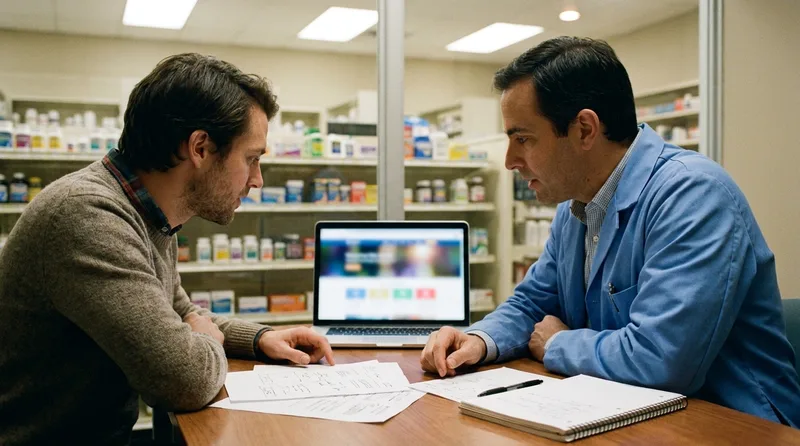
Put these five questions to every candidate:
- Do you build only for independent and compounding pharmacies?
- Who owns the domain, hosting account, and site files if the relationship ends?
- How do you handle HIPAA-aware forms and consent for text messages?
- What are your mobile speed targets, and how do you test them?
- What happens after launch: updates, security, and content support?
Which Warning Signs Should Make You Walk Away?
- Generic templates with no refill or transfer tools.
- No mention of mobile testing or page speed.
- Hosting you can't move or export.
- Promised page-one rankings.
- No redirect plan, which can erase rankings you already hold.
Compare proposals line by line. A strong one lists page counts, location pages, forms, integrations, hosting, and support hours. Vague proposals tend to hide costs that surface later as change orders. Ask for the first 90 days in writing: discovery, design, build, launch, and the first monthly review.
Judge the result by calls, refill requests, and direction clicks over a full quarter. RevealSite's pharmacy marketing ROI benchmarks explain which numbers to track and how to read them.
What Should You Do Before You Redesign Your Pharmacy Website?
Audit your current site on a phone, list what patients need to do, and decide who will own the project. Those three steps keep your Georgia pharmacy web design budget focused on results instead of cosmetics.
Open your site on a phone, using cellular data. Time how long it takes to find your hours and request a refill. Ask two staff members and one patient to try the same tasks.
Then rank the fixes by effort and impact. A tap-to-call button, accurate hours, and a short refill form often take little time. Bigger projects, such as new service pages or location pages, can follow in phases as your budget allows.
Write down every place someone gets stuck. That list becomes your design brief, and it gives any web design partner a clear target.
Ready for a pharmacy website that works as hard as you do?
RevealSite designs fast, HIPAA-aware websites for independent pharmacies. Request a free demo and see how your site could look and perform.
Request a Free Demo →Want to see what pharmacy marketing looks like in practice?
See Success Stories →Frequently Asked Questions
What are Georgia independent pharmacy web design services?▼
They're the planning, design, development, and care of a website built for an independent pharmacy in Georgia. A good package includes mobile-first pages, refill and transfer forms with privacy safeguards, local SEO setup, and ongoing maintenance so the site keeps performing after launch.
What affects the cost of Georgia independent pharmacy web design?▼
Cost depends on the number of pages, the number of locations, the forms and tools you need, and how much content the agency writes. Ask for an itemized proposal, and compare what each one includes rather than the monthly figure alone.
Does my pharmacy website need to be HIPAA compliant?▼
HIPAA applies to how you handle protected health information, including through web forms. Keep forms minimal, use secure submission, and review tracking tools on pages where patients type. Ask your attorney or privacy officer to review your setup before launch.
Can I redesign my website without losing Google rankings?▼
Yes, with planning. Keep strong page addresses where you can, redirect every old page to its closest new one, carry over titles and content that already rank, and check Google Search Console after launch to catch problems early.
Do I need a separate page for each pharmacy location?▼
Yes. Each store should have its own page with a unique address, hours, map, and directions. That helps each location rank in its own area and keeps patients from landing on the wrong store's details.
Is a template good enough for a pharmacy website?▼
A template can launch quickly, but many lack refill forms, schema markup, and location pages. Judge any option by its features, speed, and privacy handling instead of its label, and confirm you'll own the site if you leave.
Sources
- Statista: Share of Website Traffic from Mobile Devices
- HubSpot: Page Load Time and Conversion Rates
- web.dev: Business Impact of Core Web Vitals
- BrightLocal Local Consumer Review Survey 2025
- Pew Research Center: Google Users and AI Summaries
- Backlinko: Local SEO Stats
- Google Search Central: Mobile-First Indexing Best Practices
Was this article helpful?